PulseAugur / Brief
EN
LIVE 21:43:20

Brief

last 24h
[42/92] 223 sources

Multi-source AI news clustered, deduplicated, and scored 0–100 across authority, cluster strength, headline signal, and time decay.

  1. DeepSeek Recruits Civil Engineering Professionals: Building a GW-Scale Data Center

    DeepSeek is actively recruiting for an IDC Design and Planning Engineer, signaling a significant move towards building its own large-scale data centers. This initiative, likely fueled by a recent substantial funding round, indicates the company's ambition to control its computing infrastructure, moving beyond rented capacity. The role involves planning and constructing facilities ranging from megawatts to gigawatts, focusing on advanced technologies like liquid cooling and high-density GPU clusters to support future AI model development and agent product lines. AI

    IMPACT DeepSeek's move to build GW-scale data centers could accelerate AI development by securing dedicated, high-performance computing resources.

  2. Japanese telecom giant NTT plans to establish a $500 million optical network fund

    Japanese telecom giant NTT is reportedly planning to establish a $500 million fund focused on optical networks. The company aims to raise capital from investors in the US and South Korea for this initiative. Approximately 20 companies are expected to participate in the fund, including Samsung Electronics. AI

    IMPACT This fund could accelerate optical network infrastructure development, crucial for supporting future AI workloads and data transfer demands.

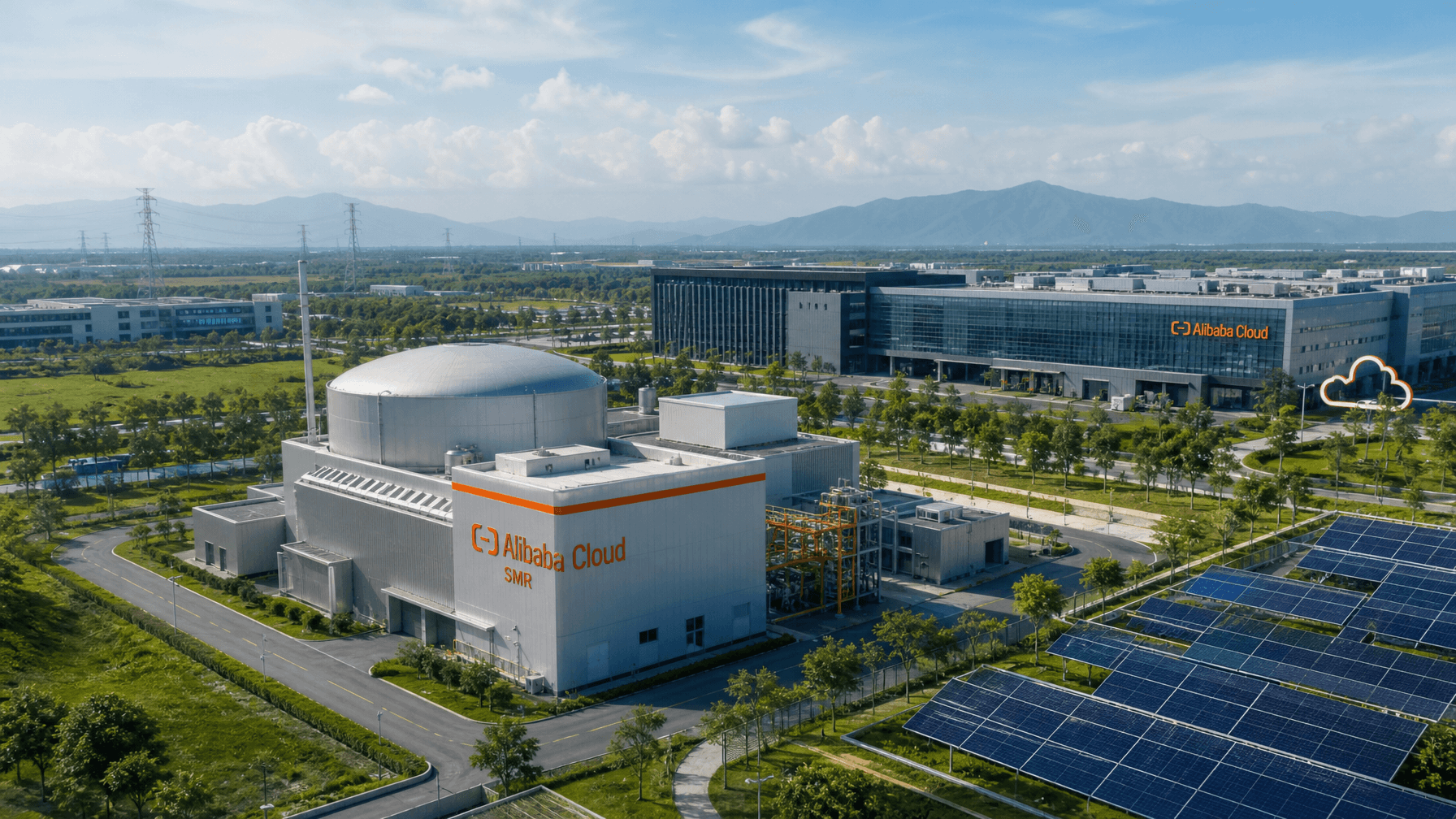
  3. Alibaba in Talks with Nuclear Power SOEs Over Small Modular Reactors for Data Centers

    Alibaba is exploring the use of small modular nuclear reactors to power its data centers in Hangzhou. The company has engaged in discussions with a Chinese state-owned nuclear power enterprise regarding this potential energy solution. However, significant hurdles related to pricing and the integration of these reactors into the existing power grid must still be overcome. AI

    Alibaba in Talks with Nuclear Power SOEs Over Small Modular Reactors for Data Centers

    IMPACT Potential for more sustainable and reliable power for AI infrastructure, reducing reliance on traditional grids.

  4. Dubai-based startup Algebra AI raised $7 million to develop its AI-as-a-Service model. The company aims to take responsibility for systems in 30,000 medium-sized enterprises.

    Algebra AI, a startup based in Dubai, has successfully raised $7 million to advance its AI-as-a-Service model. The company aims to manage AI systems for 30,000 small and medium-sized enterprises that struggle with implementing automation independently. This funding will support their expansion and development efforts in the AI management space. AI

    IMPACT This funding could accelerate AI adoption for SMEs by simplifying system management.

  5. ArchAstro emerges from stealth with 6.2M USD pre-seed to build AI agents that automate cross-company software deployments and integrations. Founded by ex-Micros

    ArchAstro has launched with $6.2 million in pre-seed funding to develop AI agents. These agents are designed to automate software deployments and integrations across different companies. The startup was founded by former engineers from major tech firms including Microsoft, Stripe, Statsig, and Meta. AI

    IMPACT This funding will enable ArchAstro to develop AI agents that could streamline complex software integration processes for businesses.

  6. Since Google announced that it is completely redesigning its search and turning it into a different product, I have also noticed other changes in the products

    Google is reportedly making significant changes to its search engine, moving towards a more AI-driven product. This shift is part of a broader trend of product alterations within Google, influenced by their advancements in AI technology. The company's focus on AI, particularly with models like Gemini, is reshaping its core offerings. AI

    IMPACT This AI-driven overhaul of Google Search could fundamentally change how users access information and interact with search results.

  7. Apple's rebuilt Siri runs on Foundation Models co-developed with Google, and its most demanding requests process on Google's servers. For a company that markete

    Apple's revamped Siri now utilizes Foundation Models that were co-developed with Google. The most complex queries handled by Siri will be processed on Google's servers. This reliance on a competitor marks a notable change for Apple, which has historically positioned itself as a privacy-focused alternative to Google. AI

    IMPACT This partnership signals a potential shift in how major tech companies leverage AI, impacting user expectations for privacy and performance.

  8. Fujikura is on a track to beat its outlook thanks to sustained demand for fiber-optic cables essential for AI data centers and a plan to raise prices, according

    Fujikura is poised to exceed its financial targets due to strong demand for fiber-optic cables, which are critical for AI data centers. The company also plans to implement price increases to further boost its performance. This positive outlook is attributed to the essential role of its products in supporting the growing AI infrastructure. AI

    IMPACT Sustained demand for fiber-optic cables highlights the growing need for robust infrastructure to support AI development and deployment.

  9. China's Lab-Grown Diamonds Emerge as Unlikely Winner in AI Boom

    China's lab-grown diamond industry is experiencing a surge in demand due to its application as a cooling material for high-performance AI chips. Chinese manufacturers have begun commercial shipments, with these synthetic diamonds playing a crucial role in managing the heat generated by increasingly powerful AI semiconductors. This unexpected demand highlights the material's importance in advancing AI technology. AI

    IMPACT Accelerates AI hardware development by providing advanced cooling solutions for high-performance chips.

  10. AI on Mac, or the computer is becoming personal again Right after the WWDC26 keynote, where Apple showed the latest systems from the 27 family, I came across the first brief

    Apple's recent WWDC26 keynote introduced new macOS systems, with a particular focus on integrating third-party AI applications locally. This approach aims to shift AI processing from the cloud to personal devices, enhancing privacy and reducing reliance on external services. Demonstrations included Perplexity, Draw Things, and LM Studio, showcasing how Macs can function as personal AI hubs. AI

    AI on Mac, or the computer is becoming personal again Right after the WWDC26 keynote, where Apple showed the latest systems from the 27 family, I came across the first brief

    IMPACT Accelerates the trend of on-device AI, enabling more private and responsive AI experiences for users and developers.

  11. Sandstone raises $30M to bring AI to in-house legal teams https://techcrunch.com/2026/06/09/sandstone-raises-30m-to-bring-ai-to-in-house-legal-teams/ # AI # Sta

    Sandstone, a legal tech startup, has secured $30 million in funding to develop AI tools for in-house legal departments. The company aims to streamline legal operations and enhance efficiency for corporate legal teams. This funding round is expected to accelerate Sandstone's product development and market expansion. AI

    IMPACT This funding could accelerate the adoption of AI within corporate legal departments, improving efficiency and potentially reducing costs.

  12. South Korean tech giant deepens its Vietnam footprint as # AI , # 5G and semiconductor demand reshape global supply chains # LG # Vietnam # Semiconductor

    LG is expanding its presence in Vietnam, driven by the growing global demand for AI, 5G, and semiconductors. This strategic move aims to strengthen its position within the evolving international supply chains for these critical technologies. AI

    IMPACT LG's expansion in Vietnam signals a strategic response to increasing global demand for AI infrastructure and components.

  13. SpaceX IPO Is A $1.77 Trillion Bet On An Orbital Economy

    SpaceX is preparing for an IPO with a projected valuation of $1.77 trillion, significantly higher than its 2024 valuation of $350 billion. While rockets are a core part of its business, investors are increasingly viewing the company as a communications and infrastructure provider. The Starlink satellite internet service, which already has over 10 million subscribers, is a major driver of this valuation, generating over $1 billion in profit in early 2026. The development of Starship, a super heavy-lift reusable rocket, is expected to further reduce launch costs and enable the construction of large-scale infrastructure in orbit, such as data centers and solar power systems. AI

    SpaceX IPO Is A $1.77 Trillion Bet On An Orbital Economy

    IMPACT Sets stage for orbital AI infrastructure, potentially lowering compute costs and enabling new space-based applications.

  14. Amazon employees ask Seattle to put the brakes on new data centers https://www.theverge.com/ai-artificial-intelligence/945809/amazon-employees-seattle-data-cent

    Employees at Amazon have urged Seattle officials to halt the construction of new data centers. The employees cite concerns about the environmental impact and the strain these facilities place on the local power grid. They are advocating for a moratorium on new data center development until these issues can be adequately addressed. AI

    IMPACT Potential slowdown in AI infrastructure build-out due to local policy concerns.

  15. UK Invests £1.1B in AI Infrastructure A Sign of Europe's Shift Toward AI Sovereignty

    The UK government has announced a significant investment of £1.1 billion to bolster its AI infrastructure. This substantial funding aims to accelerate AI development and adoption across the nation. The initiative is seen as a strategic move to enhance the UK's AI capabilities and promote technological sovereignty within Europe. AI

    IMPACT This investment could accelerate AI adoption and research within the UK, potentially fostering new AI companies and capabilities.

  16. Scalable Joint Resource Allocation for SLO-Constrained LLM Inference in Heterogeneous GPU Clouds

    Two new research papers explore the challenges of running large language models (LLMs) efficiently. The first paper investigates the performance trade-offs of deploying LLMs on edge devices like smartphones and specialized NPUs, highlighting thermal constraints and memory bandwidth limitations. The second paper introduces a scalable framework using heuristic algorithms to optimize resource allocation for LLM inference in heterogeneous GPU cloud environments, aiming to meet service level objectives while minimizing costs. AI

    IMPACT These papers offer insights into optimizing LLM performance and cost for both on-device and cloud deployments, crucial for scaling AI applications.

  17. Aperon Technical Report: Hierarchical No-Pointer Tangent-Local Search for High-Dimensional Approximate Nearest Neighbors

    Researchers have introduced HNTL (Hierarchical No-pointer Tangent-Local), a new framework for vector memory systems designed to improve the efficiency of approximate nearest neighbor searches. This method partitions high-dimensional space into local segments, representing vectors using tangent spaces and a pointerless layout to reduce memory overhead and enhance CPU performance. Benchmarks show HNTL achieves high recall rates with a smaller candidate pool and offers a significant speedup over traditional pointer-chasing methods. AI

    IMPACT Improves efficiency for high-dimensional vector search, crucial for AI applications like recommendation systems and similarity search.

  18. Convolutional Sparse Coding via the Locally Competitive Algorithm on Loihi 2

    Researchers have developed and benchmarked a convolutional sparse coding implementation using the Locally Competitive Algorithm (LCA) on Intel's Loihi 2 neuromorphic hardware. This work represents the first known implementation and evaluation of convolutional LCA on this platform. The study aims to determine the conditions under which this approach becomes advantageous for sparse inference on neuromorphic systems, positioning it as a benchmark for structured sparse inference. AI

    IMPACT Positions convolutional LCA as a benchmark for structured sparse inference on emerging neuromorphic systems.

  19. 🔥 رائج 📢 A Critical Turning Point for the AI Chip Supply Chain: The Battle Between Broadcom and Google Is Taking Shape - TMGM 🔗 https:// news.google.com/rss/art

    The AI chip supply chain is at a critical juncture, marked by a developing conflict between Broadcom and Google. This competition is poised to significantly reshape the landscape of AI hardware. AI

    IMPACT This competition could lead to significant shifts in AI hardware availability and innovation.

  20. Wall Street holds steadier as AI stocks recover some of last week's sell-off Some of the best performers were companies that sell computer chips, memory and oth

    The stock market showed resilience as AI-related companies began to rebound from a recent downturn. Companies specializing in the production of computer chips and memory components, which are crucial for the AI industry, were among the top performers. This recovery suggests a stabilization in the market following a period of volatility. AI

    Wall Street holds steadier as AI stocks recover some of last week's sell-off Some of the best performers were companies that sell computer chips, memory and oth

    IMPACT Suggests renewed investor confidence in AI infrastructure, potentially stabilizing funding for AI development and deployment.

  21. Expanding Private Cloud Compute - Apple Security Research

    Apple is expanding its Private Cloud Compute (PCC) infrastructure beyond its own data centers, partnering with Google and NVIDIA. This expansion allows Apple Intelligence workloads to run on Google Cloud, utilizing NVIDIA GPUs and Google's confidential computing technologies. The move aims to extend Apple's stringent privacy and security commitments to third-party cloud environments for more complex AI tasks. AI

    IMPACT Extends Apple's privacy-preserving AI inference capabilities to third-party cloud infrastructure, enabling more complex on-device features.

  22. Apple's private AI will run on Google's servers https://www.macrumors.com/2026/06/08/apple-private-cloud-compute-google/

    Apple is reportedly planning to use Google's cloud infrastructure to power its "Private Cloud Compute" feature for AI tasks. This move would allow Apple to process sensitive user data on remote servers while maintaining a level of privacy. The exact details of the partnership and the scope of data processed remain unclear. AI

    IMPACT This partnership could set a precedent for how major tech companies handle AI processing and data privacy in the cloud.

  23. 🤖 World’s first wind-powered underwater datacentre starts operating in China Datacentre off Shanghai coast uses less power and water than land-based equivalent

    The world's first wind-powered underwater data center has begun operations off the coast of Shanghai, China. This innovative facility is designed to be more energy and water-efficient than traditional land-based data centers. Separately, the open-source photo management software digiKam has released version 9.1, introducing support for Pixel motion photos and enhanced timezone capabilities. AI

    🤖 World’s first wind-powered underwater datacentre starts operating in China Datacentre off Shanghai coast uses less power and water than land-based equivalent

    IMPACT Underwater data centers could offer more sustainable infrastructure for AI workloads, while software updates like digiKam's improve tooling for digital asset management.

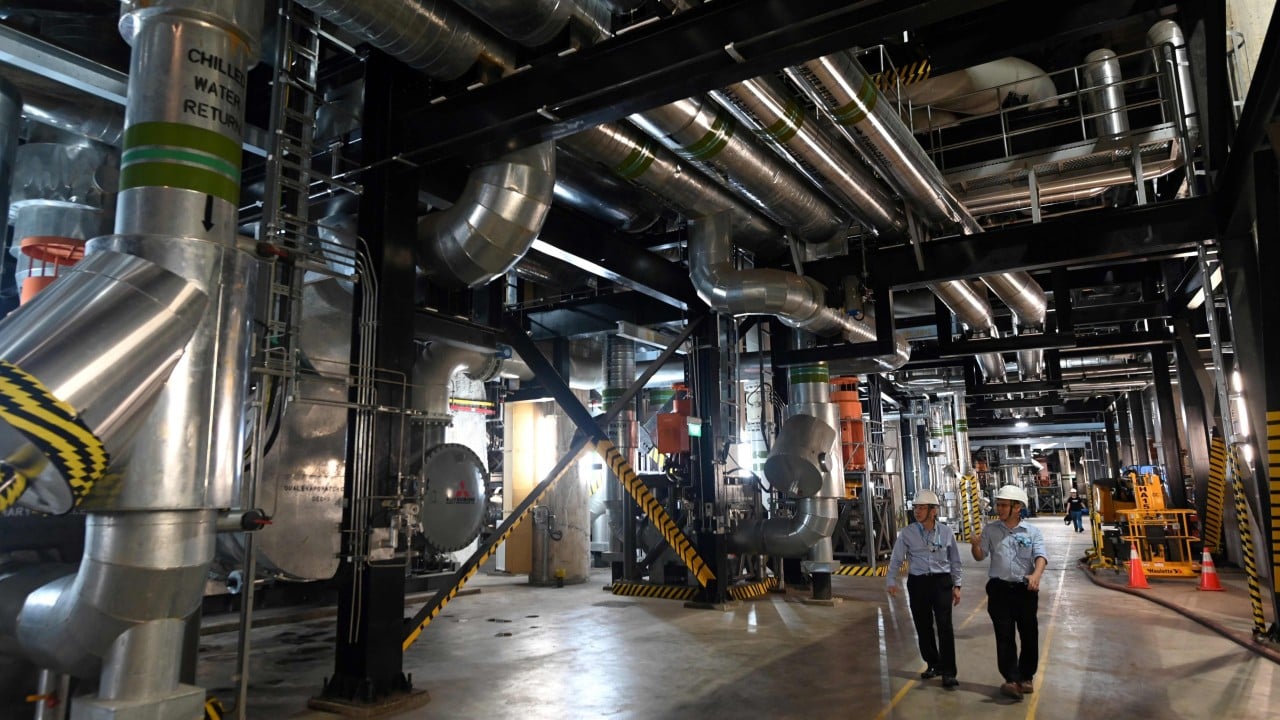
  24. Forget air-con, Singapore looks underground for a cooler future

    Singapore is increasingly relying on underground district cooling systems to combat rising temperatures and reduce its reliance on air conditioning. This concept, which uses less electricity than individual air conditioners, is being expanded across various neighborhoods, including the large Marina Bay network. Experts believe Singapore can become a model for energy-efficient cooling solutions in hot and humid climates, with the local market for this technology projected to double in the next decade. AI

    Forget air-con, Singapore looks underground for a cooler future
  25. Systematic LLM Translation of Legacy Scientific Code to Differentiable Frameworks: Application to a Land Surface Model

    Researchers have developed a novel five-phase pipeline utilizing LLM-based agents to translate legacy Fortran code into the JAX framework. This system automates the process of code migration, including dependency analysis, autonomous error correction, and numerical parity enforcement. The pipeline was successfully applied to CLM-ml-v2, a 19,000-line land surface model, resulting in a differentiable version that significantly speeds up computation and parameter recovery. AI

    IMPACT Enables rapid differentiation of complex scientific models, accelerating research and parameter estimation.

  26. 📝 The Democratization of Training Begins - Why Huawei's Ascend 910C Accelerates the Break from NVIDIA Dependency. Huawei's cutting-edge chip 'Ascend 910C' successfully post-trained DeepSeek-V4-Pro. This is not just a technological achievement, but signifies the geopolitical decentralization of AI training resources. 🔗 htt

    A research group, including Huawei and institutions from Shenzhen, claims to have successfully completed full-parameter post-training on DeepSeek's 1.6 trillion parameter V4-Pro model. This was achieved using a cluster of at least 1,000 Huawei Ascend 910C AI chips. This development is seen as a significant step towards China's AI self-reliance, particularly in overcoming challenges with training complex models on domestic hardware, though specific performance benchmarks are currently absent. AI

    IMPACT Demonstrates progress in China's domestic AI training capabilities, potentially reducing reliance on foreign hardware for complex model refinement.

  27. Vodafone’s New 5G Broadband Service Promises Fiber-Like Speeds At Home

    Vodafone has launched a new 5G Broadband service in the UK, aiming to provide fiber-like internet speeds without the need for cable installation. The service utilizes a 5G router and offers speeds up to 150Mbps, with pricing starting at £19 per month for a 50Mbps connection. This launch is supported by a survey indicating that slow or unreliable broadband is a major frustration for consumers, impacting daily life and even relationships. AI

    Vodafone’s New 5G Broadband Service Promises Fiber-Like Speeds At Home

    IMPACT This launch offers a new alternative for home internet connectivity, potentially impacting the broadband market and user experience.

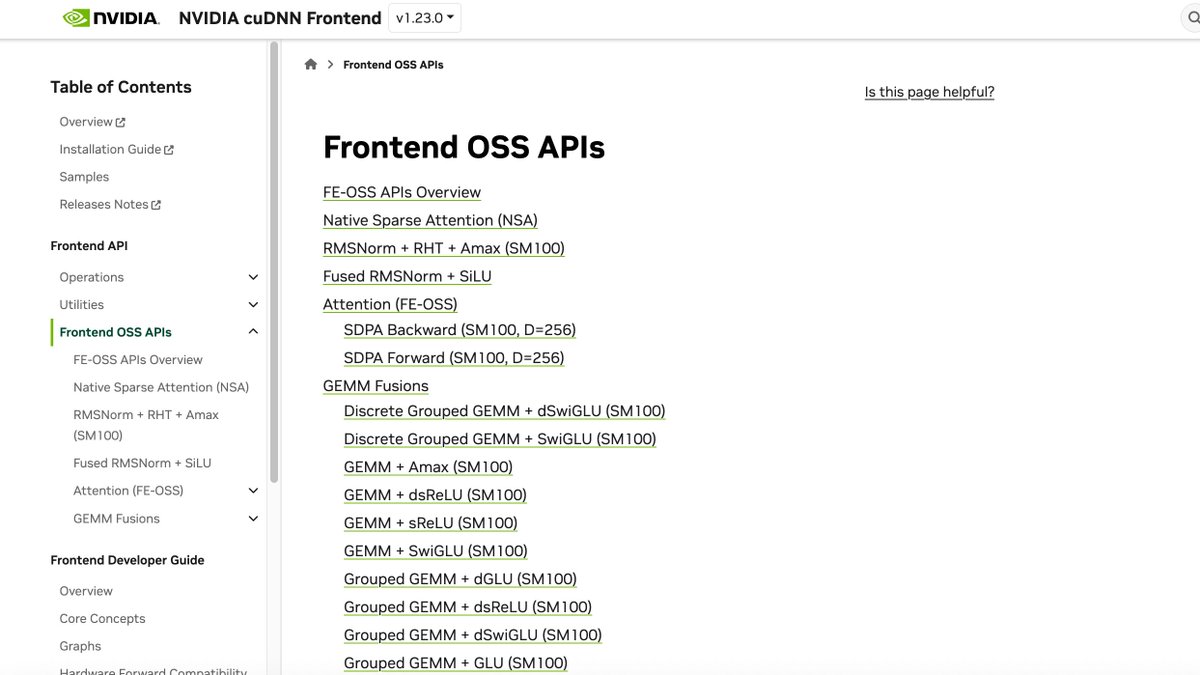
  28. @manicely6005 The public documentation can be found here too (3/3)

    NVIDIA has open-sourced parts of its cuDNN library, a significant move after 12 years of it being closed-source. This release includes over 20 Mixture-of-Experts (MoE) kernels and NSA sparse attention kernels. The codebase for these kernels is largely written in Python CuTe-DSL, with public documentation now available. AI

    @manicely6005 The public documentation can be found here too (3/3)

    IMPACT Open-sourcing of cuDNN kernels could accelerate research and development in AI infrastructure and model optimization.

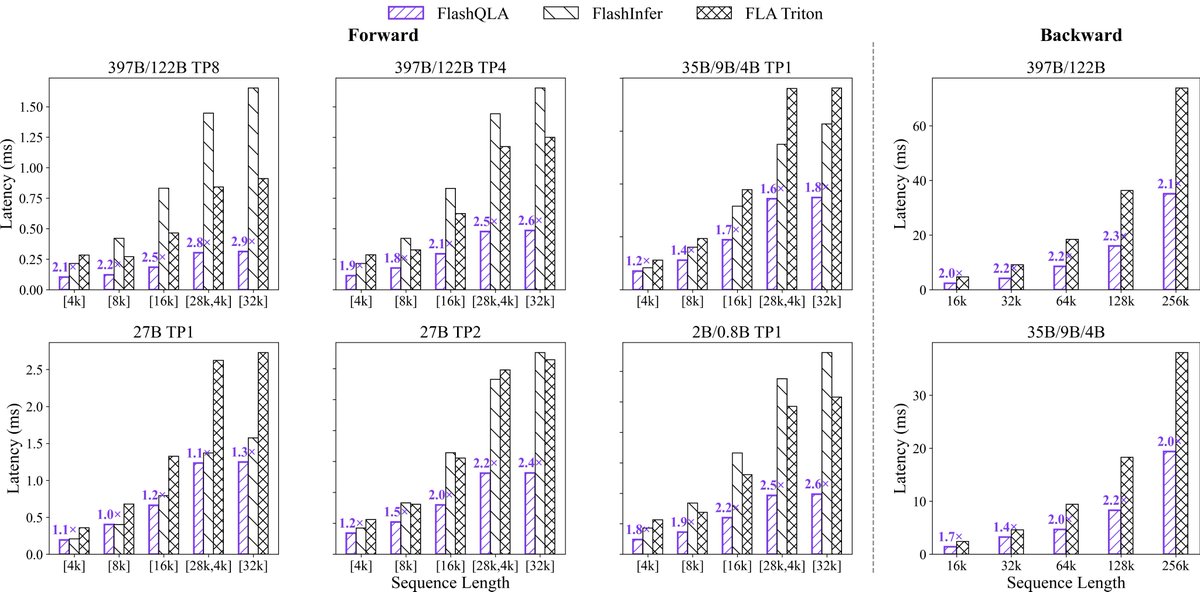
  29. Forward and backward benchmark results across common configurations. https://t.co/IHMCZRw9AW

    Alibaba's Qwen team has released FlashQLA, a new set of high-performance linear attention kernels developed using TileLang. These kernels are designed to improve the efficiency of attention mechanisms in large language models. The team also shared benchmark results for their Qwen models, showcasing performance across various configurations. AI

    Forward and backward benchmark results across common configurations. https://t.co/IHMCZRw9AW

    IMPACT Introduces optimized kernels that could improve LLM inference speed and efficiency.

  30. This is Decoupled DiLoCo: our new resilient and flexible way to train advanced AI models across multiple data centres. 🧵 https://t.co/YRmPrqIbYE

    Google DeepMind has introduced Decoupled DiLoCo, a novel approach to training advanced AI models that enhances resilience and flexibility across data centers. This system can train models like Google's 12B Gemma model across geographically dispersed regions using low-bandwidth networks and can even mix different generations of hardware, such as TPU6e and TPUv5p. Decoupled DiLoCo is designed to be self-healing, isolating and continuing training through artificial hardware failures and reintegrating units when they come back online, addressing the synchronization issues that typically stall AI training. AI

    This is Decoupled DiLoCo: our new resilient and flexible way to train advanced AI models across multiple data centres. 🧵 https://t.co/YRmPrqIbYE

    IMPACT Enables more robust and flexible large-scale AI model training, potentially reducing costs and increasing accessibility.

  31. OpenAI raises $110B on $730B pre-money valuation

    OpenAI has secured $110 billion in private funding, with Amazon contributing $50 billion and Nvidia and SoftBank each adding $30 billion, valuing the company at $730 billion pre-money. This significant investment includes substantial infrastructure partnerships, with OpenAI expanding its AWS collaboration by $100 billion and committing to significant compute usage. The funding round is still open, and OpenAI anticipates further investor participation as it focuses on scaling infrastructure to meet the growing demand for AI services. AI

    OpenAI raises $110B on $730B pre-money valuation

    IMPACT This massive funding and infrastructure deal will likely accelerate OpenAI's ability to scale its AI services and develop new products, potentially setting new benchmarks for compute and AI deployment.

  32. Apple buys Israeli startup Q.ai

    Apple has acquired the Israeli AI startup Q.ai for nearly $2 billion, aiming to bolster its capabilities in audio processing and machine learning. The startup, founded in 2022, specializes in technologies that can interpret whispered speech and enhance audio in noisy environments. This acquisition is Apple's second-largest to date and follows previous AI-focused feature integrations in products like AirPods and the Vision Pro headset. AI

    Apple buys Israeli startup Q.ai

    IMPACT Strengthens Apple's AI hardware and audio capabilities, potentially impacting future product development and competition in the AI race.

  33. Nvidia results show spending on A.I. infrastructure remains robust

    Nvidia's latest financial results indicate a continued strong demand for AI infrastructure, with significant revenue generated from its AI chip sales. The company's performance highlights the ongoing substantial investment in hardware necessary to support the rapidly expanding AI sector. This robust spending suggests that the development and deployment of advanced AI models remain a top priority for many organizations. AI

    IMPACT Confirms that the demand for AI hardware remains strong, suggesting continued investment in AI development and deployment.

  34. The U.S. grid is so weak, the AI race may be over

    The rapid expansion of AI is creating a significant bottleneck in the United States due to the limitations of its power grid, contrasting sharply with China's robust energy infrastructure. While U.S. AI growth is hampered by debates over data center power consumption and grid stability, China has proactively addressed this by overbuilding its power capacity over decades. This strategic oversupply allows China to integrate AI data centers as a means to absorb excess energy, a situation unimaginable in the U.S. where grids often operate with minimal reserve margins, leading to concerns about the sustainability of AI development. AI

    The U.S. grid is so weak, the AI race may be over

    IMPACT AI development in the US faces a critical bottleneck due to power grid limitations, potentially hindering growth compared to China's energy-secure infrastructure.

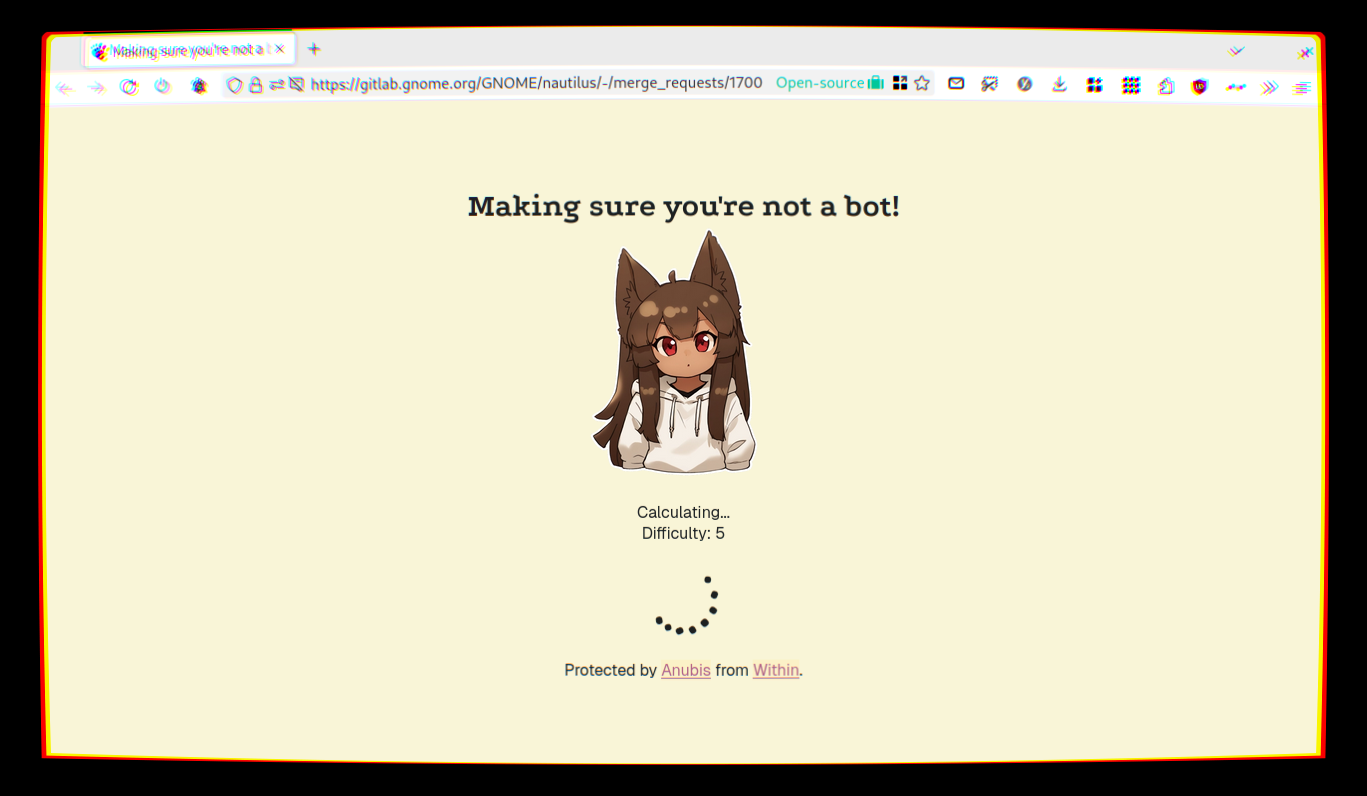
  35. FOSS infrastructure is under attack by AI companies

    AI companies are aggressively crawling open-source infrastructure, causing significant outages and disruptions for projects like SourceHut, KDE GitLab, and GNOME. These AI scrapers often disregard robots.txt and mimic legitimate user agents, making it difficult to implement effective defenses. As a result, some projects have resorted to implementing challenging proof-of-work systems to block these bots, which can also impact legitimate users. AI

    FOSS infrastructure is under attack by AI companies

    IMPACT AI data scraping practices are straining open-source infrastructure, potentially hindering collaboration and development.

  36. Intel ruined an Israeli startup it bought for $2B–and lost the AI race

    Intel has effectively dismantled Habana Labs, an Israeli AI chip startup it acquired for $2 billion, marking a significant failure in its attempt to compete with Nvidia. Despite initial optimism and a deal with Amazon for its Gaudi chips, Intel's internal issues and integration problems led to key personnel departing and the cancellation of next-generation products like Falcon Shores. This outcome represents a rare misstep for Habana's founder, Avigdor Willenz, who has a history of successful ventures in the semiconductor industry. AI

    Intel ruined an Israeli startup it bought for $2B–and lost the AI race

    IMPACT Highlights the intense competition and challenges in the AI hardware market, potentially impacting the supply chain for AI model training.

  37. Executive order on advancing United States leadership in AI infrastructure

    The White House has issued an executive order aimed at bolstering U.S. leadership in AI infrastructure. The order focuses on expanding access to computing resources, developing AI talent, and promoting responsible AI innovation. It also emphasizes the importance of international collaboration and the development of safety standards for AI technologies. AI

    IMPACT This executive order aims to solidify U.S. leadership in AI by focusing on infrastructure and talent, potentially accelerating domestic AI development and deployment.

  38. Vultr Raises $333M at $3.5B Valuation

    Vultr, a cloud computing provider focused on AI workloads, has secured $333 million in funding at a $3.5 billion valuation. The investment round was led by existing investor Thoma Bravo. The company plans to use the funds to expand its global infrastructure and enhance its AI-specific offerings. AI

    IMPACT Expansion of Vultr's infrastructure could lower costs and increase accessibility for AI development and deployment.

  39. OpenAI Selects Oracle Cloud Infrastructure to Extend Microsoft Azure AI Platform

    OpenAI has entered into a new agreement to utilize Oracle Cloud Infrastructure (OCI) for its artificial intelligence workloads. This partnership aims to expand OpenAI's existing AI platform, which is primarily hosted on Microsoft Azure. The collaboration will leverage OCI's high-performance computing capabilities to support OpenAI's growing demand for AI training and inference. AI

    IMPACT Expands AI training and inference capacity by diversifying cloud infrastructure providers.

  40. The AI industry spent 17x more on Nvidia chips than it brought in in revenue

    The AI sector's expenditure on Nvidia chips significantly outpaced its revenue generation, with a reported 17x difference. This highlights a substantial investment phase in AI infrastructure, potentially indicating a focus on future growth and capability development over immediate profitability. The data suggests a considerable capital outlay is being made to acquire the necessary hardware for training and deploying advanced AI models. AI

    IMPACT Indicates a heavy investment phase in AI infrastructure, potentially signaling future capability advancements.

  41. 1-Bit AI Infrastructure

    Researchers have developed a software stack called 'this http URL' to enable fast and lossless inference of 1-bit Large Language Models (LLMs) like BitNet b1.58 on CPUs. This new infrastructure achieves significant speedups, ranging from 2.37x to 6.17x on x86 CPUs and 1.37x to 5.07x on ARM CPUs, depending on model size. The goal is to make LLMs more efficient and deployable on a wider range of devices. AI

    1-Bit AI Infrastructure

    IMPACT Enables more efficient and widespread deployment of LLMs on consumer hardware.