PulseAugur / Brief
EN
LIVE 20:08:17

Brief

last 24h
[50/1235] 223 sources

Multi-source AI news clustered, deduplicated, and scored 0–100 across authority, cluster strength, headline signal, and time decay.

  1. Natural Language Processing (NLP) has undergone revolutionary advancements in recent years, largely driven by the adoption of neural networks. These sophisticat

    Natural Language Processing (NLP) has seen significant progress due to neural networks. These advanced computational models have changed how machines process and understand language. The field continues to evolve rapidly with ongoing research and development. AI

    IMPACT Ongoing advancements in NLP and neural networks continue to improve machine understanding and processing of human language.
  2. The paper that could pop the trillion dollar AI bubble Alternatives to current Transformer architectures could eliminate its greatest weakness: The inference ef

    A new research paper proposes an alternative to the Transformer architecture, which powers most large language models. This alternative aims to address the significant computational cost associated with Transformer inference. If successful, this could potentially reduce the massive financial investment currently driving the AI industry. AI

    IMPACT Potential for significantly reduced inference costs could reshape AI infrastructure and investment.

  3. RT @0x0SojalSec: Reverse-engineering Apple's Neural Engine and training a neural network on it. Apple has never allowed this. The ANE is only for In

    Researchers have successfully reverse-engineered Apple's Neural Engine (ANE) and trained a neural network on it. This achievement is significant as Apple has historically restricted access and direct use of the ANE for such purposes. The effort involved detailed analysis of the ANE's architecture and capabilities. AI

    IMPACT Demonstrates novel methods for hardware-level AI model integration and training.

  4. A new AI model can predict extreme storm surges with high accuracy, helping coastal cities prepare for rising sea levels and extreme weather events. The AI runs

    A novel AI model has demonstrated high accuracy in predicting extreme storm surges, offering a faster alternative to traditional physics-based simulations. This advancement will aid coastal cities in their adaptation planning by providing better flood risk assessments. The model's speed allows for more efficient preparation against rising sea levels and severe weather. AI

    IMPACT Enables faster and more accurate flood risk assessment for coastal cities, improving preparedness for climate change impacts.

  5. Philosophical, Technological, Functional, and Practical Constitution of the # SelfRegenerativeAI . Its architecture is a fusion of quantum mechanics, neural net

    A new concept called Self-Regenerative AI is proposed, aiming for unprecedented precision through a unique architecture. This AI model integrates principles from quantum mechanics, neural networks, and adaptive processing. The goal is to establish a robust framework that is philosophical, technological, functional, and practical. AI

    Philosophical, Technological, Functional, and Practical Constitution of the # SelfRegenerativeAI . Its architecture is a fusion of quantum mechanics, neural net

    IMPACT Proposes a novel AI architecture that could lead to more precise and adaptive systems.

  6. Chinese and Foreign AI Compete in Shanghai Gaokao Essay, DeepSeek and Gemini Tie for First Place with 66 Points. The 2026 Shanghai Gaokao Chinese essay topic was "As technology transforms the world, it also transforms our imagination." A media outlet, "The Paper," invited 6 Chinese and foreign [...] #TechNews #EdTech #AIWriting #DeepSeek https://unwire.hk/2026/

    Two AI models, DeepSeek and Google's Gemini, achieved a score of 66 points on a Shanghai high school entrance exam essay question. The prompt asked students to consider how technology reshapes both the world and human imagination. A media outlet, Kechuangban Daily, organized this evaluation. AI

    Chinese and Foreign AI Compete in Shanghai Gaokao Essay, DeepSeek and Gemini Tie for First Place with 66 Points. The 2026 Shanghai Gaokao Chinese essay topic was "As technology transforms the world, it also transforms our imagination." A media outlet, "The Paper," invited 6 Chinese and foreign [...] #TechNews #EdTech #AIWriting #DeepSeek https://unwire.hk/2026/

    IMPACT Demonstrates AI's growing capabilities in creative writing and standardized testing.

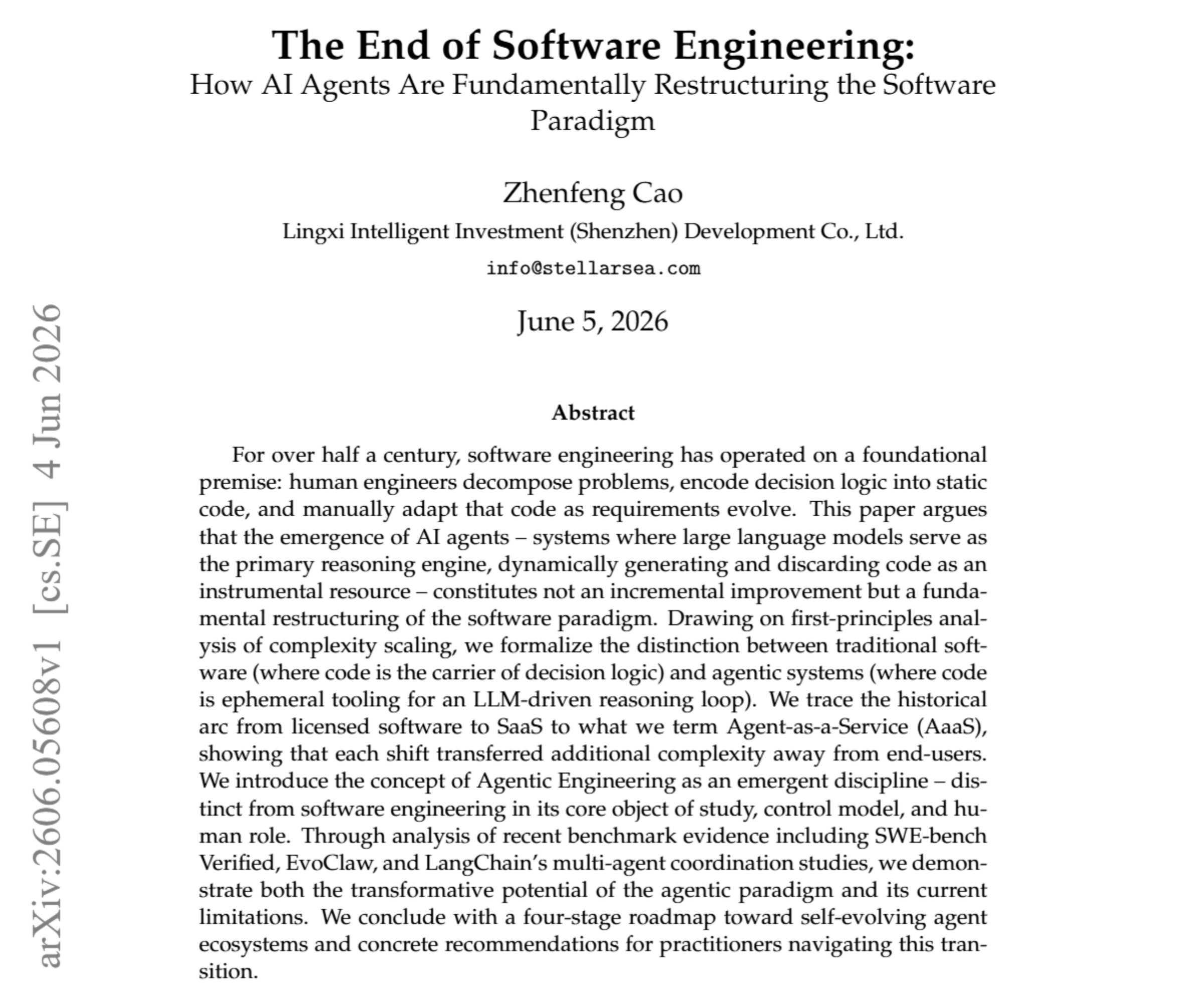
  7. 🧠 È davvero la fine della software engineering? 👉 Il paper "The End of Software Engineering" sostiene una tesi forte: gli # AI agent non sono solo un accelerato

    A new paper titled "The End of Software Engineering" proposes that AI agents represent a significant shift, potentially marking the end of traditional software engineering practices. The paper argues that these agents are not merely accelerating existing processes but are fundamentally changing how software is developed and managed. AI

    🧠 È davvero la fine della software engineering? 👉 Il paper "The End of Software Engineering" sostiene una tesi forte: gli # AI agent non sono solo un accelerato

    IMPACT Suggests AI agents may fundamentally alter software development, potentially reducing the need for traditional engineering roles.

  8. 𝜇⁢𝜆⁢ϵ⁢𝛿-Calculus: Self Optimizing Language that Seems to Exhibit Paradoxical Transfinite Cognitive Capabilities https://arxiv.org/html/2409.05351 # AI # Researc

    A new research paper introduces mu-lambda-epsilon-calculus, a self-optimizing language designed to explore complex cognitive capabilities. The calculus appears to exhibit paradoxical transfinite cognitive abilities, suggesting advanced potential in AI research. This work delves into the intersection of mathematical logic and artificial intelligence. AI

    IMPACT Introduces a new theoretical framework for self-optimizing AI languages, potentially advancing research into complex cognitive architectures.

  9. Google's AI Subscription "AI Plus" Reduced to 725 Yen, Storage Doubled to 400GB – Impress Watch

    Anthropic has released a guide detailing best practices for using Claude, focusing on recommended settings and tips for optimal performance. Separately, Google has reduced the price of its AI subscription service, "AI Plus," to 725 yen and doubled the included storage to 400GB. AI

    Google's AI Subscription "AI Plus" Reduced to 725 Yen, Storage Doubled to 400GB – Impress Watch

    IMPACT Anthropic provides guidance for its Claude model, while Google adjusts its AI subscription pricing and storage.

  10. Joint stochastic localization and applications

    Researchers have developed a new framework called joint stochastic localization, extending existing pathwise analysis techniques for high-dimensional probability and sampling. This framework unifies and characterizes existing processes under Eldan's $\alpha$-scheme, introducing a joint scheme that couples probability measures using shared Brownian motion. The resulting Eldan's $\alpha$-distance offers a novel way to measure distances between probability measures, with theoretical properties analyzed and efficient estimators developed for specific cases. AI

  11. Selecting New Measurement Locations to Diversify Traffic-Pattern Coverage: A Real-World Evaluation for Total Traffic Volume Estimation

    Researchers have developed a new algorithm to optimize the placement of traffic counters, aiming to improve city-wide traffic volume estimation. The method focuses on selecting new counter locations that diversify observed traffic patterns, rather than just spreading them evenly. A real-world evaluation demonstrated that this approach, by capturing rarer traffic patterns, led to more accurate traffic volume estimations. AI

    IMPACT This research could lead to more efficient and accurate traffic management systems by improving data collection strategies.

  12. Geometry-Driven Flow Analysis of Brain Sulcal Pattern

    Researchers have developed a new framework for analyzing brain sulcal patterns, which are indicative of neurological development and disease. This approach models cortical folding using a physics-based flow derived from mean curvature, treating folding as a source-sink structure. The resulting potential field and its gradient offer a more detailed and spatially coherent analysis of brain structure, particularly for subtle abnormalities found in conditions like juvenile myoclonic epilepsy. AI

  13. Forward-Looking Stress Testing Under Macro Scenarios: Stable SVaR Estimation Using a Hybrid GPR-HS Framework with SACS

    Researchers have developed a new framework for estimating Stressed Value-at-Risk (SVaR) in financial risk management. This hybrid Gaussian Process Regression Historical Simulation (GPR-HS) approach, enhanced with Scenario-Averaged Covariance Stabilization (SACS), aims to provide stable and reliable SVaR estimations under forward-looking macroeconomic scenarios. The framework demonstrated consistent convergence across various assets and scenarios, preserving key risk properties and offering a regulator-aligned method for applications like CCAR and ICAAP. AI

    IMPACT Provides a more stable and reliable method for financial institutions to assess risk under various economic conditions.

  14. Families of Control-Cost-Parametrized Inverse-Optimal Universal Stabilizers

    Researchers have developed a new method for designing stabilizing feedback laws in control systems. This approach allows users to select a cost function for control inputs, which then generates a family of stabilizing controllers. The method involves a three-step process including cost differentiation and function inversion, and it has been shown to be Lipschitz continuous. This property enables approximation using neural operators for performance exploration and online adaptation, with established bounds for practical stability and suboptimality. AI

  15. Generalizing Fair Top-$k$ Selection: An Integrative Approach

    Researchers have developed a new approach to fair top-k selection, which aims to ensure proportional representation for minority groups among selected candidates. This generalized method considers multiple protected groups and seeks to minimize disparity from a reference scoring function. While the problem can become computationally intractable with multiple groups, the researchers identified a gap in the hardness barrier that allows for efficient solutions when the number of groups is small and k is also small. The study also introduces a new disparity measure called utility loss, which may lead to more stable scoring functions, and demonstrates strong empirical performance on real-world datasets. AI

  16. Non-Archimedean Polydisc Spaces and Applications to Optimisation

    Researchers have introduced a novel optimization framework utilizing non-Archimedean polydisc spaces, inspired by Berkovich geometry. These spaces, formed by products of closed balls over non-Archimedean fields, offer a blend of hierarchical structure and geometric properties suitable for optimization. The work includes theoretical developments on geodesic uniqueness and the approximation properties of specific function classes, alongside an open-source Julia library for implementing these optimization procedures. AI

  17. Online Learning for Supervisory Switching Control

    Researchers have developed a novel algorithm for supervisory switching control in partially-observed linear dynamical systems. This data-driven approach adapts multi-armed bandit algorithms to a control setting, aiming to identify and deploy the correct controller from a pool of candidates. The algorithm provides finite-time guarantees and can identify the appropriate controller within $O(N \log^2 N)$ steps while simultaneously achieving finite $L_2$-gain. AI

  18. Claude Sonnet hits 100% comprehension on a data format it's never seen. Opus scores 96.2%. We tested 10 models across 3 providers.

    Anthropic's Claude Sonnet 4.6 achieved 100% comprehension on a newly developed data format called GCF, outperforming its sibling model Opus 4.6 which scored 96.2%. In tests involving 10 different models across three providers, GCF demonstrated superior performance in both comprehension and generation tasks compared to standard formats like JSON. The evaluation also found that Claude models could generate valid GCF output with minimal prompting, indicating strong adaptability. AI

    Claude Sonnet hits 100% comprehension on a data format it's never seen. Opus scores 96.2%. We tested 10 models across 3 providers.

    IMPACT Demonstrates potential for LLMs to adapt to new data structures, possibly simplifying data integration and processing.

  19. IS-CoT: Breaking the Long-form Generation Collapse via Interleaved Structural Thinking

    Researchers have introduced a new framework called Interleaved Structural Chain-of-Thought (IS-CoT) to address the issue of long-form content generation collapse in Large Language Models. This framework embeds a dynamic Plan-Write-Reflect cycle within the generation process, allowing for continuous adaptation and alignment without external agents. A model trained with this method, IS-Writer-8B, has demonstrated state-of-the-art performance on long-form benchmarks, showing improved length compliance and coherence compared to existing models. AI

    IMPACT This new framework could enable LLMs to produce more coherent and controllable long-form content, potentially impacting creative writing and content generation tools.

  20. Cross-Modal Masking for Robust Silent Speech Synthesis Using sEMG and Lipreading

    Researchers have developed a new framework for silent speech synthesis that combines surface electromyography (sEMG) and lipreading data. This approach uses modality masking during training to improve robustness against sensor failure or signal degradation. The masked multimodal system significantly reduced word error rates compared to unimodal methods, particularly for vowels and certain consonant groups, demonstrating its effectiveness for assistive technology. AI

    IMPACT This research advances assistive technologies by improving the robustness and accuracy of silent speech synthesis systems.

  21. Civil Court Simulation with Large Language Models

    Researchers have developed a multi-agent framework using large language models to simulate Chinese civil court proceedings. This system organizes role-based interactions through a five-stage trial process, incorporating memory and statute retrieval for complex adjudications. Experiments demonstrate the framework's ability to produce reliable civil judgments, particularly in liability allocation and multi-item adjudication, with memory quality significantly impacting simulation outcomes. AI

    IMPACT This framework could significantly reduce costs and increase scalability in legal education and practice by providing a robust simulation tool for civil litigation.

  22. Clinically Grounded Privacy Evaluation of Medical LMs

    A new research paper introduces a privacy evaluation framework for medical language models, focusing on realistic threat models beyond simple text recovery. The framework assesses verbatim memorization and semantic leakage of sensitive diagnoses under varying levels of adversarial access. When applied to a model trained on clinical notes, it revealed high rates of memorization for encounter metadata and significant recovery of sensitive diagnoses like abortion and HIV, though some memorized tokens were templated. AI

    IMPACT Highlights significant privacy risks in medical LMs, potentially influencing data handling and model development practices in healthcare AI.

  23. UXBench: Benchmarking User Experience in AI Assistants

    Researchers have introduced UXBench, a new benchmark designed to evaluate the user experience of AI assistants. This benchmark focuses on preference alignment and dialogue generation, utilizing over 70,000 interaction logs from a Chinese AI assistant. UXBench includes three tasks—UX Judge, UX Eval, and UX Recovery—and has been tested on 26 large language models, revealing insights into how well these models understand and improve user experience. AI

    IMPACT Establishes a new evaluation framework for AI assistants, pushing for user-centric optimization beyond raw capability.

  24. Overcoming Decoder Inconsistencies in Whisper for Dravidian and Low-Resource Languages

    Researchers have identified decoder inconsistencies in the Whisper ASR model that lead to higher word error rates for Dravidian and other low-resource languages. They found that these languages have longer words, greater vocabulary diversity, and less repetition, causing sparse token distributions and substitution errors. To address this, the paper proposes two decoder enhancements: Weighted-Attention to balance linguistic and acoustic cues, and Self-Conditioning to improve token consistency by reinjecting intermediate predictions. These methods demonstrated reduced word error rates for agglutinative and low-resource languages. AI

    IMPACT Introduces specific techniques to improve ASR performance for underrepresented languages, potentially broadening access to AI speech technologies.

  25. Self-Harness: Harnesses That Improve Themselves

    Researchers have developed a novel method called Self-Harness, enabling LLM-based agents to autonomously improve their own operational harnesses. This iterative process involves identifying model-specific failure patterns, generating targeted harness modifications, and validating these changes through regression testing. When applied to three different base models on the Terminal-Bench-2.0 benchmark, Self-Harness significantly boosted performance, demonstrating a path toward self-optimizing AI agents. AI

    IMPACT Enables LLM agents to autonomously adapt and improve their interaction with environments, potentially leading to more robust and efficient AI systems.

  26. Teach Multimodal Recommendation Model to See via Personalized Visual Extraction and Adaptive Learning

    Two new research papers introduce novel frameworks for enhancing multimodal recommendation systems. The first, "Popcorn," offers a configurable benchmark for evaluating visual evidence in movie recommendations, utilizing full movies, trailers, and thumbnails. The second, "REVEAL," proposes a plug-and-play framework to improve the utilization of visual features by refining visual extraction and adaptively reweighting visual learning, addressing the underutilization of visual data in existing models. AI

    IMPACT These frameworks aim to improve the accuracy and effectiveness of recommendation systems by better integrating visual data, potentially leading to more personalized and relevant suggestions for users.

  27. DECSELFMASK: Leveraging Unlabeled Text via Self-Relevance-Guided Masking for Decoder-Only Classification

    Researchers have developed a new self-supervised learning method called DecSelfMask to improve the performance of decoder-only models on classification tasks, particularly in domains with limited annotated data like healthcare. This approach uses relevance attribution to identify key text portions, masks them, and trains the model to reconstruct them, thereby transferring knowledge from unlabeled data. Experiments on clinical notes demonstrated significant gains over standard supervised fine-tuning and other self-learning techniques. AI

    IMPACT Enhances classification capabilities for decoder-only models, potentially reducing reliance on extensive labeled datasets in specialized fields.

  28. AbstRAG: Learning to Abstract for Retrieval Problems

    Researchers have developed AbstRAG, a new method to address abstraction gaps in retrieval-augmented generation systems. AbstRAG explicitly models abstraction as a retrieval object, decomposing the gap into components like expression and intent. The system uses reflective refinement, where a critic identifies retrieval failures, suggests patches, and accepts them under control mechanisms to improve relevance and generation accuracy. AI

    IMPACT Introduces a novel approach to improve the accuracy of retrieval-augmented generation systems by explicitly addressing abstraction mismatches.

  29. MUDIDI: A Two-Stage Framework for Multilingual Dictionary Digitization with Language Models

    Researchers have developed MUDIDI, a two-stage framework designed to digitize multilingual dictionaries, particularly those for low-resource languages. The framework addresses challenges like varied scripts, complex layouts, and the preservation of lexicographic structure. MUDIDI's first stage assesses character recognition and markup preservation, while the second stage segments dictionary entries into a machine-readable format. Experiments show that large language models (LLMs) outperform traditional OCR and vision-language models in this task, with performance further enhanced by providing additional contextual information like dictionary introductions. AI

    IMPACT This framework could significantly improve access to linguistic resources for endangered languages by enabling better digitization of dictionaries.

  30. Toward Signing Activity Projection in Sign Language Interaction

    Researchers are exploring the adaptation of Voice Activity Projection (VAP) models to predict turn-taking in sign language interactions. An initial study using the Public DGS Corpus adapted a VAP architecture to sign language, utilizing pose data from hands and facial regions. While the model showed promise in predicting SHIFT/HOLD actions, particularly with hand cues, predicting the precise SHIFT remains challenging, indicating a need for sign-language-specific event definitions. AI

    IMPACT This research could lead to more intuitive human-robot interaction for sign language users, improving accessibility in AI systems.

  31. Precision Is Not Faithfulness: Coverage-Aware Evaluation of Grounded Generation with a Complete Oracle

    Researchers have developed a new evaluation metric for grounded generation models that addresses the limitations of existing precision-focused methods. The new metric, which incorporates recall alongside precision, was tested using Formula 1 telemetry and NOAA weather forecasts, domains with complete ground truth data. Results showed that current frontier models, while precise, cover less than half of the relevant facts, highlighting the need for coverage-aware evaluation. AI

    IMPACT This new metric could lead to more robust AI models that not only generate accurate information but also cover all relevant facts, improving their reliability in critical applications.

  32. LexRubric: A Rubric-Guided Diagnostic Benchmark for Open-Ended Legal Tasks

    Researchers have developed LexRubric, a new benchmark designed to evaluate the performance of large language models on open-ended legal tasks in Chinese. The benchmark includes 649 instances covering legal consultation and judicial examination, with over 12,000 expert-written scoring criteria across six dimensions. Initial tests on 18 LLMs revealed varying capability profiles, indicating that current models still struggle with complex legal reasoning. AI

    IMPACT This benchmark will help identify weaknesses in LLMs for legal applications, guiding future development for more reliable AI in law.

  33. Is Text All You Need? Text as a Universal Information Bottleneck for Speech LLMs

    Researchers have developed a novel speech-to-LLM interface called Convex Gate (C-Gate) that constrains speech representations to the LLM's input embedding manifold. This approach ensures compatibility with pretrained LLMs while preserving continuous expressivity, unlike previous methods that either lost paralinguistic information or allowed representations to drift. C-Gate demonstrated strong joint performance in automatic speech recognition and emotion recognition, improving word error rate by up to 48.7% and matching single-task emotion accuracy. The study suggests that the geometry of time-resolved trajectories in the embedding space, rather than discrete token identities, is crucial for multimodal integration in frozen LLMs. AI

    IMPACT Introduces a new method for integrating speech data into LLMs, potentially improving multimodal AI capabilities.

  34. Event-driven dynamic trajectories reconstruction and measurement of mechanical parameters for fragments

    Researchers have developed an event-driven method to reconstruct the dynamic trajectories of fragments and measure their mechanical parameters, even in challenging detonation scenarios. This approach utilizes novel brain-inspired event cameras, which offer microsecond-level temporal resolution and high dynamic range, to overcome limitations posed by intense flashes and smoke. The system employs multiple geometric constraints and a probability model to accurately filter mismatches and reconstruct 3D trajectories, enabling the calculation of fragment velocity and kinetic energy. This technology aims to provide crucial data for evaluating warhead fragment fields and enhancing tactical protection designs. AI

    IMPACT This research could improve the accuracy of analyzing explosive events, potentially influencing defense technology and safety protocols.

  35. How Far Can Prompting Go for Minimal-Edit Ukrainian Grammatical Error Correction?

    Researchers explored the effectiveness of prompting API-accessed Large Language Models for Ukrainian grammatical error correction. Their study found that while fine-tuned models still lead, certain commercial LLMs, particularly Claude and Gemini, showed significant improvement with Ukrainian-specific prompts and minimal-edit strategies. The best configuration achieved over 90% of the gap to the state-of-the-art, though some models exhibited overcorrection patterns related to Ukrainian linguistics. AI

    IMPACT Demonstrates potential for API-accessed LLMs to improve Ukrainian language processing, reducing reliance on fine-tuning.

  36. Trajectory Optimization in Single and Dual-UAV Bearing-Only Target Localization

    Researchers have developed a new trajectory optimization method for unmanned aerial vehicles (UAVs) engaged in bearing-only target localization. This approach utilizes the Fisher Information Matrix (FIM) to dynamically adjust the UAV's path based on geometric configurations and maneuverability. For dual-UAV systems, an added term optimizes triangulation geometry to prevent trajectory aggregation. The method significantly reduces localization errors, with reported improvements of 99.21% in single-UAV scenarios and 69.70% in dual-UAV configurations compared to existing FIM-based techniques. AI

    IMPACT Enhances precision in UAV-based surveillance and tracking systems, potentially improving operational efficiency and data reliability.

  37. Hybrid Metaheuristic Combining the Dragonfly Algorithm and Tabu Search for the Traveling Salesman Problem

    Researchers have developed a new hybrid metaheuristic approach to solve the Traveling Salesman Problem (TSP), a complex optimization challenge. This method integrates the Dragonfly Algorithm, known for its global search capabilities, with Tabu Search, which uses memory to refine solutions locally. The combined strategy aims to improve tour quality by exploring broadly and then fine-tuning promising results, showing better performance than individual algorithms on benchmark instances. AI

    IMPACT Introduces a novel algorithmic approach for combinatorial optimization problems.

  38. From Genes to Tokens: a GWAS-inspired Approach for Interpretable Stylometric Analysis

    Researchers have developed a new method for stylometric analysis inspired by genome-wide association studies (GWAS). This approach uses logistic regression to identify statistically significant lexical markers associated with individual authors across English, German, and Russian text corpora. The technique aims to provide a more interpretable way to understand authorship attribution. AI

    IMPACT Introduces a novel, interpretable method for analyzing text authorship, potentially aiding in content verification and literary analysis.

  39. NüshuVoice: Reviving the Voice of Endangered Nüshu with Pitch-Aware Text-to-Speech

    Researchers have developed NüshuVoice, the first text-to-speech system designed to revive the endangered Nüshu language. This system addresses the challenge of extremely limited audio data by creating a new sentence-level dataset. It utilizes a pitch-aware VITS framework, Nüshu-PitchVITS, which incorporates Nüshu's five-level pitch notation to improve speech synthesis accuracy and intelligibility. AI

    IMPACT Revives an endangered language through AI, potentially enabling new forms of cultural preservation and accessibility.

  40. Structural Grid Descriptors Predict Within-Task Solver Success on ARC-AGI

    Researchers have developed a method using structural grid descriptors to predict the success of symbolic solvers on ARC-AGI tasks. Across numerous runs and distinct solver architectures, these descriptors, measured at 50% trajectory completion, effectively discriminate between successful and failed attempts. The findings generalize across different solvers and suggest that the predictive content primarily relates to a single grid-complexity axis, offering potential for optimizing solver efficiency. AI

    IMPACT Introduces a novel method for predicting AI solver performance, potentially improving efficiency and understanding of complex reasoning tasks.

  41. sGPO: Trading Inference FLOPs for Training Efficiency in RLVR

    Researchers have developed a new training strategy called sorted Group Policy Optimization (sGPO) to improve the efficiency of Reinforcement Learning with Verifiable Rewards (RLVR). This method uses a small amount of inference computation to identify query difficulty, allowing for better allocation of training resources. By profiling queries and adapting the training group size, sGPO significantly reduces wasted computation and can decrease total training compute by up to three times while maintaining or improving performance. AI

    IMPACT Reduces training compute for RLVR, potentially accelerating research and development in areas requiring verifiable rewards.

  42. Deep Learning Pose Estimation for Multi-Label Recognition of Combined Hyperkinetic Movement Disorders

    Researchers have developed a novel framework using markerless pose estimation and a tabular foundation model to identify multiple hyperkinetic movement disorders from routine videos. The system was initially trained on adult patients and then tested on a pediatric cohort, demonstrating improved accuracy after a lightweight calibration. This approach aims to provide an objective and scalable method for diagnosing and monitoring conditions like dystonia, tremor, and tics, which are often challenging to assess due to their subjective and variable nature. AI

    IMPACT Provides a more objective and scalable method for diagnosing and monitoring complex movement disorders, potentially improving patient care.

  43. Evaluation Cards: An Interpretive Layer for AI Evaluation Reporting

    Researchers have introduced "EvalCards," a new framework designed to standardize the reporting of AI evaluation results. This system aims to address inconsistencies across various platforms like leaderboards, model cards, and research papers. EvalCards integrates benchmark metadata, evaluation data, and model information into a unified record, providing four key interpretive signals to enhance clarity and comparability for different audiences. AI

    IMPACT Standardizes AI evaluation reporting, improving comparability and transparency for researchers and non-research audiences.

  44. Echo-Memory: A Controlled Study of Memory in Action World Models

    Researchers have introduced Echo-Memory, a framework designed to rigorously study memory mechanisms within action-conditioned world models. These models, which generate videos based on initial frames, text prompts, and action sequences, often struggle with memory retention, leading to inconsistencies when scenes are revisited. Echo-Memory isolates memory components by keeping other model aspects constant, allowing for a direct comparison of different memory storage and retrieval strategies. The study found that raw context serves as a strong baseline for capacity, and that aggressive compression can degrade performance, while block-wise state-space recurrence proved most effective for long-term memory recall. AI

    IMPACT Provides a standardized protocol for evaluating memory in video generation models, potentially leading to more robust and consistent AI-generated content.

  45. MotionGPT-2: A General-Purpose Motion-Language Model for Motion Generation and Understanding

    Researchers have developed MotionGPT-2, a large motion-language model designed to generate and understand human movements from text descriptions. This model integrates multimodal inputs like text and poses into a unified prompt system, enabling it to handle various motion-related tasks. MotionGPT-2 utilizes a novel motion discretization framework to ensure fine-grained control over body and hand movements, demonstrating effectiveness in generation, captioning, and completion tasks. AI

    IMPACT These models advance the state-of-the-art in generating realistic human motion from text, with potential applications in animation, gaming, and virtual reality.

  46. Scalable Joint Resource Allocation for SLO-Constrained LLM Inference in Heterogeneous GPU Clouds

    Two new research papers explore the challenges of running large language models (LLMs) efficiently. The first paper investigates the performance trade-offs of deploying LLMs on edge devices like smartphones and specialized NPUs, highlighting thermal constraints and memory bandwidth limitations. The second paper introduces a scalable framework using heuristic algorithms to optimize resource allocation for LLM inference in heterogeneous GPU cloud environments, aiming to meet service level objectives while minimizing costs. AI

    IMPACT These papers offer insights into optimizing LLM performance and cost for both on-device and cloud deployments, crucial for scaling AI applications.

  47. Performance Evaluation of Social Learning

    Researchers have identified paradoxes within the rejection rate metric used to evaluate social learning performance in decentralized decision-making systems. Their analysis reveals this metric is unsuitable for accurately measuring performance. The study then focuses on error probability for a binary Gaussian problem, deriving a formula that highlights an irreducible, agent-dependent gap between decentralized and centralized error probabilities. AI

    IMPACT Highlights limitations in current evaluation metrics for decentralized AI systems, potentially guiding future research in agent coordination and decision-making.

  48. End-to-End Context Compression at Scale

    Researchers have developed Latent Context Language Models (LCLMs), a new family of encoder-decoder compressors designed to address memory bottlenecks in long-context language model inference. Through extensive architecture search and pre-training on over 350 billion tokens, these models achieve compression ratios of 1:4, 1:8, and 1:16. LCLMs improve upon existing methods by enhancing general-task performance, compression speed, and reducing peak memory usage, making them efficient backbones for long-horizon agents. AI

    IMPACT Introduces a new method for efficient long-context processing, potentially enabling more capable and less memory-intensive AI agents.

  49. ChinaHeritaQA: A Culturally-Grounded Visual Question Answering Dataset for World Heritage Sites in China

    Researchers have introduced ChinaHeritaQA, a new dataset designed to test the cultural reasoning capabilities of vision-language models (VLMs). The dataset includes over 2,000 images of Chinese World Heritage sites, paired with more than 14,000 bilingual questions covering various cognitive dimensions. Initial evaluations show that while current top VLMs perform well on visual recognition tasks, they struggle with deeper cultural and historical understanding, indicating a gap in their ability to process culturally grounded information. AI

    IMPACT This dataset highlights current limitations in AI's cultural and historical understanding, potentially guiding future research in culturally aware multimodal learning.

  50. Generalization in Nonlinear Least Squares via Learned Feature Geometry

    Researchers have developed a new method to understand how nonlinear least-squares models generalize. Their approach uses on-average algorithmic stability to derive error bounds for local minimizers. These bounds are linked to the geometry of the gradient model at the trained parameters, offering insights that depend on learned geometry rather than just parameter count. AI

    IMPACT Provides theoretical grounding for understanding model generalization, potentially informing future model development.