PulseAugur / Brief
LIVE 08:33:09

Brief

last 24h
[50/238] 185 sources

Multi-source AI news clustered, deduplicated, and scored 0–100 across authority, cluster strength, headline signal, and time decay.

  1. China’s expanding industrial strategy

    China's industrial strategy is evolving from sector-specific targets to a comprehensive approach across all production levels, according to a report by the US Chamber of Commerce and Rhodium Group. This expanded strategy, detailed in the latest five-year plan, now encompasses frontier technologies like biomanufacturing, embodied intelligence, and intelligent driving. The initiative builds upon previous industrial policies such as "Made in China 2025." AI
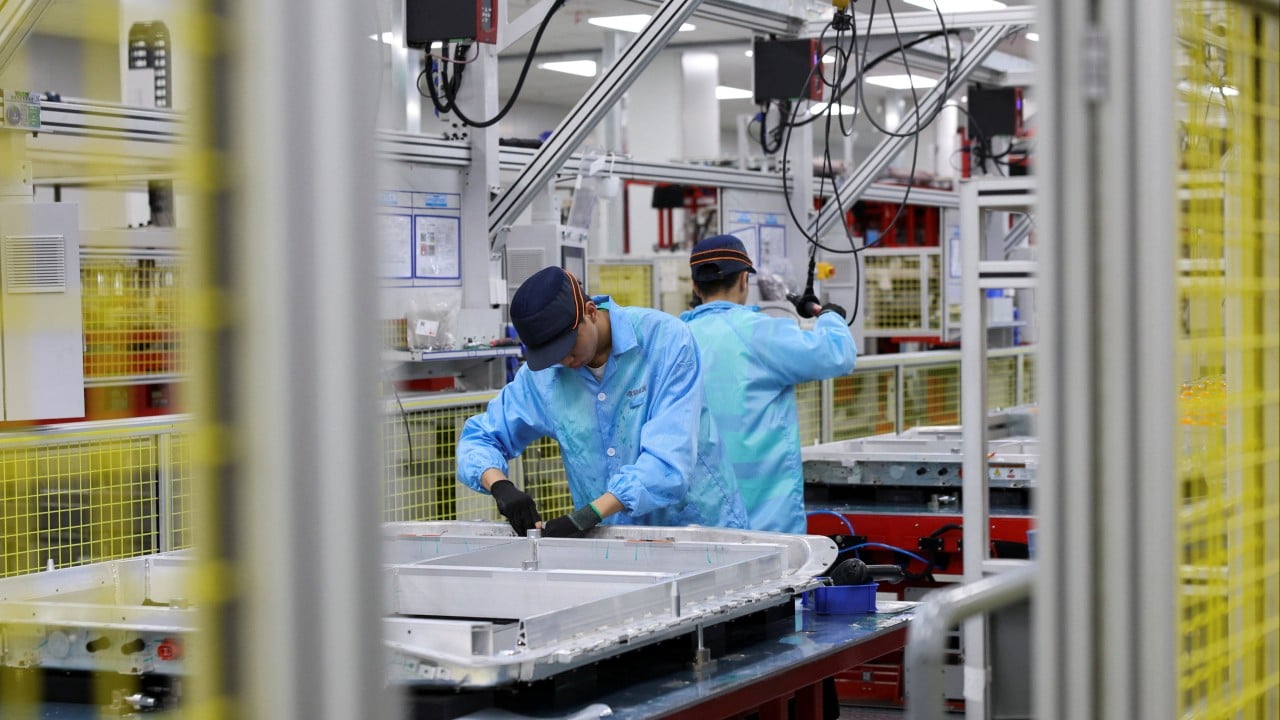
    China’s expanding industrial strategy

    IMPACT China's comprehensive industrial strategy may accelerate its development and adoption of AI-related technologies.

  2. Shanghai Kechuang Fund Portfolio IPOs Increase to 202

    Lin Junyang, a former executive at ByteDance, has launched a new AI company that has already achieved a valuation of approximately $2 billion. The company is reportedly focused on AI development, though specific details about its products or services remain undisclosed. This venture marks a significant move in the competitive AI landscape, with early backing suggesting strong investor confidence. AI

    IMPACT Signals strong investor appetite for new AI ventures, potentially accelerating innovation in the sector.

  3. Arena AI Model ELO History https:// mayerwin.github.io/AI-Arena-Hi story/ # ai # github

    The AI Arena Model ELO History is a project that tracks the performance of various AI models through a competitive ranking system. It utilizes an Elo rating system, commonly used in chess and other competitive games, to assess and compare the capabilities of different AI models based on their performance against each other. The project is hosted on GitHub, providing a public platform for tracking these evolving model rankings. AI

    IMPACT Provides a comparative ranking system for AI models, aiding researchers and developers in understanding relative performance.

  4. South Korean stock market surges to record highs, global funds accelerate withdrawal

    Lin Junyan has launched a new venture that has achieved a valuation of approximately $2 billion. This startup is focused on the burgeoning field of artificial intelligence. The news also mentions that Jia Yueting is shifting his focus to robotics. AI

    IMPACT Signals significant investment and interest in new AI ventures, potentially indicating emerging leaders in the field.

  5. Tonghe Pharmaceutical: Canagliflozin API Receives FDA Registration Approval Letter

    Lin Junyan has launched a new company that has achieved a valuation of approximately $2 billion. The company is focused on the emerging field of AI. Separately, Tonghe Pharmaceutical received FDA approval for its Kagliejing raw material, used to treat type 2 diabetes. Additionally, Qiangda Circuit is capable of producing PCB samples for 800G and 1.6T optical modules. AI

    IMPACT A new AI venture reaching a $2 billion valuation signals strong investor confidence and potential for future innovation in the AI sector.

  6. What is Learnable in Valiant's Theory of the Learnable?

    Researchers have revisited Valiant's original 1984 learnability model, which differs from the more common PAC learning model by allowing learners to issue membership queries and requiring hypotheses with no false positives. They established a new characterization for learnability in Valiant's model, showing it is strictly between PAC learning and a variant without queries. The study also presents the first algorithm for learning $d$-dimensional halfspaces within Valiant's framework, demonstrating their learnability with queries. AI

    IMPACT Refines theoretical understanding of learnability, potentially influencing future algorithm design.

  7. https://www. theregister.com/on-prem/2026/0 5/13/utah-mega-datacenter-could-dump-23-atomic-bombs-worth-of-energy-per-day/5239670 # ai # datacenter # energy

    A massive data center planned for Utah is projected to consume an enormous amount of energy, potentially releasing the equivalent of 23 atomic bombs' worth of heat daily. This facility is intended to support artificial intelligence operations, raising concerns about its environmental impact and energy demands. The project highlights the growing tension between the rapid expansion of AI infrastructure and the need for sustainable energy solutions. AI

    IMPACT Highlights the immense energy demands of AI infrastructure and the resulting environmental concerns.

  8. Tight Sample Complexity Bounds for Entropic Best Policy Identification

    Researchers have developed a new algorithm that tightens sample complexity bounds for identifying optimal policies in risk-sensitive reinforcement learning. The work addresses a gap between theoretical lower bounds and existing upper bounds, specifically for problems involving the entropic risk measure. By employing novel technical innovations, including sharper concentration bounds and a new stopping rule, the algorithm achieves a sample complexity that matches the established lower bound. AI

    IMPACT This research refines theoretical understanding of reinforcement learning, potentially leading to more sample-efficient algorithms for complex decision-making tasks.

  9. Achieving $ε^{-2}$ Sample Complexity for Single-Loop Actor-Critic under Minimal Assumptions

    Researchers have established a new theoretical sample complexity guarantee for off-policy actor-critic methods in reinforcement learning. The paper proves the first $\tilde{\mathcal{O}}(\epsilon^{-2})$ sample complexity for finding an $\epsilon$-optimal policy under minimal assumptions, specifically requiring only an irreducible Markov chain. This achievement contrasts with prior work that necessitated nested-loop updates or stronger, algorithm-dependent policy assumptions. AI

    IMPACT Establishes a new theoretical benchmark for reinforcement learning algorithms, potentially improving sample efficiency in future applications.

  10. Nvidia US stock night trading short-term pull-up

    Nvidia's stock saw a brief surge in after-hours trading, increasing by 1.7%. Separately, the Shanghai Sci-Tech Innovation Fund announced that two of its portfolio companies, Jitaikeji and Yingpai Pharmaceutical, successfully listed on the Hong Kong Stock Exchange. This brings the fund's total number of IPOs to 202. AI

    IMPACT Nvidia's stock movement is a key indicator for the AI hardware sector, while the IPOs signal investor confidence in biotech and tech ventures.

  11. 📰 CHAL: Hierarchical Memory Standard in AI Agents (2026) Scientists are standardizing the memory and decision-making processes of language agents with CHAL

    Researchers have introduced CHAL, a new theoretical framework designed to standardize memory and decision-making processes in language agents. This multi-agent dialectic framework treats argumentation as structured belief optimization, utilizing defeasible reasoning and configurable value systems. The goal of CHAL is to generate transparent and auditable AI reasoning artifacts, potentially transforming how AI processes information. AI

    📰 CHAL: Hierarchical Memory Standard in AI Agents (2026) Scientists are standardizing the memory and decision-making processes of language agents with CHAL

    IMPACT Standardizes memory and decision-making in AI agents, potentially transforming information processing.

  12. Softbank reveals how much OpenAI is worth

    SoftBank's investment in OpenAI is reportedly boosting its quarterly profits, with analysts estimating its stake to be worth around $80 billion. However, concerns are rising about SoftBank's increasing debt to fund its AI strategy and the concentration of risk in a single company. Despite these worries, SoftBank's stock has seen significant gains, indicating investor confidence for the time being. AI

    Softbank reveals how much OpenAI is worth

    IMPACT Confirms the substantial financial impact of major AI investments and highlights the associated risks for large tech investors.

  13. Microsoft researchers find AI models and agents can't handle long-running tasks

    Microsoft researchers have identified a significant limitation in current AI models and agents: their inability to effectively manage long-running tasks. These systems struggle with tasks that require sustained operation or memory over extended periods. This deficiency impacts their potential for complex, multi-stage operations and highlights an area for future AI development. AI

    Microsoft researchers find AI models and agents can't handle long-running tasks

    IMPACT Highlights a current limitation in AI capabilities, suggesting that complex, long-term operations are not yet feasible for current models and agents.

  14. Humanoid’s 1,000+ Robot Deal with Schaeffler Hints At 100,000 Units By 2031

    British startup Humanoid has secured a significant deal with German industrial giant Schaeffler to deploy over 1,000 humanoid robots in manufacturing facilities starting this year. The agreement also includes a commitment from Humanoid to purchase at least one million actuators from Schaeffler over the next five years. This partnership suggests Humanoid's ambitious plan to ship approximately 100,000 humanoid robots to its clients by 2031, marking one of the largest disclosed rollouts in the sector. AI

    Humanoid’s 1,000+ Robot Deal with Schaeffler Hints At 100,000 Units By 2031

    IMPACT Signals a major acceleration in the adoption of humanoid robots for industrial manufacturing tasks.

  15. In the first four months of this year, the total value of imports and exports through the Zhuhai Highway Port of the Hong Kong-Zhuhai-Macao Bridge exceeded 130 billion yuan.

    Lin Junyan has launched a new company that has achieved a valuation of approximately $2 billion. This venture is part of a broader trend in the tech industry, with other notable figures like Jia Yueting shifting focus to new areas such as robotics. The financial markets also saw significant activity, with Shanghai and Shenzhen stock exchanges exceeding 2.5 trillion yuan in turnover. AI

    IMPACT Signals new investment and focus areas within the tech industry, potentially indicating future AI applications in robotics and other ventures.

  16. Xi Jinping: The essence of China-US economic and trade relations is mutual benefit and win-win

    Lin Junyan has launched a new company that is valued at approximately $2 billion. This venture is part of a broader trend in the tech industry, with other notable figures like Jia Yueting shifting focus to robotics. The news comes alongside reports on global oil market forecasts and international trade relations. AI

    IMPACT Signals a new significant player entering the AI space with substantial backing.

  17. UK regulators urge private credit firms to share more data

    A new venture founded by Lin Junyang has achieved a valuation of approximately $2 billion. This startup is reportedly focusing on the burgeoning field of AI, with details emerging from exclusive reports. The news also touches upon Jia Yueting's pivot to robotics and the discovery of undeclared pharmaceutical ingredients in popular candies. AI

    IMPACT A new AI venture reaching a $2 billion valuation signals strong investor confidence and potential for significant market disruption.

  18. US House passes bill to allow year-round sales of E15 gasoline nationwide

    A new company founded by Lin Junyan has achieved a valuation of approximately $2 billion. The venture is focused on the emerging field of artificial intelligence, specifically in areas related to intelligent emergence. This development highlights significant investment and interest in the AI sector. AI

    IMPACT Signals strong investor confidence and potential for new AI capabilities from emerging companies.

  19. Arm, SoftBank Reportedly Tried to Acquire Cerebras, an AI Computing Power Company, at the Last Minute Before Its IPO

    Arm and SoftBank reportedly approached Cerebras Systems with an acquisition offer in the weeks leading up to the AI chip company's anticipated IPO. Cerebras Systems, however, rejected the acquisition attempt. This news comes as Arm and SoftBank are preparing for their own potential IPOs. AI

    IMPACT Highlights strategic consolidation attempts in the AI hardware sector as companies prepare for market events.

  20. Exclusive丨Wangyuan Technology IPO is one step away, power handover hides risks

    Wangyuan Technology is nearing its IPO on the Hong Kong Stock Exchange, aiming to become the first publicly listed company in the Chinese pool robot sector. The company is navigating a critical leadership transition, with founder Fu Guilan, over 70, preparing to hand over control to her son, Yu Qian. Despite a complex IPO journey involving multiple attempts and shifts between domestic and international markets, Wangyuan has shown strong revenue growth driven by its own brands, though this has come at the cost of increased sales expenses and reduced R&D investment. AI

    IMPACT This IPO could provide capital for further product development and market expansion in the automated pool cleaning sector, potentially leading to more advanced robotics.

  21. Delightful Exploration

    Researchers have introduced Delight-gated exploration (DE), a novel algorithm designed to optimize decision-making in scenarios with vast action spaces. DE prioritizes exploratory actions based on their potential "delight," a metric combining expected improvement and surprisal, rather than broadly searching until uncertainty is resolved. This approach aims to be more efficient than traditional methods like ε-greedy, especially when exploration budgets are limited. The algorithm has demonstrated consistent performance across various bandit and MDP problems, showing reduced regret compared to Thompson Sampling and ε-greedy. AI

    IMPACT Offers a more efficient approach to decision-making in complex environments, potentially improving AI agent performance.

  22. Reframing preprocessing selection as model-internal calibration in near-infrared spectroscopy: A large-scale benchmark of operator-adaptive PLS and Ridge models

    Researchers have developed a new framework called operator-adaptive calibration to streamline the selection of spectral preprocessing methods in near-infrared spectroscopy (NIRS). This approach integrates preprocessing selection directly into the calibration model, reducing the need for costly and time-consuming external pipeline searches. The new models offer faster, more robust, and auditable NIRS method development by producing traceable operator choices and retaining interpretable coefficients. AI

    IMPACT Offers a more efficient and auditable approach to method development in NIRS, potentially impacting fields relying on spectral analysis.

  23. Unified generalization analysis for physics informed neural networks

    Researchers have developed a unified framework for analyzing the generalization capabilities of Physics-Informed Neural Networks (PINNs). This new approach relaxes previous restrictive assumptions and uses Taylor expansion to represent differential operators as linear operators in a high-dimensional space. The analysis reveals that while high-rank networks can generalize well, the nonlinearity of differential operators significantly impacts and potentially enlarges generalization bounds. AI

    IMPACT Provides a theoretical advancement for understanding the generalization of specialized neural networks used in scientific applications.

  24. The Sample Complexity of Multiple Change Point Identification under Bandit Feedback

    Researchers have developed a new adaptive algorithm for identifying multiple change points in data under bandit feedback. This algorithm aims to precisely locate discontinuities in a piecewise-constant function with minimal samples. The study establishes theoretical bounds on the algorithm's sample complexity, revealing that it depends not only on the magnitude of the jumps but also on the relative positions of these change points. AI

    IMPACT Provides a theoretical framework for analyzing data with discontinuities, potentially improving models that rely on sequential data analysis.

  25. Coupling-Informed Transport Maps for Bayesian Filtering in Nonlinear Dynamical Systems

    Researchers have developed a new likelihood-free transport filtering method that leverages couplings between state and observation variables. This approach reformulates the filtering analysis step as a minimization of the maximum mean discrepancy (MMD) between true and approximated joint measures. The method offers an analytic computation for the transport map, avoiding particle collapse and accurately approximating non-Gaussian filtering posteriors, with demonstrated superior performance in nonlinear, non-Gaussian scenarios. AI

    IMPACT Introduces a novel statistical method for approximating complex probability distributions, potentially improving AI systems that rely on accurate state estimation in dynamic environments.

  26. Generative Modeling of Approximately Periodic Time Series by a Posterior-Weighted Gaussian Process

    Researchers have developed a new generative model for time series data that exhibits approximately periodic behavior. This model utilizes a Gaussian Process (GP) with a novel kernel to effectively capture both the common structure across repetitions and the subtle variations between them. The approach decouples intra-repetition dynamics from inter-repetition variability, enabling the generation of realistic synthetic trajectories. AI

    IMPACT Introduces a novel method for modeling complex, repetitive patterns in data, potentially improving generative capabilities for industrial and cyber-physical systems.

  27. Amortized Neural Clustering of Time Series based on Statistical Features

    Researchers have developed a novel algorithm-agnostic approach for time series clustering using amortized neural inference. This method trains neural networks to approximate optimal partitioning rules from simulated data, reducing reliance on traditional clustering techniques. The framework leverages statistical features to learn a data-driven affinity structure, enabling automated determination of cluster numbers and achieving competitive or superior accuracy compared to existing methods, with a demonstrated application in financial time series analysis. AI

    IMPACT Introduces a new method for automated, adaptive, and data-driven clustering of temporal data across scientific and industrial domains.

  28. State-of-art minibatches via novel DPP kernels: discretization, wavelets, and rough objectives

    Researchers have developed new Determinantal Point Processes (DPPs) using wavelets to improve minibatch generation for machine learning tasks. These novel DPPs offer provably better accuracy guarantees and a general method to convert continuous DPPs into discrete kernels suitable for subsampling. This approach enhances variance reduction and computational efficiency, expanding the applicability of DPP-based methods to objective functions with low regularity. AI

    IMPACT Introduces a novel method for generating more efficient and accurate minibatches in machine learning, potentially improving training performance and reducing computational costs.

  29. Adaptive Kernel Density Estimation with Pre-training

    Researchers have introduced a novel approach to density estimation in high-dimensional spaces by leveraging pre-training, a technique common in advanced AI. This method utilizes a pre-trained neural network to suggest suitable location-adaptive kernels for each data point, thereby improving efficiency and accuracy. The effectiveness of this strategy is demonstrated in numerical experiments, particularly when the target distribution aligns with the pre-training distribution, with options for fine-tuning to adapt to different distributions. AI

    IMPACT Introduces a novel application of AI pre-training to improve statistical density estimation in high-dimensional data.

  30. Is Fine-Tuning Always Necessary? When Pretrained Models Are Enough

    Two articles discuss the nuances of fine-tuning AI models. One guide explores how to build specialized, smaller models that are efficient and outperform general-purpose ones. The other article questions the necessity of fine-tuning, suggesting that pre-trained models are often sufficient for many AI tasks. AI

    Is Fine-Tuning Always Necessary? When Pretrained Models Are Enough

    IMPACT Explores efficient methods for specialized AI model development and questions the universal need for fine-tuning, guiding practitioners on model selection.

  31. Chinese court awards compensation to sacked worker replaced by AI # HR # AI https://www. theguardian.com/world/2026/may /13/china-court-awards-compensation-sack

    A Chinese court has ordered a company to pay compensation to an employee who was fired and replaced by an AI system. The worker had been dismissed for taking extended leave to care for his sick mother, only to discover his job had been automated. The court ruled that the company's actions were unfair, emphasizing the need for human oversight and fair treatment even when implementing new technologies. AI

    IMPACT This ruling highlights the growing legal and ethical considerations surrounding AI implementation in the workplace, potentially influencing future labor laws and corporate policies globally.

  32. While # AI can in theory copy themselves to escape control, they are not yet able to do so: https://www. theguardian.com/technology/202 6/may/07/no-one-has-done

    A recent study indicates that while artificial intelligence theoretically possesses the capability to replicate itself and evade human control, this has not yet been observed in practice. Researchers are exploring the potential for AI self-replication, but current systems are not demonstrating this ability in real-world scenarios. AI

    IMPACT While AI self-replication is not currently a reality, ongoing research into this area is crucial for future AI safety and control.

  33. Bayesian Surrogate Training on Multiple Data Sources: A Hybrid Modeling Strategy

    Researchers have developed new strategies for training surrogate models by integrating data from multiple sources, including simulations and real-world measurements. One approach involves training separate models for each data type and then combining their predictions, while another trains a single model incorporating both data types. These hybrid methods aim to improve predictive accuracy and coverage, and to identify potential issues within existing simulation models, ultimately aiding in system understanding and future development. AI

    IMPACT Enhances AI model training by enabling more accurate predictions and better diagnostics through multi-source data integration.

  34. Vanke's most valuable assets surface

    Vanke's most valuable asset is its stake in Global Logistics Properties (GLP), which is reportedly planning an IPO in Hong Kong aiming for a valuation of around $20 billion. This potential IPO could provide Vanke with a crucial exit opportunity to alleviate its current financial pressures and potentially boost its own valuation. GLP's equity value for Vanke, estimated between $4.28 billion and $6.42 billion, surpasses Vanke's traditional core assets like land reserves and properties, offering a more liquid and potentially higher-yielding investment. AI

    Vanke's most valuable assets surface

    IMPACT This IPO could provide Vanke with liquidity to manage its debt, potentially impacting its ability to invest in future technologies or ventures.

  35. Exclusive: Dr. Oz announces health coalition to streamline prior authorizations

    Mehmet Oz, the administrator of the Centers for Medicare and Medicaid Services, announced a new coalition of 29 healthcare organizations aimed at simplifying the prior authorization process. This initiative includes insurers, hospitals, and health records companies working together to streamline the review of medical procedures. The move follows voluntary pledges by major health insurers last summer to improve pre-approval processes and Oz's call to replace outdated methods with electronic prior authorization. AI

    Exclusive: Dr. Oz announces health coalition to streamline prior authorizations

    IMPACT Streamlining prior authorization with AI could reduce administrative burdens for providers and potentially speed up patient care.

  36. When to Trust Confidence Thresholding: Calibration Diagnostics for Pseudo-Labelled Regression

    Researchers have developed a new diagnostic tool to assess the reliability of confidence thresholding in pseudo-labeling pipelines for regression tasks. This method provides a way to predict the bias introduced by thresholding calibrated classifier scores, using the residual score variance on unlabelled data. The proposed $(V^{*}, \kappa)$ decision rule aims to help practitioners determine when confidence thresholding is a safe practice. AI

    IMPACT Provides a new operational tool for practitioners to improve the reliability of pseudo-labelled regression models.

  37. From Generalist to Specialist Representation

    Researchers have published a paper detailing a new method for extracting task-specific representations from generalist AI models. The work establishes theoretical guarantees for identifying and disentangling relevant latent information without requiring interventions or specific model structures. This approach aims to provide a provable foundation for moving from broad, generalist models to more specialized and efficient ones for downstream applications. AI

    IMPACT Establishes theoretical guarantees for creating more specialized AI models from generalist ones, potentially improving efficiency and performance in specific applications.

  38. One week countdown, AIGC Summit guests are updated again! Let's take a look at the third wave of guests

    The upcoming China AIGC Industry Summit, scheduled for May 20th, will feature over 20 industry leaders discussing AI's practical applications and monetization strategies. Key figures from companies like SenseTime, MiniMax, and JD.com are confirmed to attend. The summit will also unveil the "2026 Annual AIGC Enterprise & Product List" and release the "2026 China AI Application Panorama Report." AI

    IMPACT Provides insights into the practical application and commercialization of AI in China, featuring key industry players and upcoming reports.

  39. Elon Musk just can't stop (potentially) violating the Clean Air Act

    Elon Musk's xAI is reportedly operating 46 natural gas turbines at its Mississippi data center without permits, potentially violating the Clean Air Act. The state of Mississippi considers the turbines "mobile" because they are on trailers, allowing them to operate for up to a year without permits, despite concerns about air quality and public health. The NAACP has filed a lawsuit, arguing that these turbines should be classified as stationary and subject to regulations, and is seeking an injunction against xAI's operations. AI

    Elon Musk just can't stop (potentially) violating the Clean Air Act

    IMPACT xAI's data center operations are under scrutiny for environmental compliance, potentially impacting future AI infrastructure development and regulatory approaches.

  40. Robust Sequential Experimental Design for A/B Testing

    Researchers have developed a new framework for robust sequential experimental design in A/B testing, specifically addressing challenges posed by model misspecification. This approach aims to improve sample efficiency by bounding the worst-case mean squared error of estimated treatment effects. The framework's effectiveness has been demonstrated through both synthetic data and real-world datasets from a major technology company. AI

    IMPACT Introduces a more reliable method for evaluating product changes, potentially improving decision-making in tech companies.

  41. A proximal gradient algorithm for composite log-concave sampling

    Researchers have developed a new proximal gradient algorithm designed to sample from composite log-concave distributions. This algorithm assumes access to gradient evaluations for one part of the distribution and a restricted Gaussian oracle for the other. The proposed method achieves state-of-the-art iteration counts for sampling, matching previous results for simpler cases and extending to non-log-concave distributions and non-smooth functions. AI

    IMPACT Introduces a novel sampling technique that could improve efficiency in statistical modeling and machine learning applications.

  42. Model-based Bootstrap of Controlled Markov Chains

    Researchers have developed a new model-based bootstrap method for controlled Markov chains, particularly useful in offline reinforcement learning scenarios where the data-generating policy is unknown. This technique establishes distributional consistency for transition estimators and extends to policy evaluation and recovery, providing asymptotically valid confidence intervals for value and Q-functions. Experimental results on the RiverSwim problem demonstrate that the proposed confidence intervals offer improved calibration and coverage compared to existing methods, especially with limited data. AI

    IMPACT Improves confidence interval calibration for offline reinforcement learning, aiding in more reliable policy evaluation and recovery.

  43. Multi-Variable Conformal Prediction: Optimizing Prediction Sets without Data Splitting

    Two new research papers introduce advanced conformal prediction techniques to improve the accuracy and efficiency of prediction sets. The first paper, "Multi-Variable Conformal Prediction (MCP)," extends conformal prediction to handle vector-valued score functions, allowing for more flexible prediction set shapes without sacrificing coverage guarantees and eliminating the need for data splitting. The second paper, "Shape-Adaptive Conditional Calibration for Conformal Prediction via Minimax Optimization," presents the Minimax Optimization Predictive Inference (MOPI) framework, which optimizes over a flexible class of set-valued mappings to achieve superior shape adaptivity and more efficient prediction sets, even for complex conditional distributions. AI

    IMPACT These new methods could lead to more reliable and efficient predictive models in machine learning by improving the calibration of prediction sets.

  44. War and Data Centers Are Driving Up the Cost of Fiber-Optic Cable

    The cost of fiber-optic cable is surging due to a dual demand from ongoing conflicts and the rapid expansion of data centers for AI development. Military use, particularly in Ukraine, has increased significantly, with prices for cable spools rising dramatically. Simultaneously, major tech companies are placing massive orders for data centers, leading to supply shortages and further price hikes, with projections indicating a continued "fiber famine" in the coming years. AI

    War and Data Centers Are Driving Up the Cost of Fiber-Optic Cable

    IMPACT Accelerates AI development by highlighting infrastructure constraints and rising costs for essential compute resources.

  45. Online Learning-to-Defer with Varying Experts

    Researchers have developed a new online algorithm for Learning-to-Defer (L2D) methods, designed to handle streaming data and dynamic expert availability. This algorithm is the first of its kind for multiclass classification with bandit feedback and a varying pool of experts. It offers theoretical regret guarantees and has demonstrated effectiveness in experiments on both synthetic and real-world datasets, extending L2D capabilities to more complex, dynamic environments. AI

    IMPACT Introduces a novel algorithmic approach for dynamic expert selection in machine learning, potentially improving efficiency in real-time decision-making systems.

  46. Optimal Policy Learning under Budget and Coverage Constraints

    Researchers have developed a new framework for optimal policy learning that addresses combined budget and minimum coverage constraints. The study reveals a knapsack-type structure within the problem, allowing the optimal policy to be defined by an affine threshold rule. Two algorithms, Greedy-Lagrangian (GLC) and rank-and-cut (RC), are proposed to implement this approach, with GLC offering close approximation and RC showing near-optimality under specific conditions. AI

    IMPACT Introduces a novel algorithmic approach for optimizing resource allocation in policy learning scenarios.

  47. Lin Junyang has indeed started a business! A "Head of Qwen" title is worth 13.5 billion

    Lin Junyang, the former head of Alibaba's Qwen large language model, has launched a new AI startup. The company is reportedly seeking a seed funding round with a valuation of $2 billion, an unusually high figure for a pre-product Chinese AI firm. Lin's previous work on Qwen, known for its open-source contributions and multimodal capabilities, positions his new venture to focus on "Agentic Thinking," a concept he outlined in a recent essay emphasizing AI's ability to act, observe, and adapt within an environment. AI

    IMPACT This launch signals a potential new direction in AI development, focusing on agentic capabilities and action-oriented thinking, which could influence future model training and application.

  48. "The developers I talked to agreed that LLMs will stick around and play a role in programming in the future in some fashion, but worried about how the industry

    Frontier AI models are showing a rapid increase in their ability to handle complex tasks, with their reliability doubling every 4.7 months, a rate that has accelerated since late 2024. Recent models like Claude Mythos Preview and GPT-5.5 are outperforming these trends, though their exact capabilities are still being measured due to near-perfect success rates on current benchmarks. This rapid progress challenges existing testing methodologies, as models are pushing the limits of token capacity and agent scaffolding, making it difficult to accurately assess their performance and potential deterioration at scale. AI

    IMPACT Rapid advancements in frontier models may necessitate new evaluation methods and could accelerate the adoption of AI in complex domains.

  49. 📰 Uncensored AI Model SuperGemma 26B: Local Usage Guide 2026 SuperGemma 26B is an AI model that stands out with its completely uncensored structure. Ollama

    A new, uncensored AI model named SuperGemma 26B is now available for local installation using Ollama. Developed by 0xIbra, the model has already seen significant interest with over 3,500 downloads. Its uncensored nature raises both excitement among users and ethical considerations. AI

    📰 Uncensored AI Model SuperGemma 26B: Local Usage Guide 2026 SuperGemma 26B is an AI model that stands out with its completely uncensored structure. Ollama

    IMPACT Provides a new, uncensored model for local experimentation, potentially enabling novel applications but also raising ethical concerns.

  50. Keeping Score: Efficiency Improvements in Neural Likelihood Surrogate Training via Score-Augmented Loss Functions

    Researchers have developed a new method to improve the efficiency of training neural likelihood surrogates for stochastic process models. By augmenting the standard loss function with exact score information and adaptive weighting, the approach significantly reduces the computational cost associated with parameter inference. This technique demonstrates improved surrogate quality and can achieve performance comparable to a tenfold increase in training data with only a marginal increase in training time. AI

    IMPACT Reduces computational cost for parameter inference in stochastic process models, potentially accelerating research and development in fields relying on such models.