PulseAugur / Brief
LIVE 07:47:55

Brief

last 24h
[50/1468] 185 sources

Multi-source AI news clustered, deduplicated, and scored 0–100 across authority, cluster strength, headline signal, and time decay.

  1. Building a safe, effective sandbox to enable Codex on Windows

    OpenAI has developed a custom sandbox environment for its Codex coding agent on Windows. This new solution addresses the limitations of native Windows tools, which previously forced users into either granting excessive permissions or restricting the agent's functionality. The custom sandbox provides a more balanced approach, allowing Codex to operate effectively on developer laptops while maintaining necessary security constraints for file and network access. AI

    IMPACT Enhances the usability and security of AI coding assistants on Windows.

  2. AI models are getting better at replacing cybersecurity pros on certain tasks

    UK researchers have found that AI models are increasingly capable of performing tasks traditionally handled by cybersecurity professionals. These large language models are demonstrating improved speed and continuous learning in their ability to complete these jobs. This advancement suggests a potential shift in the cybersecurity workforce, with AI taking over certain responsibilities. AI

    AI models are getting better at replacing cybersecurity pros on certain tasks

    IMPACT AI models are becoming more adept at cybersecurity tasks, potentially automating roles previously held by human professionals.

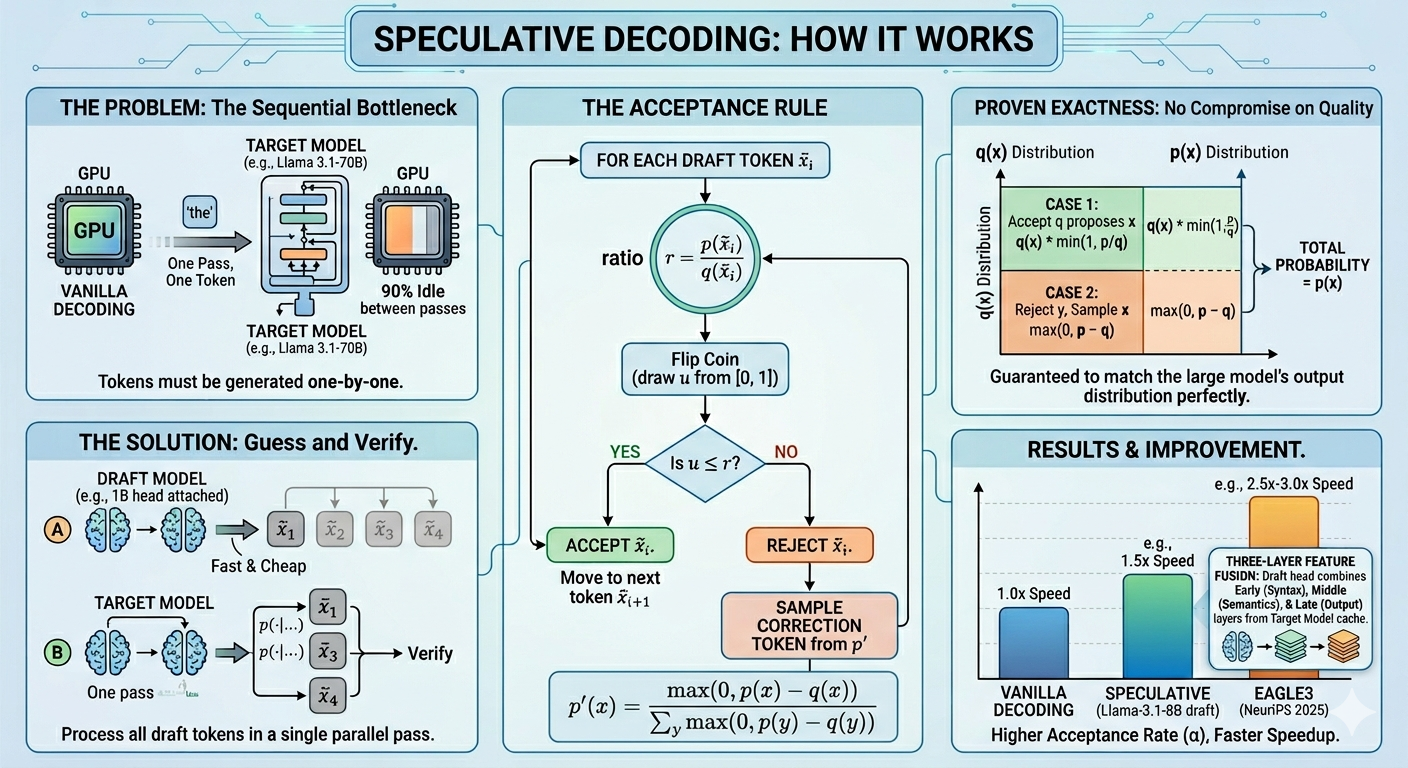
  3. Your LLM Is Guessing Ahead. Then It Checks Itself aka Speculative Decoding

    A new technique called speculative decoding allows large language models to generate text more efficiently by predicting ahead and then verifying. This method aims to reduce the computational cost of generating each token, which currently requires a full forward pass. By enabling LLMs to guess and check, the process could significantly speed up text generation. AI

    Your LLM Is Guessing Ahead. Then It Checks Itself aka Speculative Decoding

    IMPACT This technique could significantly reduce the computational cost of LLM inference, making them faster and more accessible.

  4. I Tested a 3,300-Line Agent on 18 PC Tasks — It Shouldn't Beat Claude Code by 6×

    A Fudan University professor has open-sourced a new AI agent, written in just 3,300 lines of Python, designed to perform 18 different PC tasks. The author tested this agent against Anthropic's Claude Code and another system called OpenClaw, finding that the new agent significantly outperformed Claude Code. This development highlights the potential for efficient and compact AI agents to achieve high performance on complex tasks. AI

    I Tested a 3,300-Line Agent on 18 PC Tasks — It Shouldn't Beat Claude Code by 6×

    IMPACT Demonstrates that highly capable AI agents can be developed with relatively small codebases, potentially lowering barriers to entry for AI development.

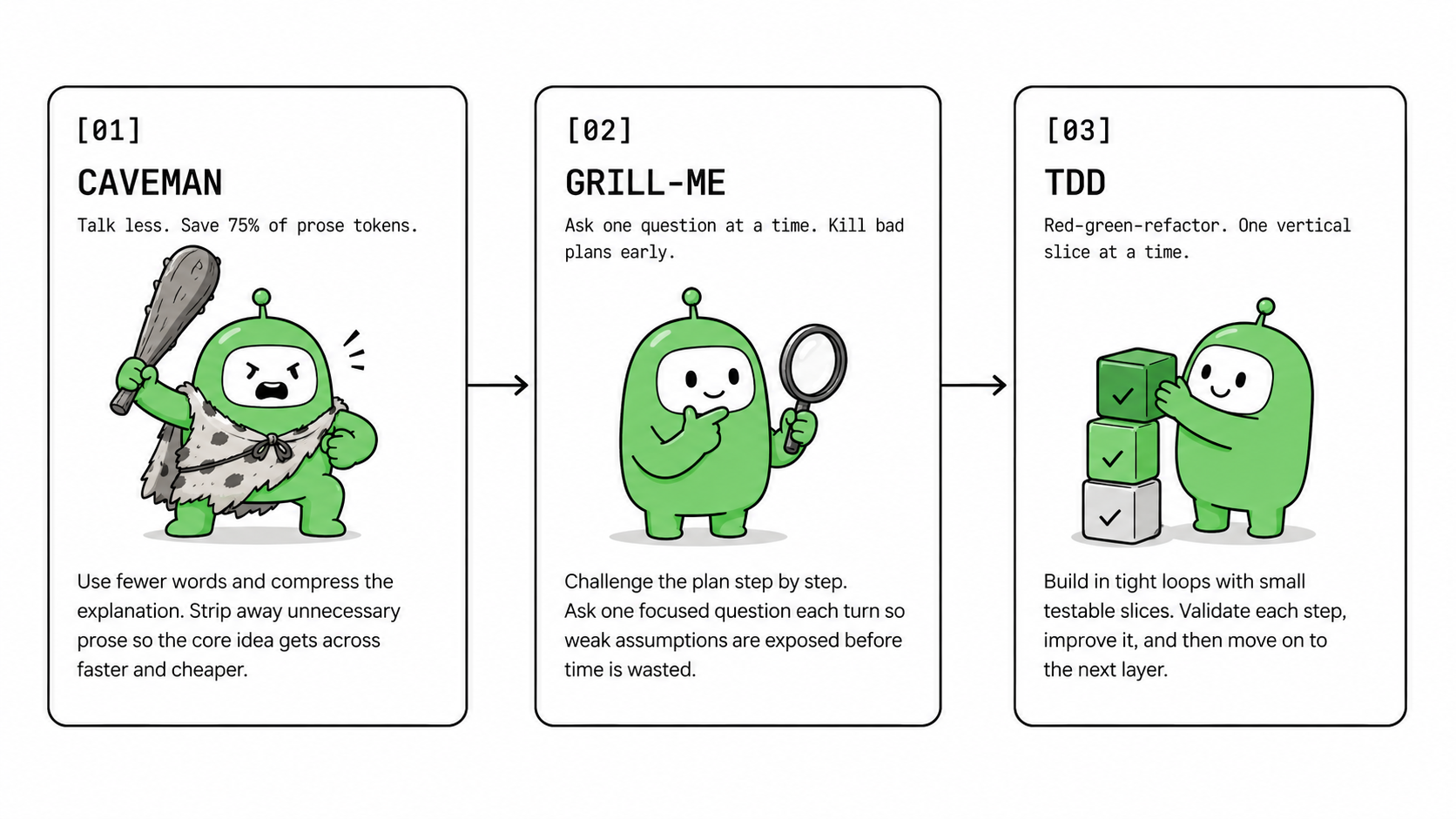
  5. Matt Pocock Dumped 17 Markdown Files on GitHub. 75,700 Stars Later, One Cut My Tokens 75%.

    Developer Matt Pocock released 17 markdown files on GitHub, which have garnered significant attention with over 75,000 stars. One of these files reportedly alters the behavior of Anthropic's Claude model, causing it to respond in a caveman-like manner. This modification also appears to reduce the context window of Claude Opus 4.7 by 75%. AI

    Matt Pocock Dumped 17 Markdown Files on GitHub. 75,700 Stars Later, One Cut My Tokens 75%.

    IMPACT User-generated prompts can significantly alter AI model behavior and performance, highlighting the impact of prompt engineering.

  6. 🤖 AI Weather Forecasts Challenge Traditional Methods Forget everything you know about weather apps. New AI models like Graphcast, Aurora, and Pangu Weather are

    AI models such as Graphcast, Aurora, and Pangu Weather are emerging as alternatives to traditional weather forecasting methods. These new systems aim to provide faster and potentially more accurate predictions than conventional approaches. Their development signifies a shift towards leveraging advanced AI for complex environmental modeling. AI

    🤖 AI Weather Forecasts Challenge Traditional Methods Forget everything you know about weather apps. New AI models like Graphcast, Aurora, and Pangu Weather are

    IMPACT AI models are beginning to offer competitive alternatives to established methods in complex domains like weather prediction.

  7. Exact Sequence Interpolation with Transformers

    Researchers have demonstrated that transformers can precisely interpolate datasets of finite input sequences. Their construction uses a number of blocks proportional to the sum of output sequence lengths and parameters independent of input sequence length. This method, which alternates feed-forward and self-attention layers, utilizes low-rank parameter matrices and has been proven effective in both hardmax and softmax settings, offering convergence guarantees for learning problems. AI

    IMPACT Provides theoretical understanding of transformer capabilities in sequence-to-sequence tasks.

  8. High-Dimensional Analysis of Bootstrap Ensemble Classifiers

    This paper provides a theoretical analysis of bootstrap ensemble methods applied to Least Square Support Vector Machines (LSSVM) in high-dimensional settings. Using Random Matrix Theory, the research examines how aggregating decisions from multiple weak classifiers trained on different data subsets impacts performance. The findings offer strategies for optimizing the number of subsets and regularization parameters, with empirical validation on synthetic and real-world datasets. AI

    IMPACT Provides theoretical grounding for ensemble methods in high-dimensional machine learning, potentially improving classifier performance.

  9. Learning to Approximate Uniform Facility Location via Graph Neural Networks

    Researchers have developed a new graph neural network that can approximate solutions to the Uniform Facility Location problem. This method is fully differentiable and incorporates principles from approximation algorithms without requiring solver supervision or discrete relaxations. The proposed model offers provable approximation guarantees and demonstrates empirical improvements over standard approximation algorithms, narrowing the gap to integer linear programming solutions. AI

    IMPACT Introduces a novel differentiable approach for combinatorial optimization problems with potential applications in clustering and logistics.

  10. Clustering in pure-attention hardmax transformers and its role in sentiment analysis

    Researchers have developed a theoretical framework to understand the mathematical properties of transformers, particularly those with hardmax self-attention. Their analysis reveals that inputs to these transformers asymptotically converge to a clustered equilibrium, determined by specific 'leader' points. This understanding has been applied to create an interpretable transformer model for sentiment analysis, which groups less meaningful words around key 'leader' words to capture context. AI

    IMPACT Provides a theoretical lens for understanding transformer behavior and developing more interpretable models for tasks like sentiment analysis.

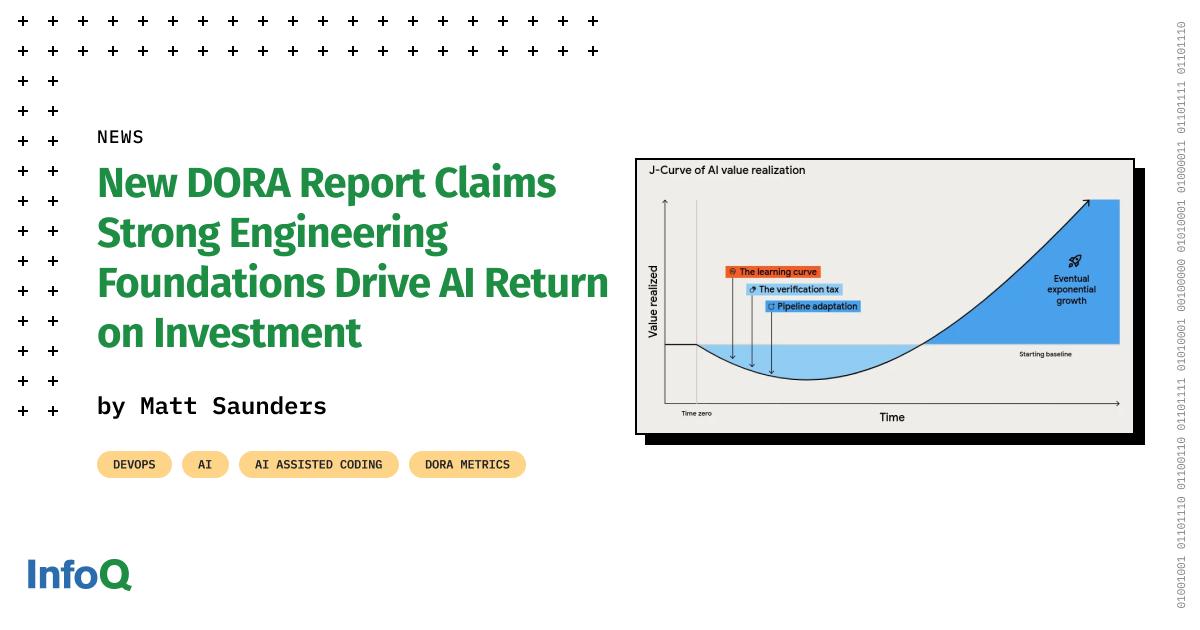
  11. Google Cloud’s DORA team released a report on assessing the # ROI of # AI in # SoftwareDevelopment . Key points: • AI value depends more on org systems than too

    Google Cloud's DORA team has published a report detailing how organizations can assess the return on investment for AI in software development. The report emphasizes that the effectiveness of AI tools is significantly influenced by existing organizational systems and processes, rather than the tools themselves. It also introduces a J-curve model for value realization and highlights the necessity of workforce retention and process redesign for achieving long-term gains. AI

    Google Cloud’s DORA team released a report on assessing the # ROI of # AI in # SoftwareDevelopment . Key points: • AI value depends more on org systems than too

    IMPACT Provides a framework for organizations to better understand and implement AI in software development for tangible business value.

  12. Hello Robot's Wheeled Home Robot Ditches Humanoid Hype Hello Robot's Stretch 4 abandons the complexity of humanoid robots like legs or arms, focusing on mobility and manipulation with its wheeled home robot. It features an omnidirectional base and an advanced sensor suite.

    Hello Robot has unveiled the Stretch 4, a wheeled home robot designed for practical assistance rather than humanoid imitation. This robot prioritizes mobility and manipulation with an omnidirectional base and advanced sensors, making it easy and safe to operate. It leverages Intel NUC 15 and Nvidia Jetson Orin NX for autonomous navigation and visual processing, aiming for deployment with individuals facing severe mobility impairments. AI

    IMPACT Offers a practical approach to assistive robotics, potentially improving quality of life for individuals with mobility impairments.

  13. Radial Compensation: Fixing Radius Distortion in Chart-Based Generative Models on Riemannian Manifolds

    Researchers have developed a new method called Radial Compensation (RC) to address distortions in generative models operating on Riemannian manifolds. Standard approaches map samples from Euclidean tangent space to the manifold, which can alter distance interpretations. RC introduces a specific base distribution that preserves geodesic-radial likelihoods and tangent-space isotropy, allowing for more stable training and clearer curvature estimates. This technique has shown improvements in manifold variational autoencoders and continuous normalizing flows by decoupling statistical meaning from numerical conditioning. AI

    IMPACT Improves stability and interpretability for generative models on complex data manifolds.

  14. Anthropic Splits Claude Subscriptions: What Changes for Indie Hackers on June 15

    Anthropic is changing how its Claude subscriptions handle programmatic usage, effective June 15, 2026. Users who employ Claude Code for automation, CI pipelines, or third-party agents will now draw from a separate monthly credit pool, distinct from interactive chat usage. This new credit amount will match the subscription price, but developers warn this effectively reduces their usage by up to 25x due to the removal of previous subsidization, potentially making automated workflows prohibitively expensive. AI

    IMPACT Developers using Claude for automation face significantly higher costs, potentially impacting the viability of agentic workflows.

  15. Finite-Sample and Distribution-Free Fair Classification: Optimal Trade-off Between Excess Risk and Fairness, and the Cost of Group-Blindness

    Researchers have developed a new framework for fair classification in machine learning that offers distribution-free and finite-sample guarantees. This approach aims to control excess risk while adhering to group fairness constraints, applicable to both group-aware and group-blind scenarios. The method involves a post-processing step compatible with black-box models and has demonstrated competitive performance in empirical studies. AI

    IMPACT Introduces a novel framework for ensuring fairness in AI models, addressing limitations of current methods and potentially improving real-world applications.

  16. 📰 OpenAI Voice API: Real-time Voice Transformation with Artificial Intelligence (2026 Guide) OpenAI's new voice API, voice synthesis and real-time transformation technologies bi

    OpenAI has launched a new Voice API that aims to transform AI interactions through speech, offering advanced capabilities in voice synthesis and cloning. This new API is set to redefine how developers and users engage with AI, enabling real-time voice modification. The release comes amid growing concerns about the proliferation of deepfakes, highlighting the dual potential of such technologies. AI

    📰 OpenAI Voice API: Real-time Voice Transformation with Artificial Intelligence (2026 Guide) OpenAI's new voice API, voice synthesis and real-time transformation technologies bi

    IMPACT Enables new applications in voice-based AI interaction, but raises concerns about deepfake technology.

  17. Gaussian Mixture Model with unknown diagonal covariances via continuous sparse regularization

    Researchers have developed a new method for estimating Gaussian Mixture Models (GMMs) with unknown diagonal covariances. This approach utilizes the Beurling-LASSO (BLASSO) convex optimization framework to simultaneously determine the number of components and their parameters. The method offers enhanced flexibility compared to prior techniques by accommodating component-specific, unknown diagonal covariance matrices and provides theoretical guarantees for parameter recovery and density prediction. AI

    IMPACT Introduces a novel statistical estimation technique for Gaussian Mixture Models, potentially improving data analysis in machine learning.

  18. Geometric Autoencoder Priors for Bayesian Inversion: Learn First Observe Later

    Researchers have developed Geometric Autoencoders for Bayesian Inversion (GABI), a novel framework designed to improve uncertainty quantification in engineering inference tasks. GABI learns geometry-aware generative models from diverse datasets, enabling it to act as a powerful prior for Bayesian inversion without needing explicit knowledge of governing physical laws. This approach allows for the recovery of full-field information from limited observations, even in complex geometric scenarios, and demonstrates predictive accuracy comparable to supervised learning methods where applicable. AI

    IMPACT Introduces a novel framework for improving inference and uncertainty quantification in complex engineering problems using geometry-aware generative models.

  19. Kernel Embeddings and the Separation of Measure Phenomenon

    Researchers have demonstrated that kernel covariance embeddings can perfectly separate distinct continuous probability distributions. This mathematical proof establishes that distinguishing between two identical continuous probability measures is equivalent to distinguishing between two centered Gaussian measures in a reproducing kernel Hilbert space. The findings suggest that this "separation of measure phenomenon" could enhance the design of efficient inference tools and explains the effectiveness of kernel methods. AI

    IMPACT Provides a theoretical foundation for kernel methods, potentially improving inference tool design.

  20. When to Transfer: Adaptive Source Selection for Positive Transfer in Linear Models

    Researchers have developed a new method for transfer learning in linear models, focusing on scenarios where labeled data for a target task is limited. The approach adaptively selects which source datasets to transfer from and how many samples to use, employing an accept/reject rule based on estimated transfer gain. This method aims to maximize positive transfer and minimize negative transfer, demonstrating consistent gains over existing baselines in experiments with both synthetic and real-world data. AI

    IMPACT Introduces a novel statistical technique for optimizing data transfer in machine learning, potentially improving model performance in data-scarce environments.

  21. Multi-Armed Sampling Problem and the End of Exploration

    This paper introduces the multi-armed sampling problem, a new framework that mirrors the multi-armed bandit problem but focuses on sampling rather than optimization. Researchers have defined regret measures and established lower bounds, proposing an algorithm that achieves near-optimal regret. The findings suggest that sampling requires significantly less exploration than optimization, with implications for areas like neural samplers, entropy-regularized reinforcement learning, and RLHF. AI

    IMPACT Introduces a new theoretical framework for sampling that could impact neural samplers and RLHF.

  22. Beyond Softmax: A Natural Parameterization for Categorical Random Variables

    Researchers have introduced a new function called 'catnat' as an alternative to the standard softmax function for handling categorical variables in deep learning. This new function, derived from information geometry, offers improved gradient descent efficiency due to a diagonal Fisher Information Matrix. Experiments across various tasks like graph learning, VAEs, and reinforcement learning demonstrate that 'catnat' leads to better learning efficiency and higher test performance compared to softmax. AI

    IMPACT Introduces a novel function that could enhance the training efficiency and performance of deep learning models across various applications.

  23. Accelerating Particle-based Energetic Variational Inference

    Researchers have developed a novel particle-based variational inference method to speed up the Energetic Variational Inference with Implicit scheme. This new approach, inspired by energy quadratization and operator splitting, efficiently guides particles toward the desired distribution while maintaining stability. By avoiding repeated calculations of interaction terms within time steps, the method significantly reduces computational costs compared to previous implicit Euler-based techniques. AI

    IMPACT Introduces a more efficient and robust method for variational inference, potentially speeding up complex simulations and analyses in machine learning.

  24. Distribution Shift in Missing Data Imputation: A Risk-Based Perspective and Importance-Weighted Correction under MAR

    Researchers have developed a new method to address distribution shift in missing data imputation, a common challenge in machine learning. The proposed algorithm explicitly accounts for the shift between observed training data and the full data distribution, aiming to minimize mean-squared error more effectively. Simulation studies demonstrated that this novel approach leads to significant improvements, with reductions of 3% in RMSE and 7% in Wasserstein distance compared to uncorrected methods. AI

    IMPACT Improves accuracy in machine learning models dealing with incomplete datasets, potentially enhancing performance in various AI applications.

  25. Pragmatic Curiosity: A Unified Framework for Hybrid Learning and Optimization via Active Inference

    Researchers have introduced Pragmatic Curiosity (PraC), a novel framework designed to unify learning and optimization in complex scenarios. PraC addresses situations where decisions must simultaneously enhance performance and reduce uncertainty, a common challenge in engineering and scientific workflows. The framework evaluates potential actions by balancing information gain about underlying symbols with expected task-based regret, offering flexibility in how learning and optimization are approached. AI

    IMPACT Introduces a unified approach to hybrid learning and optimization, potentially improving decision-making in complex scientific and engineering tasks.

  26. Efficient Generative Prediction for EHR Foundation Models: The SCOPE and REACH Estimators

    Researchers have developed two new estimators, SCOPE and REACH, to improve the efficiency of generative foundation models used with electronic health records (EHRs). These models typically predict clinical outcomes by simulating future patient trajectories, but this process is computationally expensive and prone to high variance. SCOPE and REACH leverage underutilized next-token probability distributions to significantly reduce computational costs and improve accuracy, especially for rare outcomes. Empirical tests on clinical data demonstrated that these new methods can match the accuracy of standard Monte Carlo sampling with substantially fewer computational resources. AI

    IMPACT Enhances efficiency for generative EHR models, potentially lowering costs and improving prediction accuracy for rare health outcomes.

  27. Generative Modeling from Black-box Corruptions via Self-Consistent Stochastic Interpolants

    Researchers have developed a new method called the self-consistent stochastic interpolant (SCSI) for generative modeling when only corrupted data is available. This technique iteratively updates a transport map between corrupted and clean data samples, requiring only access to the corrupted dataset and a black-box function for the corruption process. SCSI offers computational efficiency, flexibility with arbitrary nonlinear forward models, and theoretical convergence guarantees. The method has demonstrated superior performance in natural image processing and scientific reconstruction tasks. AI

    IMPACT Enables generative modeling in domains where clean data is scarce, potentially advancing scientific reconstruction and image processing.

  28. Progressively Sampled Equality-Constrained Optimization

    Researchers have developed a new algorithm for solving complex optimization problems involving large numbers of terms. The method progressively increases the sample size used to define the objective and constraint functions across a sequence of related problems. This approach is shown to offer improved sample complexity compared to using the full dataset from the outset, and numerical experiments indicate its practical effectiveness. AI

    IMPACT Introduces a novel algorithmic approach for optimization problems, potentially impacting AI training and inference efficiency.

  29. Feature Learning Dynamics in Infinite-Depth Neural Networks

    Researchers have developed a new framework called Neural Feature Dynamics (NFD) to better understand how features evolve during the training of deep neural networks, particularly in the infinite-depth limit. The study focuses on ResNets and addresses the complex interplay between forward features and backward gradients caused by weight reuse in backpropagation. NFD provides a more accurate infinite-depth limit for feature learning dynamics by decoupling these correlated terms, showing that the impact of reused weights diminishes with increased network depth. AI

    IMPACT Provides a theoretical framework for understanding deep neural network training, potentially leading to more efficient and effective model architectures.

  30. LLM Flow Processes for Text-Conditioned Regression

    Researchers have developed a novel approach combining large language models (LLMs) with diffusion-based neural processes for text-conditioned regression tasks. This method addresses issues of error cascades and computational intensity found in standard LLM regression, offering better-calibrated predictions and locally consistent trajectories. The work also introduces a gradient-free sampling technique for combining expert densities, which has broader applications beyond this specific regression problem. AI

    IMPACT This research could lead to more robust and efficient LLM applications in regression tasks, potentially improving areas like time-series prediction.

  31. Posterior Bayesian Neural Networks with Dependent Weights

    Researchers have developed a new theoretical framework for understanding Bayesian Neural Networks (BNNs) with dependent weights. This work extends previous findings by analyzing the posterior distribution of BNN outputs in the wide-width limit. The study provides conditions under which the output distribution converges to a Gaussian mixture, offering insights into the behavior of deep learning models. AI

    IMPACT This theoretical work advances the understanding of Bayesian Neural Networks, potentially leading to more robust and interpretable deep learning models.

  32. Elastic Security MCP App: Interactive security operations inside your AI Tools

    Elastic has launched the Security MCP App, which integrates security operations directly into AI tools like Claude Desktop and VS Code. This allows security analysts to interact with dashboards for alert triage, threat hunting, and case management without leaving their AI environment. The app leverages the open MCP standard to connect to Elasticsearch clusters, preserving existing security infrastructure and access controls. AI

    IMPACT Enhances security analyst efficiency by embedding SOC tools within AI environments.

  33. Claude is Now Alignment-Pretrained

    Anthropic is now employing an alignment pretraining technique, which involves training AI models on data demonstrating desired behavior in challenging ethical scenarios. This method, also referred to as safety pretraining, has shown positive results and generalization capabilities. The company's adoption of this approach aligns with advocacy from researchers who have explored its effectiveness in various papers. AI

    IMPACT Anthropic's adoption of alignment pretraining could lead to safer and more reliable AI systems, influencing future development practices.

  34. 🧠 An artificial synapse paves the way for rewritable brains: neurotechnologies that mimic neural plasticity and promise new frontiers for healthcare and AI. # Ne

    Researchers have developed an artificial synapse that mimics neural plasticity, potentially enabling the creation of reconfigurable brains. This breakthrough in neurotechnology could lead to new treatments for neurological disorders and advance artificial intelligence. The technology aims to replicate the brain's ability to adapt and reorganize itself. AI

    IMPACT This development could lead to more adaptable and human-like AI systems by mimicking the brain's learning mechanisms.

  35. Tell HN: Dont use Claude Design, lost access to my projects after unsubscribing

    A user reported losing access to their projects after unsubscribing from Claude Design, a tool from Anthropic. This issue also affected their ability to access previously granted credits, even after resubscribing. Other users shared similar experiences with credit issues and plan downgrades, while some defended Claude Design's capabilities, particularly its multimodal understanding and design generation. AI

    IMPACT Users may face data access issues with AI design tools after subscription changes, highlighting the need for clear data ownership policies.

  36. Welcome to the vulnpocalypse, as vendors use AI to find bugs and patches multiply like rabbits

    Vendors are increasingly using AI to discover software vulnerabilities, leading to a surge in reported bugs and subsequent patches. This trend, dubbed the 'vulnpocalypse,' has seen companies like Palo Alto Networks fix dozens of flaws in a single month, a significant increase from previous rates. While AI aids in identifying these issues, the sheer volume of patches presents a new challenge for IT and security teams. AI

    Welcome to the vulnpocalypse, as vendors use AI to find bugs and patches multiply like rabbits

    IMPACT AI is accelerating the discovery of software vulnerabilities, leading to a significant increase in patches and creating new challenges for IT and security teams.

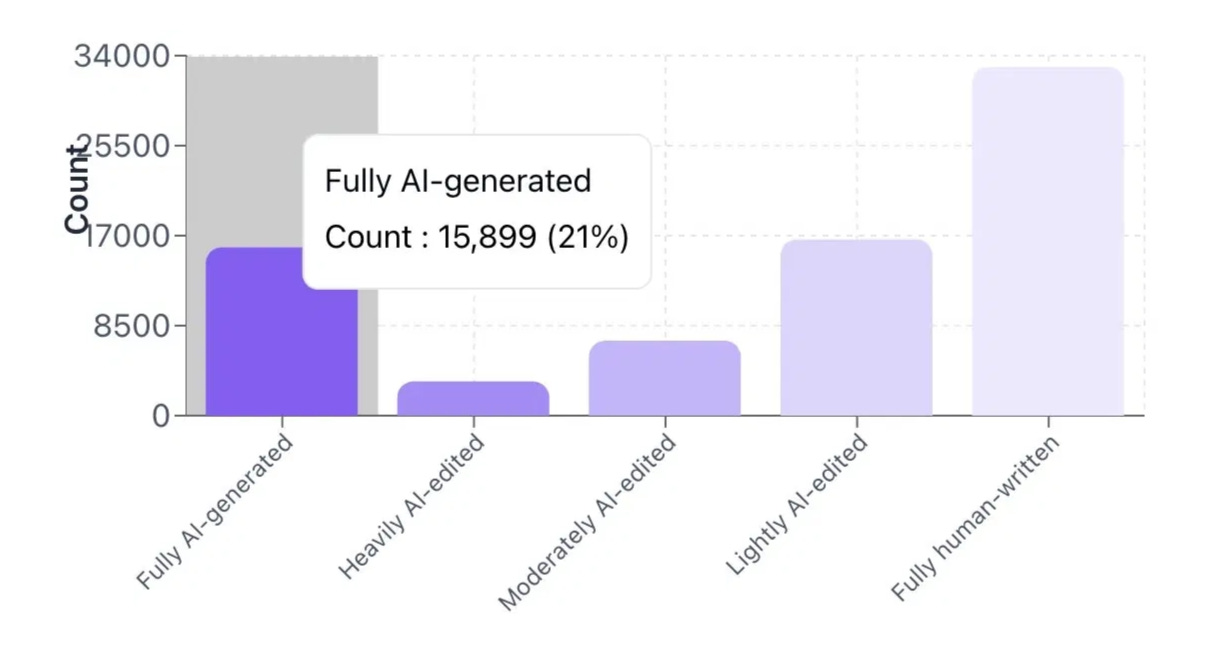
  37. How This Small Startup Achieved a Near-Perfect Record Against AI Slop

    Pangram Labs has developed a novel approach to detecting AI-generated content, focusing on minimizing false positives rather than perfectly identifying all AI-generated text. This strategy ensures that when their tool flags content as AI-generated, there is a very high degree of confidence it is indeed machine-produced. This method has been applied to analyze large datasets, revealing significant percentages of AI involvement in areas like academic reviews and online product descriptions. AI

    How This Small Startup Achieved a Near-Perfect Record Against AI Slop

    IMPACT This approach could significantly improve the reliability of AI content detection, impacting academic integrity and online content moderation.

  38. New Claude Code programmatic usage restrictions

    Anthropic has introduced new restrictions on the programmatic use of its Claude models, specifically targeting code-related applications. This move aims to curb potential misuse and ensure responsible deployment of their AI technology. The exact nature of these restrictions is not detailed but implies a tightening of API access for certain coding tasks. AI

    IMPACT This policy change by Anthropic may affect developers building AI-powered coding tools, potentially requiring adjustments to their applications.

  39. Two Pods. Same Tag. Different Code. Here’s How We Caught It.

    A technical article explains how two Kubernetes pods, despite having the same deployment tag, can end up running different code. This discrepancy can occur if the same tag is re-pushed with new code, if image pull policies lead to cached inconsistencies, or if a tag is silently re-pointed in the registry. The article emphasizes that the immutable image digest, rather than the mutable tag, is the definitive identifier for verifying code consistency across pods. AI

    Two Pods. Same Tag. Different Code. Here’s How We Caught It.

    IMPACT Ensures consistent code deployment in containerized environments, crucial for reliable AI application operation.

  40. See through local AI lies with Irish eyes

    The ICCL Enforce project has introduced Verity, a fact-checking server designed to combat misinformation generated by AI. This tool aims to help users discern the accuracy of AI-produced content. The development comes amid growing concerns about the proliferation of AI-generated falsehoods. AI

    See through local AI lies with Irish eyes

    IMPACT Provides a tool to verify AI-generated content, potentially improving trust and reducing the spread of misinformation.

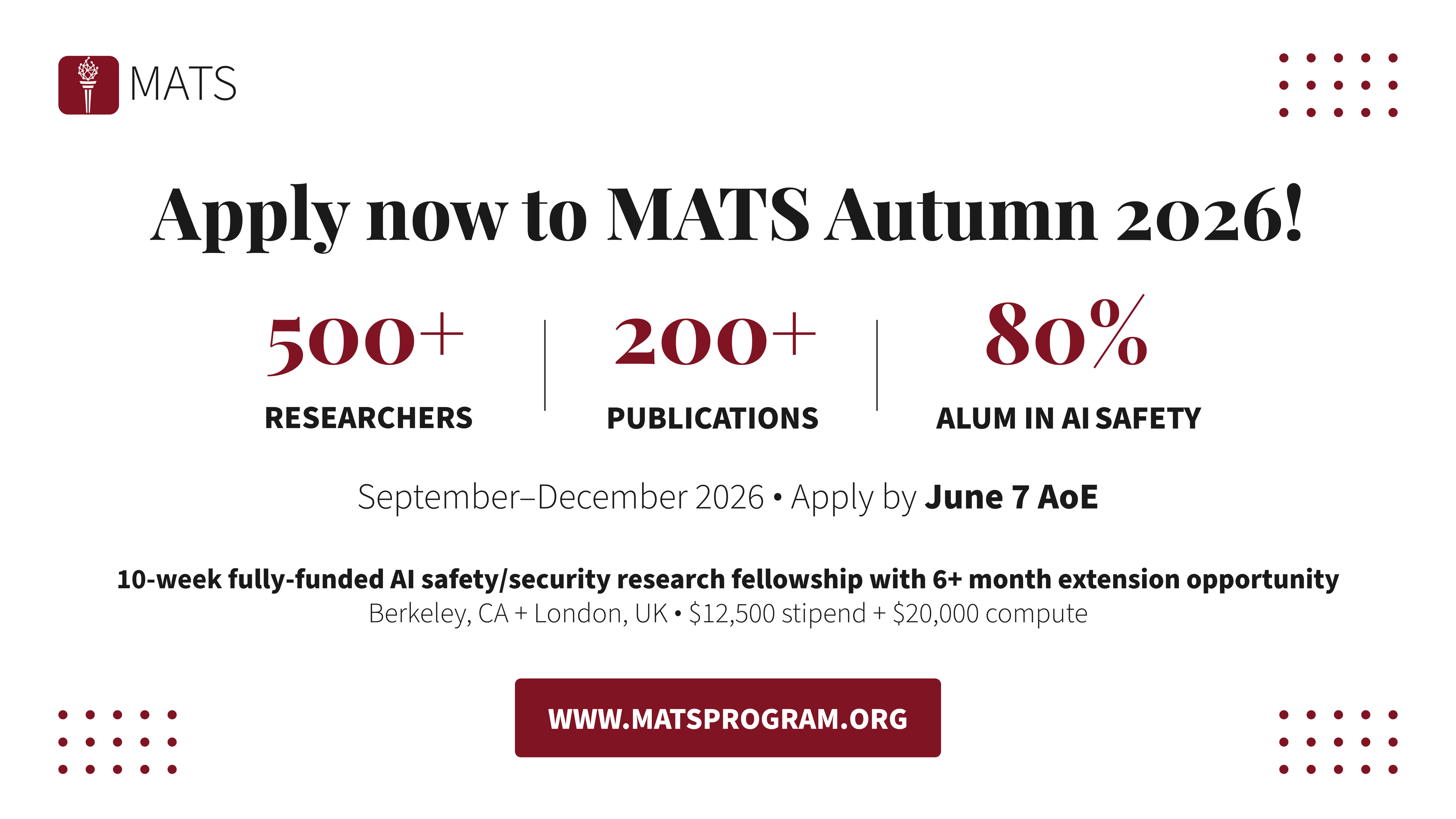
  41. MATS Autumn 2026 Fellowship Applications Now Open—Apply by June 7

    MATS Research is now accepting applications for its Autumn 2026 fellowship, a 10-week program focused on AI alignment, security, and governance. The fellowship, running from September 28 to December 5, 2026, offers a $5,000 monthly stipend, an $8,000 monthly compute budget, and covers housing, meals, and travel. This cohort introduces new tracks in Founding & Field-Building and Biosecurity, expanding the program's capacity to train researchers and founders in AI safety. AI

    MATS Autumn 2026 Fellowship Applications Now Open—Apply by June 7

    IMPACT Accelerates talent development in AI safety and alignment research, potentially leading to new startups and initiatives.

  42. Banned on first day of enterprise subscription; three weeks later have not reached a human at Anthropic

    A user reported that their company's enterprise subscription to an Anthropic product was banned on the first day of use. Despite multiple attempts by IT to contact customer support over three weeks, they have been unable to reach a human representative. This has left many employees unable to access the service they are paying for, prompting the user to seek alternative solutions for resolving the issue. AI

    IMPACT Enterprise customers are experiencing significant issues with accessing and receiving support for AI products, potentially hindering adoption.

  43. I Beat Claude Sonnet With a 6B Model I Built in 15 Days for $300

    A developer has created a 6-billion parameter language model that outperforms Anthropic's Claude Sonnet in specific niche benchmarks. This custom model was developed in just 15 days with a budget of $300. While not a general-purpose model, it demonstrates the potential for highly specialized, cost-effective AI solutions. AI

    I Beat Claude Sonnet With a 6B Model I Built in 15 Days for $300

    IMPACT Demonstrates that specialized, low-cost models can rival larger commercial offerings in niche applications, potentially lowering barriers to custom AI development.

  44. RLHF trained Claude to be verbose. Here's the proof

    Reinforcement Learning from Human Feedback (RLHF) can inadvertently train large language models like Claude to be overly verbose, according to a developer's experiment. The process, which involves training a reward model on human preferences, compresses complex judgments into a single score, potentially losing nuances and reinforcing unintended behaviors. This can lead to models producing lengthy, hedged answers even when instructed to be concise, as the underlying reward signal prioritizes factors beyond directness. AI

    IMPACT Reveals how RLHF can lead to model verbosity, impacting user experience and requiring careful prompt engineering.

  45. Small Area Estimation of Case Growths for Timely COVID-19 Outbreak Detection

    Researchers have developed a novel transfer learning framework called Transfer Learning Random Forest (TLRF) to improve the accuracy and speed of estimating COVID-19 case growth rates. This method converts growth rate estimation into a regression task, enabling effective transfer learning across different locations and time periods. TLRF adaptively selects fitting window sizes based on relevant features, allowing for accurate estimations even in counties with limited data, and has demonstrated significant improvements in timely outbreak detection compared to existing methods. AI

    IMPACT Introduces a new statistical method that could enhance public health surveillance and response capabilities for infectious diseases.

  46. Horospherical Depth and Busemann Median on Hadamard Manifolds

    Researchers have introduced a new concept called horospherical depth, designed for statistical analysis on Hadamard manifolds. This depth measure is intrinsically defined and does not rely on linearization or a specific base point, making it more robust. The study proves the existence and properties of the Busemann median, which is derived from this depth, and demonstrates its stability under perturbations and contamination. AI

    IMPACT Introduces a novel statistical framework that could potentially be applied to AI models operating in complex, non-Euclidean spaces.

  47. Claude subscription changes coverage of `claude -p`

    Anthropic has updated its Claude CLI tool, introducing a new feature that allows users to specify a particular prompt for the AI. This enhancement aims to provide more control and context for users interacting with Claude through the command line. AI

    IMPACT Enhances user control for command-line AI interactions.

  48. Prepare for Sonnet 4.5 ending

    Anthropic is phasing out its Sonnet 4.5 model, prompting user questions about the transition process. Users are seeking information on how chats will migrate to newer models and the continuity of conversations. They are also looking for official announcements regarding the model's end-of-life and the timeline for this change. AI

    IMPACT Users are discussing the deprecation of a specific model, seeking information on migration and continuity.

  49. Wireloom: A Markdown extension for UI wireframes

    Wireloom is a new Markdown extension that allows users to describe UI wireframes using a simple, indented text format. This tool is particularly useful for AI agents, enabling them to generate UI layouts directly from natural language prompts without needing a graphical interface. The generated wireframes are output as SVGs, which can be easily embedded in Markdown documents, version-controlled in Git, and reviewed in code-based workflows. AI

    IMPACT Enables AI agents to generate UI wireframes, streamlining design workflows.