PulseAugur / Brief
LIVE 03:24:44

Brief

last 24h
[21/171] 185 sources

Multi-source AI news clustered, deduplicated, and scored 0–100 across authority, cluster strength, headline signal, and time decay.

  1. TOOL · arXiv cs.CL ·

    Annotations Mitigate Post-Training Mode Collapse

    Researchers have developed a new method called annotation-anchored training to address semantic mode collapse in large language models. This technique involves pretraining models on documents paired with semantic annotations, which helps maintain the diversity of the original pretraining data during fine-tuning. The approach allows models to generate more diverse outputs by using these annotations as anchors, reportedly reducing diversity collapse by six times compared to standard supervised fine-tuning and showing improved performance with increased model scale. AI

    IMPACT Mitigates semantic diversity loss in LLMs, potentially leading to more varied and robust model outputs.

  2. TOOL · 36氪 (36Kr) 中文(ZH) · · [2 sources]

    News: Advanced packaging and testing equipment procurement demand surges, with some equipment delivery times extending to over 1 year

    The AI creation platform Lingzhu has launched its second internal beta, featuring significant upgrades. Users can now access the platform without an invitation code and experience a notable performance boost due to the integration of the DeepSeek V4 large language model. This integration reportedly triples efficiency in the demand analysis phase, reducing processing time from nearly 20 seconds to under 5 seconds, alongside optimizations to the user interface. AI

    IMPACT AI platform Lingzhu's integration of DeepSeek V4 significantly speeds up demand analysis, potentially improving user workflow efficiency.

  3. TOOL · arXiv cs.LG ·

    Learning Graph Foundation Models on Riemannian Graph-of-Graphs

    Researchers have introduced R-GFM, a novel Graph Foundation Model that utilizes a Riemannian Graph-of-Graphs approach to address limitations in existing models. Unlike previous methods that use fixed-hop subgraph sampling, R-GFM models structural scale as a primary element, constructing multi-scale graphs and learning representations from Riemannian manifolds. This new architecture reportedly reduces structural domain generalization error and has achieved state-of-the-art performance, with relative improvements up to 49% on downstream tasks. AI

    IMPACT Introduces a new architecture for graph foundation models that improves performance on diverse graph tasks by adapting to structural scale.

  4. TOOL · arXiv stat.ML ·

    Upper Generalization Bounds for Neural Oscillators

    Researchers have developed theoretical upper generalization bounds for neural oscillators, which are architectures combining second-order ordinary differential equations with multilayer perceptrons. These bounds, derived using the Rademacher complexity framework, quantify the generalization capacities for approximating causal operators and stable dynamical systems. The findings indicate that estimation errors scale polynomially with MLP sizes and time length, suggesting that regularization of MLP Lipschitz constants can enhance generalization, particularly with limited training data. AI

    IMPACT Provides theoretical grounding for neural oscillator architectures, potentially improving their reliability in dynamic system modeling.

  5. TOOL · arXiv cs.CL ·

    TRACER: Verifiable Generative Provenance for Multimodal Tool-Using Agents

    Researchers have developed TRACER, a new framework designed to provide verifiable generative provenance for multimodal tool-using agents. This system generates answers alongside structured records that link each sentence to supporting tool observations and semantic relations. TRACER aims to address the 'provenance gap' by making tool use more verifiable and optimizable, distinguishing between direct evidence, condensation, and inference. A new benchmark, TRACE-Bench, was also created to evaluate sentence-level provenance reconstruction, showing TRACER's effectiveness in improving accuracy and reducing unnecessary tool calls. AI

    IMPACT Improves the verifiability and efficiency of multimodal AI agents by providing sentence-level evidence tracking.

  6. TOOL · arXiv cs.CL ·

    FocuSFT: Bilevel Optimization for Dilution-Aware Long-Context Fine-Tuning

    Researchers have developed FocuSFT, a novel bilevel optimization framework designed to improve how large language models handle long contexts. This method addresses the issue of "attention dilution," where models tend to focus on privileged tokens rather than semantically relevant ones during fine-tuning. By using a parametric memory to concentrate attention on key content, FocuSFT significantly enhances performance on long-context benchmarks like BABILong and RULER, while also showing gains in agentic tool use on GPQA. AI

    IMPACT Enhances LLM ability to process and utilize information across extended contexts, potentially improving performance in complex reasoning and retrieval tasks.

  7. TOOL · Hugging Face Daily Papers ·

    Fashion Florence: Fine-Tuning Florence-2 for Structured Fashion Attribute Extraction

    Researchers have developed Fashion Florence, a vision-language model based on Florence-2, specifically fine-tuned for extracting structured fashion attributes from images. This model can generate a JSON object detailing category, color, material, style, and occasion tags, which is directly usable by recommendation and retrieval systems. In evaluations, Fashion Florence outperformed GPT-4o-mini and Gemini 2.5 Flash in category and style tag accuracy, while also demonstrating high JSON output validity and efficiency with its 0.77B parameters. AI

    IMPACT Enables direct programmatic use of fashion attributes for recommendation and retrieval systems, improving e-commerce operations.

  8. TOOL · Mastodon — fosstodon.org ·

    AI Model Distillation Discover how a 26M model breakthrough can boost efficiency in AI model creation https:// airanked.dev/posts/ai-model-di stillation # AI #

    Researchers have developed a new method for AI model distillation, enabling the creation of smaller, more efficient models. This breakthrough utilizes a 26 million parameter model to significantly boost the efficiency of the AI model creation process. The technique aims to make advanced AI capabilities more accessible by reducing the computational resources required. AI

    AI Model Distillation Discover how a 26M model breakthrough can boost efficiency in AI model creation https:// airanked.dev/posts/ai-model-di stillation # AI #

    IMPACT Enables creation of smaller, more efficient AI models, potentially lowering computational costs and increasing accessibility.

  9. TOOL · Mastodon — fosstodon.org ·

    🧠 A company has released an open source model designed to run LLM guardrails. The model, called GLiNER, is now available for public use. 💬 Hacker News 🔗 https:/

    A company has released GLiNER, an open-source small language model designed to implement guardrails for larger language models. This model is now publicly available for use. GLiNER aims to provide faster and more efficient safety moderation capabilities. AI

    🧠 A company has released an open source model designed to run LLM guardrails. The model, called GLiNER, is now available for public use. 💬 Hacker News 🔗 https:/

    IMPACT Provides a new open-source tool for implementing safety guardrails in LLMs, potentially improving moderation efficiency.

  10. TOOL · dev.to — LLM tag ·

    ExLlamaV3 Updates, Unsloth Qwen GGUFs & Phi3 Autonomous Bridge

    This week's local AI news highlights significant updates to the ExLlamaV3 inference library, enhancing efficiency for running quantized Llama models on consumer GPUs. Additionally, new GGUF-quantized versions of Qwen 3.6 models are now available through Unsloth, making them more accessible for local use. The cluster also features an innovative project that uses a Phi3 model to create an autonomous agent capable of controlling a user's main computer. AI

    IMPACT Enhances local AI inference performance and enables new autonomous agent capabilities on consumer hardware.

  11. TOOL · Medium — Claude tag ·

    Anthropic Built an AI That Hacks Better Than 99% of Humans.

    Anthropic has developed an AI model capable of identifying and exploiting software vulnerabilities at a level surpassing 99% of human hackers. This AI demonstrated a significant leap in exploit capability, reportedly a 90x increase, by successfully tackling a 27-year-old bug in OpenBSD. The development highlights the growing potential of AI in cybersecurity, both for defense and offense. AI

    Anthropic Built an AI That Hacks Better Than 99% of Humans.

    IMPACT This AI's advanced hacking capabilities could significantly shift cybersecurity paradigms, necessitating new defense strategies.

  12. TOOL · arXiv cs.LG ·

    Stable Long-Horizon PDE Forecasting via Latent Structured Spectral Propagators

    Researchers have developed a new neural forecasting framework called Latent Structured Spectral Propagators (SSP) to improve the long-horizon forecasting of time-dependent partial differential equations (PDEs). This method addresses the error accumulation and dynamic drift issues common in existing neural operators when used autoregressively. SSP reformulates PDE rollout by learning a propagator in a latent space, separating physical state mapping, projection into a compact propagation state, and spectral mode evolution, which enhances stability and accuracy in temporal extrapolation. AI

    IMPACT Introduces a novel method for more stable and accurate long-term forecasting of complex physical systems, potentially impacting scientific simulation and prediction.

  13. TOOL · arXiv cs.AI ·

    CFSPMNet: Cross-subject Fourier-guided Spatial-Patch Mamba Network for EEG Motor Imagery Decoding in Stroke Patients

    Researchers have developed CFSPMNet, a novel framework designed to improve the decoding of motor imagery electroencephalography (MI-EEG) signals for stroke patients. This new model addresses the challenge of cross-patient decoding by treating MI-EEG as latent neural-state organization, combining a Fourier-Reorganized State Mamba Network (FRSM) with Shared-Private Prototype Matching (SPPM). Experiments on two stroke MI-EEG datasets demonstrated that CFSPMNet achieved superior accuracies compared to existing CNN, Transformer, and Mamba-based methods, suggesting that latent neural-state modeling can enhance brain-computer interface decoding for rehabilitation. AI

    IMPACT Introduces a novel approach to cross-patient BCI decoding, potentially improving rehabilitation tools for stroke survivors.

  14. TOOL · arXiv cs.LG ·

    TopoU-Net: a U-Net architecture for topological domains

    Researchers have developed TopoU-Net, a novel U-Net architecture designed to handle complex datasets with higher-order structures beyond simple grids or graphs. This architecture leverages combinatorial complexes, using cells and incidences to represent data, allowing for flexible encoder-decoder designs. TopoU-Net demonstrates strong performance across various tasks, including node classification and image reconstruction, particularly excelling on heterophilic graphs and complex hypergraph datasets. AI

    IMPACT Introduces a flexible encoder-decoder template for higher-order structured data, potentially improving performance on complex graph and hypergraph tasks.

  15. TOOL · arXiv cs.AI ·

    Continual Harness: Online Adaptation for Self-Improving Foundation Agents

    Researchers have developed "Continual Harness," a novel framework for embodied AI agents that enables self-improvement without requiring environment resets. This system allows agents to adapt and refine their own strategies, prompts, and tools by drawing on past experiences within a single continuous run. Experiments on playing Pokémon demonstrated that agents using Continual Harness achieved significant progress, nearing the performance of expert-designed systems and showing sustained in-game milestone advancements through a co-learning loop with a frontier teacher model. AI

    IMPACT Enables embodied agents to learn and adapt continuously, potentially accelerating progress in robotics and complex decision-making tasks.

  16. TOOL · Mastodon — fosstodon.org 日本語(JA) ·

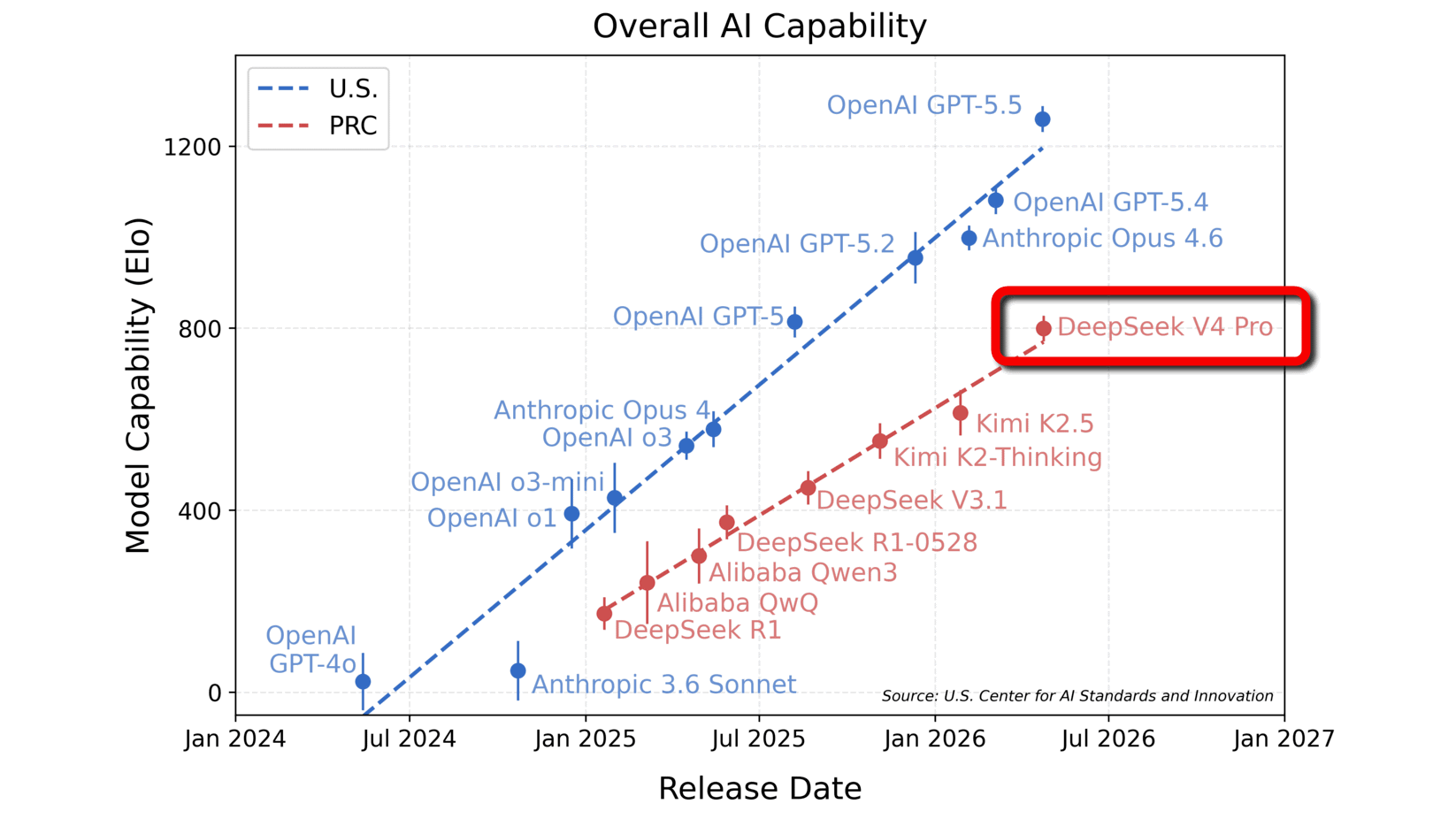
    DeepSeek V4 Pro is about 8 months behind major US AI models, but is currently the highest performing Chinese AI model, according to a report by CAISI, a US government AI risk management agency

    The U.S. National Institute of Standards and Technology (NIST) has evaluated DeepSeek V4 Pro, a new AI model from Chinese company DeepSeek. The evaluation found that DeepSeek V4 Pro performs comparably to OpenAI's GPT-5, which was released approximately eight months prior. Despite this lag, DeepSeek V4 Pro achieved the highest score among Chinese-developed AI models to date, surpassing previous top performers like Kimi K2.5. Notably, the NIST report also highlighted DeepSeek V4 Pro's superior cost-efficiency compared to similar U.S. AI models, offering significant savings on token processing. AI

    DeepSeek V4 Pro is about 8 months behind major US AI models, but is currently the highest performing Chinese AI model, according to a report by CAISI, a US government AI risk management agency

    IMPACT Establishes a new performance benchmark for Chinese AI models and highlights cost-efficiency advantages.

  17. TOOL · Medium — Claude tag · · [23 sources]

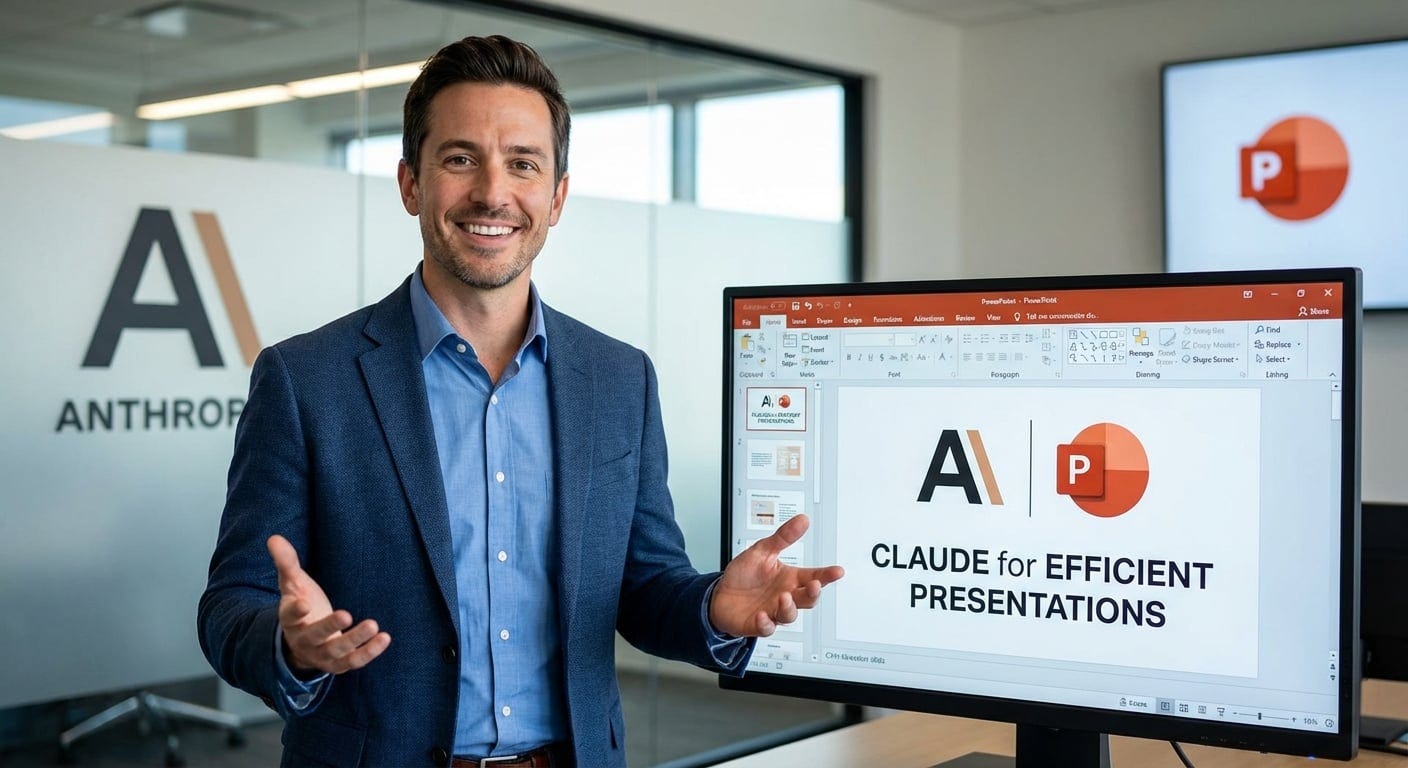
    Claude by Anthropic for PowerPoint: A Guide

    Anthropic has officially launched Claude for Microsoft 365 applications, allowing users to directly utilize Claude within Excel, PowerPoint, and Word. This integration aims to enhance productivity by enabling users to leverage AI assistance for tasks across these common office tools. The move signifies a growing trend of AI assistants becoming embedded within existing productivity suites. AI

    Claude by Anthropic for PowerPoint: A Guide

    IMPACT Enhances productivity by embedding AI assistance directly into common office applications.

  18. TOOL · Mastodon — mastodon.social 日本語(JA) · · [6 sources]

    Claude Supports 9 Creative Software Titles, Collaborates with Adobe and Blender – Sumaho!!

    Anthropic's Claude AI is now compatible with nine creative software applications, including Adobe and Blender, enhancing its utility for content creation. Separately, Google has released a Gemini application for Mac users, enabling them to ask questions about shared screen content. Additionally, Anyma collaborated with Google's Gemini to produce a documentary about their Coachella performance. AI

    Claude Supports 9 Creative Software Titles, Collaborates with Adobe and Blender – Sumaho!!

    IMPACT Expands creative workflows with AI integration and introduces new AI-powered desktop tools for enhanced user interaction.

  19. TOOL · HN — claude cli stories · · [2 sources]

    Use the Claude Agent SDK with Your Claude Plan

    Anthropic is enhancing its Claude Opus model by offering a 1 million token context window by default for its Max, Team, and Enterprise plans. Additionally, starting June 15, 2026, eligible users on Pro, Max, Team, and Enterprise plans will receive a monthly credit for using the Claude Agent SDK. This credit covers usage for the SDK in custom projects, the `claude -p` command, and third-party applications, but does not apply to interactive use or web-based conversations. AI

    IMPACT Anthropic's move expands context window capabilities and incentivizes developer adoption of its Agent SDK.

  20. TOOL · HN — claude cli stories · · [5 sources]

    Show HN: Tilth – I spent tokens so my agents would stop wasting them (~4k Rust)

    A new tool called Tilth has been released, designed to optimize AI agent interactions with code by reducing token usage and improving navigation. It claims significant cost reductions and accuracy improvements across various Anthropic Claude models, including Sonnet, Opus, and Haiku. Concurrently, Anthropic has updated its Claude Pro model access, requiring users to enable extra usage for Opus models and providing methods to select specific model versions like Opus 4.6 or 4.7 within Claude Code. AI

    IMPACT Tilth's token-saving capabilities could lower operational costs for AI agents interacting with code, while Anthropic's model access changes may influence user choices and spending on their Pro tier.