PulseAugur / Brief
LIVE 23:15:27

Brief

last 24h
[50/690] 185 sources

Multi-source AI news clustered, deduplicated, and scored 0–100 across authority, cluster strength, headline signal, and time decay.

  1. RESEARCH · arXiv cs.CV · · [2 sources]

    EgoEV-HandPose: Egocentric 3D Hand Pose Estimation and Gesture Recognition with Stereo Event Cameras

    Researchers have developed two new frameworks for improving 3D hand pose estimation from egocentric camera views. EgoForce utilizes a differentiable forearm representation and a unified transformer to achieve state-of-the-art accuracy across various camera types, reducing MPJPE by up to 28%. EgoEV-HandPose, on the other hand, employs stereo event cameras and a novel KeypointBEV fusion module to jointly estimate bimanual hand poses and recognize gestures, achieving an MPJPE of 30.54mm and 86.87% gesture recognition accuracy. Both methods aim to enhance applications in AR/VR and human-computer interaction by providing more robust and accurate hand tracking. AI

    IMPACT These advancements in egocentric hand tracking could significantly improve the realism and interactivity of AR/VR experiences and human-computer interfaces.

  2. RESEARCH · arXiv stat.ML · · [2 sources]

    Approximation Theory of Laplacian-Based Neural Operators for Reaction-Diffusion System

    Researchers have developed a new theoretical framework for neural operators, a type of AI model used to learn solutions for complex systems like partial differential equations. This work specifically addresses the approximation analysis for nonlinear reaction-diffusion systems, which are crucial for modeling pattern formation. The study establishes explicit error bounds and demonstrates that their proposed Laplacian eigenfunction-based architecture can significantly reduce the parameter complexity required for accurate predictions. AI

    IMPACT Provides a theoretical foundation for using neural operators to model complex physical systems more efficiently.

  3. TOOL · dev.to — Claude Code tag ·

    I Was Calling It 'Setup' for Six Months. arXiv Has a Better Word: Harness

    A recent arXiv paper introduces the term "harness" to formally describe the components that structure and control AI agents, moving beyond informal terms like "setup" or "config." The paper, "Natural-Language Agent Harnesses," by Linyue Pan and colleagues, proposes a standardized natural language format for these harnesses, along with a runtime called IHR (Intelligent Harness Runtime). This formalization aims to make agent engineering more transferable, comparable, and scientifically studied, arguing that natural language specifications remain crucial for agent control even as foundation models improve. AI

    IMPACT Formalizes agent engineering concepts, potentially improving agent development, transferability, and comparability.

  4. RESEARCH · arXiv stat.ML · · [2 sources]

    Random-Set Graph Neural Networks

    Researchers have introduced Random-Set Graph Neural Networks (RS-GNNs) to address uncertainty quantification in graph learning. This new framework models node-level epistemic uncertainty using a belief function formalism. Experiments on nine datasets, including autonomous driving benchmarks, show RS-GNNs offer improved uncertainty estimation capabilities. AI

    IMPACT Improves reliability of graph-based AI systems by quantifying uncertainty in predictions.

  5. RESEARCH · arXiv stat.ML Deutsch(DE) · · [2 sources]

    QDSB: Quantized Diffusion Schrödinger Bridges

    Researchers have introduced Quantized Diffusion Schrödinger Bridges (QDSB), a novel method for learning generative models from unpaired data. QDSB addresses the computational challenges of traditional Schrödinger bridges by quantizing endpoint distributions and using cell-wise sampling to reconstruct the data plan. This approach significantly reduces training time while maintaining sample quality comparable to existing methods. AI

    IMPACT Accelerates generative model training by reducing computational costs and time.

  6. RESEARCH · arXiv stat.ML · · [2 sources]

    LOFT: Low-Rank Orthogonal Fine-Tuning via Task-Aware Support Selection

    Researchers have introduced LOFT, a novel framework for low-rank orthogonal parameter-efficient fine-tuning (PEFT). This method explicitly separates the adaptation subspace from the transformation applied within it, offering a unified approach that encompasses existing orthogonal PEFT techniques. LOFT's key innovation lies in its task-aware support selection strategy, informed by downstream training signals, which improves the efficiency-performance trade-off. AI

    IMPACT Introduces a new method to improve the efficiency and performance of fine-tuning large models, potentially reducing computational costs for adaptation.

  7. RESEARCH · arXiv stat.ML · · [2 sources]

    Variance-aware Reward Modeling with Anchor Guidance

    Researchers have developed a new framework called Anchor-guided Variance-aware Reward Modeling to address limitations in standard reward models when dealing with diverse human preferences. This method enhances existing Gaussian reward models by introducing two response-level anchor labels, resolving a fundamental non-identifiability issue. The framework has demonstrated improved performance in reward modeling and downstream Reinforcement Learning from Human Feedback (RLHF) tasks across simulations and real-world datasets. AI

    IMPACT Enhances reward modeling for RLHF, potentially improving the alignment and performance of AI systems trained on diverse human feedback.

  8. RESEARCH · arXiv stat.ML · · [2 sources]

    Minimax Rates and Spectral Distillation for Tree Ensembles

    Researchers have developed a new spectral perspective to better understand tree ensemble algorithms like random forests and gradient boosting machines. This approach reveals that the decay rate of eigenvalues in the induced kernel operator dictates the statistical convergence for random forest regression. The findings also enable the creation of compressed tree ensembles, yielding significantly smaller models that retain competitive predictive accuracy, outperforming current methods for forest pruning and rule extraction. AI

    IMPACT Advances understanding of widely used tree ensemble models and enables more efficient model compression for resource-constrained environments.

  9. TOOL · arXiv stat.ML ·

    Targeted Synthetic Control Method

    Researchers have developed a new statistical method called Targeted Synthetic Control (TSC) to improve causal effect estimation in panel data. This two-stage approach refines initial weights to reduce bias and ensures the counterfactual estimation is a convex combination of observed outcomes, allowing for direct interpretation. The TSC method is flexible, capable of integrating various machine learning models, and has demonstrated superior accuracy over existing state-of-the-art baselines in both synthetic and real-world experiments. AI

    IMPACT Introduces a novel statistical technique that can be integrated with machine learning models for more accurate causal inference.

  10. RESEARCH · MarkTechPost · · [3 sources]

    Mira Murati’s Thinking Machines Lab Introduces Interaction Models: A Native Multimodal Architecture for Real-Time Human-AI Collaboration

    Thinking Machines Lab, an AI research lab, has introduced a new class of systems called interaction models designed to overcome the limitations of traditional turn-based AI. These models feature a native multimodal architecture that allows for real-time human-AI collaboration, processing audio, video, and text inputs and outputs in continuous 200ms micro-turns. This approach enables the AI to listen, interrupt, and react proactively, moving beyond static chat interfaces to a more dynamic and integrated interaction. AI

    Mira Murati’s Thinking Machines Lab Introduces Interaction Models: A Native Multimodal Architecture for Real-Time Human-AI Collaboration

    IMPACT Moves AI interaction beyond static chat interfaces to real-time, multimodal collaboration.

  11. TOOL · arXiv stat.ML ·

    Local and Mixing-Based Algorithms for Gaussian Graphical Model Selection from Glauber Dynamics

    Researchers have developed new algorithms for Gaussian graphical model selection when data comes from dependent dynamics, rather than independent samples. One approach uses a local edge-testing estimator that can be implemented in parallel and does not require the data chain to fully mix. The second method involves a burn-in and thinning reduction, proving that a subsampled trajectory can approximate independent samples, allowing standard learners to be used. Both methods include finite-sample recovery guarantees and information-theoretic lower bounds on observation time. AI

    IMPACT Introduces novel algorithmic approaches for statistical inference in dependent data settings, potentially improving model selection accuracy in complex systems.

  12. TOOL · arXiv stat.ML ·

    The feasibility of multi-graph alignment: a Bayesian approach

    Researchers have established thresholds for the feasibility of aligning random multi-graphs using a Bayesian framework. Their findings indicate an "all-or-nothing" phenomenon in the Gaussian model, where alignment is either highly probable or statistically impossible above or below a critical threshold, respectively. In the sparse Erdős-Rényi model, a threshold was identified below which meaningful partial alignment is not possible, with a conjecture that partial alignment is achievable above it. AI

    IMPACT Establishes a theoretical framework for understanding alignment in complex data structures, potentially impacting future AI research in areas requiring relational data analysis.

  13. RESEARCH · arXiv cs.CL · · [2 sources]

    Caraman at SemEval-2026 Task 8: Three-Stage Multi-Turn Retrieval with Query Rewriting, Hybrid Search, and Cross-Encoder Reranking

    Researchers have developed a three-stage retrieval system for multi-turn conversations, enhancing accuracy in information retrieval tasks. The system first refines context-dependent queries using a fine-tuned Qwen 2.5 7B model to create standalone questions. It then employs a hybrid search combining BM25 and dense vector retrieval, fused with Reciprocal Rank Fusion, before a cross-encoder model reranks the results for improved precision. This approach achieved a notable nDCG@5 score in a recent SemEval task, outperforming many other systems. AI

    IMPACT Improves multi-turn conversational search accuracy by combining advanced query rewriting, hybrid search, and cross-encoder reranking.

  14. RESEARCH · arXiv stat.ML · · [2 sources]

    Posterior Contraction Rates for Sparse Kolmogorov-Arnold Networks in Anisotropic Besov Spaces

    Researchers have developed a theoretical framework for sparse Bayesian Kolmogorov-Arnold Networks (KANs). Their work establishes statistical foundations for KANs, demonstrating that these networks can achieve near-minimax posterior contraction rates. The analysis shows that KANs can adapt to unknown function smoothness and avoid the curse of dimensionality by controlling approximation complexity through width and parameter sparsity, rather than depth. AI

    IMPACT Provides theoretical grounding for KANs, potentially influencing future neural network architectures and their statistical analysis.

  15. RESEARCH · arXiv stat.ML · · [2 sources]

    Learning U-Statistics with Active Inference

    Researchers have developed a new active inference framework for U-statistics, aiming to improve estimation efficiency when labeling data is expensive. This approach selectively queries informative labels within a fixed budget, building upon augmented inverse probability weighting U-statistics. The framework is also extended to U-statistic-based empirical risk minimization, showing significant gains in efficiency and maintaining target coverage in experiments. AI

    IMPACT This research could lead to more efficient data labeling strategies in machine learning applications where data acquisition is costly.

  16. TOOL · Mastodon — fosstodon.org ·

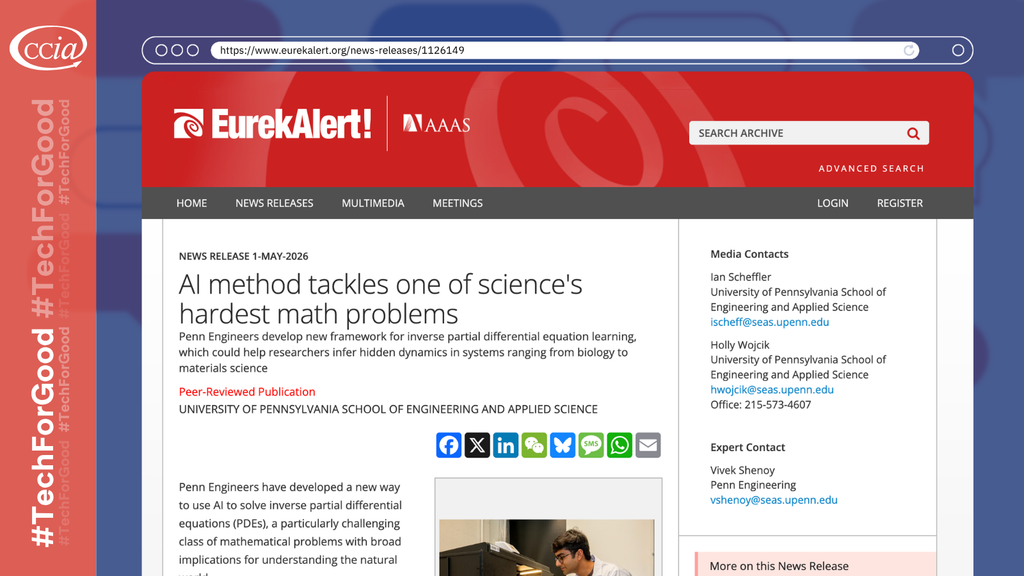
    Breaking through mathematical barriers is key to advancing scientific discovery. Penn Engineers have designed a new # AI framework to solve complex equations, h

    Researchers at the University of Pennsylvania have developed a novel AI framework aimed at tackling complex mathematical equations. This advancement is expected to accelerate scientific discovery by enabling a deeper understanding of intricate systems, such as DNA interactions and weather patterns. AI

    Breaking through mathematical barriers is key to advancing scientific discovery. Penn Engineers have designed a new # AI framework to solve complex equations, h

    IMPACT This AI framework could accelerate scientific breakthroughs by improving the analysis of complex data in fields like biology and meteorology.

  17. RESEARCH · arXiv stat.ML · · [2 sources]

    A Composite Activation Function for Learning Stable Binary Representations

    Researchers have developed a new activation function called Heavy Tailed Activation Function (HTAF) to address the challenges of training neural networks with binary representations. HTAF is a smooth approximation of the Heaviside function, designed to maintain a large gradient mass for stable optimization. This new function enables the stable training of various neural network types, including Spiking Neural Networks and Binary Neural Networks, using gradient-based methods. The researchers also introduced Implicit Concept Bottleneck Models (ICBMs), which utilize HTAF to create interpretable image models with discrete feature representations, achieving performance comparable to or better than existing models. AI

    IMPACT Enables more efficient and interpretable neural network training for specific applications.

  18. RESEARCH · MarkTechPost · · [2 sources]

    Tilde Research Introduces Aurora: A Leverage-Aware Optimizer That Fixes a Hidden Neuron Death Problem in Muon

    Tilde Research has introduced Aurora, a novel optimizer designed to train neural networks more effectively. Aurora addresses a critical issue in the popular Muon optimizer where a significant number of neurons become permanently inactive during training. The new optimizer, demonstrated with a 1.1B parameter pretraining experiment, achieves state-of-the-art performance on the modded-nanoGPT speedrun benchmark and has its code released publicly. AI

    Tilde Research Introduces Aurora: A Leverage-Aware Optimizer That Fixes a Hidden Neuron Death Problem in Muon

    IMPACT Fixes a critical flaw in a widely-used optimizer, potentially improving training efficiency and model performance for large-scale models.

  19. RESEARCH · arXiv stat.ML · · [2 sources]

    Post-ADC Inference: Valid Inference After Active Data Collection

    Researchers have introduced a new framework called post-ADC inference to address the challenges of statistical validity when data collected through active data collection (ADC) is reused for subsequent inferential tasks. This method accounts for biases introduced by both the data collection process and data-dependent target construction. The framework aims to provide valid p-values and confidence intervals, applicable to various ADC processes without strict assumptions on the underlying black-box function or surrogate models. AI

    IMPACT Enables more reliable statistical analysis in machine learning workflows that use active data collection.

  20. RESEARCH · arXiv stat.ML · · [2 sources]

    Adaptive Calibration in Non-Stationary Environments

    Researchers have developed new online prediction algorithms designed to adapt their calibration error based on the degree of non-stationarity in the environment. These algorithms aim to perform optimally across a spectrum from stable, i.i.d. settings to highly adversarial ones. The proposed methods achieve adaptive calibration guarantees, matching optimal rates in stationary cases and recovering known bounds for adversarial regimes. AI

    IMPACT Introduces adaptive algorithms for online predictions, potentially improving AI system performance in dynamic environments.

  21. RESEARCH · arXiv stat.ML · · [2 sources]

    FibQuant: Universal Vector Quantization for Random-Access KV-Cache Compression

    Researchers have developed FibQuant, a novel vector quantization method designed to significantly compress the key-value (KV) cache used in large language models. This technique aims to reduce the memory traffic associated with long-context inference by replacing scalar quantization with a more efficient vector-based approach. Experiments show FibQuant can achieve substantial compression ratios, such as 34x on GPT-2 small KV caches while maintaining high fidelity, and demonstrates improved perplexity compared to existing methods on models like TinyLlama-1.1B. AI

    IMPACT Enables more efficient long-context inference by reducing KV-cache memory requirements, potentially lowering operational costs and increasing model accessibility.

  22. TOOL · dev.to — LLM tag Nederlands(NL) ·

    Benchmark Results: SmolLM3 3B, Phi-4-mini, DeepSeek V4, Grok 4.20 — Agent Coding Tested

    A recent agent coding benchmark revealed that smaller, more efficient models are outperforming larger, frontier models. The SmolLM3 3B model, capable of running on a laptop, achieved a score of 93.3, significantly surpassing models like Grok 4.20 and DeepSeek V4 Pro. This suggests that model size may not be the primary determinant of agentic coding capabilities, challenging previous assumptions about the necessity of massive parameter counts for advanced tasks. AI

    IMPACT Demonstrates that smaller models can achieve high performance in agentic coding tasks, potentially reducing hardware requirements for advanced AI applications.

  23. TOOL · Towards AI ·

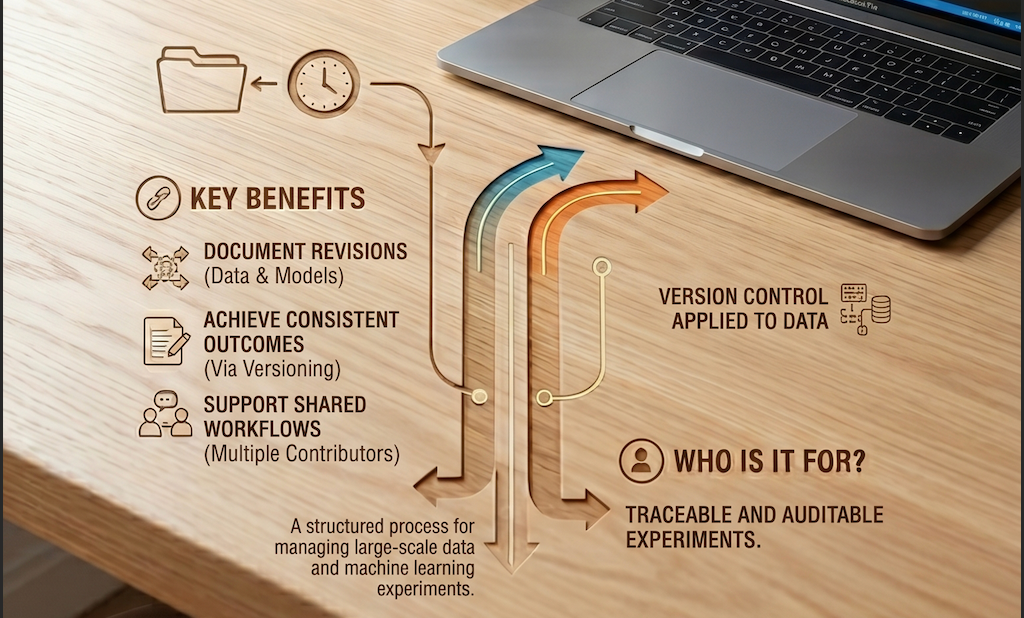
    Dataset Versioning Without the Tools: A Practical Approach for Reproducible Machine Learning

    This article proposes a practical, tool-free method for versioning datasets in machine learning to ensure reproducibility. It argues that maintaining a consistent data contract between pipelines and training processes is key, rather than relying on specialized tools like DVC or MLflow initially. The approach involves disciplined automation and metadata tracking, such as lineage and transformation details, before adopting more complex solutions. AI

    Dataset Versioning Without the Tools: A Practical Approach for Reproducible Machine Learning

    IMPACT Provides a lightweight, reproducible data versioning strategy for ML practitioners, reducing reliance on complex tools.

  24. TOOL · arXiv cs.LG ·

    Search Your Block Floating Point Scales!

    Researchers have developed a new method called ScaleSearch to optimize the selection of scale factors in Block Floating Point (BFP) quantization for generative models. This technique aims to minimize quantization errors by leveraging mantissa bits, thereby improving the performance of existing quantization methods like Post Training Quantization (PTQ) and low-precision attention. Experiments demonstrate significant reductions in quantization error and performance improvements on language models such as Qwen3-8B and Llama 3.1 70B, while maintaining near-baseline accuracy. AI

    IMPACT Improves efficiency and accuracy of generative models by optimizing quantization techniques.

  25. TOOL · arXiv cs.AI ·

    Towards Affordable Energy: A Gymnasium Environment for Electric Utility Demand-Response Programs

    Researchers have developed DR-Gym, an open-source Gymnasium-compatible environment to train reinforcement learning agents for optimizing electric utility demand-response programs. This simulator addresses the challenge of offline data limitations by creating a realistic, market-level environment that captures the interactive feedback between utility pricing and customer adaptation. DR-Gym features a regime-switching wholesale price model, physics-based building demand profiles, and a configurable multi-objective reward function to support diverse learning objectives for grid flexibility and energy affordability. AI

    IMPACT Enables AI-driven optimization of energy demand-response programs, potentially improving grid flexibility and consumer affordability.

  26. TOOL · arXiv cs.CV ·

    Covering Human Action Space for Computer Use: Data Synthesis and Benchmark

    Researchers have introduced CUActSpot, a new benchmark designed to evaluate computer-use agents (CUAs) on complex and infrequent interactions across multiple modalities. The benchmark addresses the long-tail issue in GUI operations where a few complex interactions cause most task failures, hypothesizing this is due to data scarcity. Their proposed data-synthesis pipeline generates scenes, records interactions, and uses an LLM to create instructions and action traces, leading to their Phi-Ground-Any-4B model outperforming larger open-source models. AI

    IMPACT This benchmark aims to improve the reliability of AI agents for complex tasks, potentially increasing user trust and adoption in real-world applications.

  27. TOOL · arXiv cs.CV ·

    AlphaGRPO: Unlocking Self-Reflective Multimodal Generation in UMMs via Decompositional Verifiable Reward

    Researchers have introduced AlphaGRPO, a new framework designed to improve multimodal generation in Unified Multimodal Models (UMMs). This approach uses Group Relative Policy Optimization (GRPO) to enable models to perform advanced reasoning tasks like inferring user intent for text-to-image generation and self-correcting outputs. To provide better supervision, AlphaGRPO incorporates a Decompositional Verifiable Reward (DVReward) system, which breaks down user requests into verifiable questions evaluated by a general multimodal large language model (MLLM). Experiments show AlphaGRPO significantly enhances performance on various multimodal generation and editing benchmarks. AI

    IMPACT Introduces a novel self-reflective reinforcement approach for multimodal models, potentially improving generation fidelity and user intent inference.

  28. TOOL · arXiv cs.CV ·

    OmniNFT: Modality-wise Omni Diffusion Reinforcement for Joint Audio-Video Generation

    Researchers have introduced OmniNFT, a new framework for generating joint audio and video content. This approach utilizes a modality-aware online diffusion reinforcement learning method to overcome challenges in multi-objective advantages, gradient imbalance between modalities, and credit assignment. OmniNFT employs modality-wise advantage routing, layer-wise gradient surgery, and region-wise loss reweighting to improve audio-video quality, alignment, and synchronization. AI

    IMPACT Introduces a novel framework for joint audio-video generation, potentially improving realism and synchronization in multimedia AI.

  29. TOOL · arXiv cs.AI ·

    Enabling AI-Native Mobility in 6G: A Real-World Dataset for Handover, Beam Management, and Timing Advance

    Researchers have released a new real-world dataset designed to improve AI and machine learning models for 6G mobile networks. The dataset captures various mobility scenarios, including pedestrian, vehicular, and train travel, focusing on handover events and timing advance measurements. This data aims to overcome the limitations of simulated datasets, providing a more accurate foundation for developing AI-native mobility procedures and reducing service interruptions. AI

    IMPACT Provides a realistic dataset to train and evaluate AI/ML models for critical 6G mobility functions, potentially reducing service interruptions.

  30. RESEARCH · arXiv stat.ML · · [2 sources]

    Spatial Adapter: Structured Spatial Decomposition and Closed-Form Covariance for Frozen Predictors

    Researchers have developed a "Spatial Adapter," a novel post-hoc layer designed to enhance frozen predictive models. This adapter efficiently learns a structured spatial representation of a model's residual field and its covariance without altering the original model's parameters. The technique utilizes a spatially regularized orthonormal basis and per-sample scores, enabling kriging-style spatial prediction and uncertainty quantification for downstream applications. AI

    IMPACT Introduces a parameter-efficient method to improve spatial prediction and uncertainty quantification in existing models.

  31. TOOL · arXiv cs.CV ·

    SenseNova-U1: Unifying Multimodal Understanding and Generation with NEO-unify Architecture

    Researchers have introduced SenseNova-U1, a novel unified architecture for multimodal AI that integrates understanding and generation into a single process. This approach aims to overcome the limitations of current models that treat these functions separately. The SenseNova-U1 models, including variants like SenseNova-U1-8B-MoT and SenseNova-U1-A3B-MoT, demonstrate strong performance across various tasks such as text understanding, visual perception, reasoning, and image generation. AI

    IMPACT This unified approach to multimodal AI could lead to more capable and efficient models for tasks involving both understanding and generation.

  32. TOOL · arXiv cs.CV ·

    From Web to Pixels: Bringing Agentic Search into Visual Perception

    Researchers have introduced a new benchmark and framework called WebEye to address the challenge of visual perception in open-world scenarios. This benchmark focuses on tasks where identifying an object requires external information, such as recent events or multi-hop relations, before it can be localized within an image. The proposed Pixel-Searcher agentic workflow aims to resolve hidden target identities and bind them to visual instances, demonstrating strong performance on the WebEye benchmark. AI

    IMPACT Introduces a new benchmark and agentic workflow for visual perception, potentially advancing research in open-world object identification and grounding.

  33. TOOL · arXiv cs.CV Italiano(IT) ·

    CausalCine: Real-Time Autoregressive Generation for Multi-Shot Video Narratives

    Researchers have introduced CausalCine, a new framework designed for generating multi-shot video narratives in real-time. Unlike existing autoregressive models that struggle with long sequences and semantic drift, CausalCine handles shot transitions, dynamic prompts, and context reuse. It employs a causal base model trained on multi-shot sequences and a Content-Aware Memory Routing mechanism to maintain coherence across shots, enabling interactive video generation that approaches bidirectional model capabilities. AI

    IMPACT Enables more coherent and interactive real-time generation of complex video narratives, moving beyond simple scene extensions.

  34. TOOL · arXiv cs.CV ·

    Elastic Attention Cores for Scalable Vision Transformers

    Researchers have developed VECA, a novel Vision Transformer architecture that addresses the quadratic computational cost associated with high-resolution images. VECA utilizes an efficient linear-time attention mechanism by employing a small set of learned 'core' embeddings that act as a communication interface for patch tokens. This core-periphery structure allows patch tokens to interact indirectly through the cores, reducing complexity from quadratic to linear and enabling elastic trade-offs between compute and accuracy. AI

    IMPACT Introduces a new attention mechanism that could enable Vision Transformers to scale more efficiently to higher resolutions and complex tasks.

  35. TOOL · arXiv cs.CL ·

    Task-Adaptive Embedding Refinement via Test-time LLM Guidance

    Researchers have developed a method to improve the performance of text embedding models for zero-shot search and classification tasks. Their approach uses a large language model (LLM) to refine query embeddings in real-time based on feedback from a small set of documents. This LLM-guided refinement consistently boosts performance across various benchmarks, showing improvements of up to 25% in tasks like literature search and intent detection. The technique makes embedding models more adaptable and practical for scenarios where full LLM pipelines are not feasible. AI

    IMPACT Enhances the utility of embedding models for tasks requiring real-time adaptation, potentially reducing reliance on more complex LLM pipelines.

  36. TOOL · arXiv cs.CL ·

    MEME: Multi-entity & Evolving Memory Evaluation

    Researchers have introduced MEME, a new benchmark designed to evaluate the memory capabilities of LLM-based agents in persistent environments. MEME addresses limitations in prior work by defining six tasks that cover multi-entity interactions and evolving memory states, including novel challenges like dependency reasoning and deletion. Initial evaluations across six memory systems revealed significant performance collapses on dependency reasoning tasks, with even advanced LLMs and prompt optimization failing to bridge the gap. While one system using Claude Opus 4.7 showed partial success, its high cost indicates practical scalability challenges for current memory solutions. AI

    IMPACT Highlights critical gaps in LLM agent memory, suggesting current systems struggle with complex reasoning and evolving states, impacting their real-world applicability.

  37. TOOL · arXiv cs.AI ·

    KV-Fold: One-Step KV-Cache Recurrence for Long-Context Inference

    Researchers have developed KV-Fold, a novel method for extending the context window of large language models without requiring retraining. This technique treats the key-value cache as an accumulator in a functional programming-style fold, allowing the model to process sequential chunks of data while maintaining a stable internal state. KV-Fold has demonstrated 100% exact-match retrieval on needle-in-a-haystack benchmarks across various context lengths and model sizes, operating within the memory constraints of a single GPU. AI

    IMPACT Enables LLMs to process significantly longer contexts without costly retraining, potentially improving performance on tasks requiring extensive background information.

  38. TOOL · arXiv cs.LG ·

    High-arity Sample Compression

    Researchers have introduced a new framework for high-arity learning theory, focusing on sample compression schemes. Their work demonstrates that the existence of a high-arity sample compression scheme with non-trivial quality directly implies high-arity PAC learnability. This theoretical advancement contributes to understanding learning concepts in product spaces. AI

    IMPACT Advances theoretical understanding of machine learning in product spaces, potentially influencing future algorithm development.

  39. TOOL · arXiv cs.AI ·

    The Algorithmic Caricature: Auditing LLM-Generated Political Discourse Across Crisis Events

    Researchers have developed a new method to detect AI-generated political discourse by comparing its characteristics to real human online behavior. Their study analyzed over 1.7 million posts across nine crisis events, finding that synthetic text, while fluent, is less realistic than observed discourse. The AI-generated content tends to be more negative, structurally regular, and abstract, lacking the emotional variation and colloquialisms found in human posts. This 'Caricature Gap' suggests that current LLMs struggle with population-level realism, offering a new auditing framework beyond traditional text detection. AI

    IMPACT Introduces a novel 'Caricature Gap' metric for auditing LLM-generated discourse, potentially improving detection of synthetic political content.

  40. TOOL · arXiv cs.CV ·

    FuTCR: Future-Targeted Contrast and Repulsion for Continual Panoptic Segmentation

    Researchers have introduced FuTCR, a novel framework designed to improve continual panoptic segmentation. This method addresses the challenge of adapting to new object categories over time by restructuring representations before new classes are introduced. FuTCR identifies potential future object regions within unlabeled pixels and uses contrastive learning to build coherent prototypes from these regions while simultaneously repelling background features. Experiments demonstrate that FuTCR significantly enhances the performance on new classes in continual panoptic segmentation tasks. AI

    IMPACT Improves adaptation to new object categories in dense prediction tasks, potentially enhancing real-world applications of segmentation models.

  41. TOOL · arXiv cs.CV ·

    GaitProtector: Impersonation-Driven Gait De-Identification via Training-Free Diffusion Latent Optimization

    Researchers have developed GaitProtector, a novel framework for de-identifying gait patterns by simultaneously obscuring the original identity and impersonating a target identity. This method utilizes a training-free diffusion latent optimization pipeline, leveraging a pretrained 3D video diffusion model to generate protected gaits. Experiments demonstrate significant reductions in gait recognition accuracy while preserving visual and temporal quality, and maintaining utility for downstream diagnostic tasks. AI

    IMPACT Introduces a new privacy-preserving technique for gait analysis that could impact biometric security and medical diagnostics.

  42. TOOL · arXiv cs.CV ·

    AOI-SSL: Self-Supervised Framework for Efficient Segmentation of Wire-bonded Semiconductors In Optical Inspection

    Researchers have developed AOI-SSL, a novel self-supervised framework designed to improve the efficiency of semantic segmentation for wire-bonded semiconductors in automated optical inspection. This framework utilizes Masked Autoencoders for pre-training on small industrial datasets, significantly reducing the need for extensive labeled examples. The system also incorporates in-context inference methods that allow for near-instant adaptation to new devices or challenging samples by leveraging similarity-based retrieval from dense encoder embeddings. AI

    IMPACT This framework could streamline quality control in semiconductor manufacturing by reducing the need for extensive re-training of inspection models.

  43. TOOL · arXiv cs.CL ·

    TextSeal: A Localized LLM Watermark for Provenance & Distillation Protection

    Researchers have developed TextSeal, a novel watermarking technique for large language models designed to protect against unauthorized use and distillation. This method utilizes dual-key generation and entropy-weighted scoring for robust detection, even in mixed human-AI content. TextSeal maintains output diversity and does not introduce inference overhead, outperforming existing baselines while preserving downstream task performance and human-perceived quality. AI

    IMPACT Introduces a new method to track and protect LLM outputs, potentially impacting model provenance and preventing unauthorized derivative works.

  44. TOOL · arXiv cs.LG ·

    Environment-Adaptive Preference Optimization for Wildfire Prediction

    Researchers have developed a new framework called Environment-Adaptive Preference Optimization (EAPO) to improve the prediction of rare, high-impact events like wildfires. EAPO addresses the challenge of models failing under changing environmental conditions and the difficulty of learning from infrequent events. The method constructs aligned datasets and uses a hybrid fine-tuning approach combining supervised learning with preference optimization to refine prediction boundaries and enhance detection of extreme events. AI

    IMPACT Enhances the reliability of AI models for predicting rare, high-impact environmental events, crucial for disaster preparedness.

  45. TOOL · arXiv cs.LG ·

    Learning Minimally Rigid Graphs with High Realization Counts

    Researchers have developed a reinforcement-learning method to construct minimally rigid graphs with a high number of realizations. This approach uses Henneberg moves and optimizes realization-count invariants with a policy network. The method has successfully matched known optima for planar realization counts and improved bounds for spherical realization counts, identifying new record graphs. AI

    IMPACT Introduces a novel AI-driven method for solving extremal problems in graph theory, potentially advancing computational geometry and related fields.

  46. TOOL · arXiv cs.CL ·

    Geometric Factual Recall in Transformers

    Researchers have proposed a new theory of how transformer language models memorize factual information, suggesting a 'geometric' form of memorization rather than traditional associative memory. This model posits that learned embeddings encode relational structure, with the MLP acting as a relation-conditioned selector. Experiments with a single-layer transformer demonstrated that logarithmic embedding dimensions suffice for memorizing random bijections, and the MLP learned a generic selection mechanism transferable to new facts. AI

    IMPACT Proposes a new understanding of how LLMs store information, potentially leading to more efficient model architectures.

  47. RESEARCH · arXiv stat.ML · · [2 sources]

    Causal Algorithmic Recourse: Foundations and Methods

    Researchers have developed a new causal framework for algorithmic recourse, addressing the limitations of existing methods that treat recourse outcomes as static counterfactuals. This novel approach models recourse as a dynamic process, accounting for repeated decisions and potential changes in latent conditions for an individual. The framework introduces post-recourse stability conditions, enabling recourse inference from observational data alone, and proposes copula-based and distribution-free algorithms for practical application. AI

    IMPACT Enhances AI system trustworthiness by providing more robust methods for individuals to understand and potentially reverse adverse decisions.

  48. TOOL · arXiv cs.LG ·

    Trajectory-Agnostic Asteroid Detection in TESS with Deep Learning

    Researchers have developed a new deep learning method called a W-Net, utilizing two stacked 3D U-Nets, to detect asteroids in TESS image data. This approach is robust to variations in asteroid speed and direction, unlike traditional shift-and-stack algorithms, and includes a novel Adaptive Normalization technique for data scaling. The team has also released the code for generating TESS training data with asteroid masks to aid the scientific community, with potential applications for future missions like the Nancy Grace Roman Space Telescope. AI

    IMPACT Enhances astronomical survey capabilities by improving asteroid detection efficiency and robustness.

  49. RESEARCH · arXiv stat.ML · · [2 sources]

    Causal Bias Detection in Generative Artifical Intelligence

    Researchers have developed a new framework for detecting causal bias in generative AI systems. This methodology extends causal inference principles to address the unique complexities of generative models, which differ from standard machine learning by implicitly constructing their own causal mechanisms. The approach allows for a granular quantification of fairness impacts across various causal pathways and the model's replacement of real-world mechanisms. The paper demonstrates its utility by analyzing race and gender bias in large language models using diverse datasets. AI

    IMPACT Provides a new theoretical framework and practical tools for identifying and quantifying bias in generative AI, crucial for fair and ethical deployment.

  50. RESEARCH · arXiv stat.ML · · [2 sources]

    Causal Fairness for Survival Analysis

    Researchers have developed a new causal framework to analyze fairness in time-to-event (TTE) analysis, a type of statistical modeling often used in healthcare and other high-stakes domains. This framework allows for the decomposition of survival disparities into direct, indirect, and spurious pathways, offering a more understandable explanation for why and how these disparities emerge over time. The non-parametric approach involves formalizing assumptions with graphical models, recovering survival functions, and applying causal reduction theorems for efficient estimation. The method was applied to study racial disparities in intensive care unit (ICU) outcomes. AI

    IMPACT Provides a novel method for understanding and mitigating bias in temporal AI models, crucial for equitable decision-making in sensitive applications.