PulseAugur / Brief
LIVE 08:31:33

Brief

last 24h
[50/1383] 185 sources

Multi-source AI news clustered, deduplicated, and scored 0–100 across authority, cluster strength, headline signal, and time decay.

  1. A Citizen-Track Minimum Substrate for the Aktuanz Layer: Reading Olivia Zhu’s minimal-embodiment

    This article delves into Olivia Zhu's concept of a "minimal embodiment" within the Aktuanz layer, exploring its implications for citizen-tracking technologies. It examines how this minimal substrate could function as a foundational element for tracking systems, potentially influencing how data is collected and processed. AI
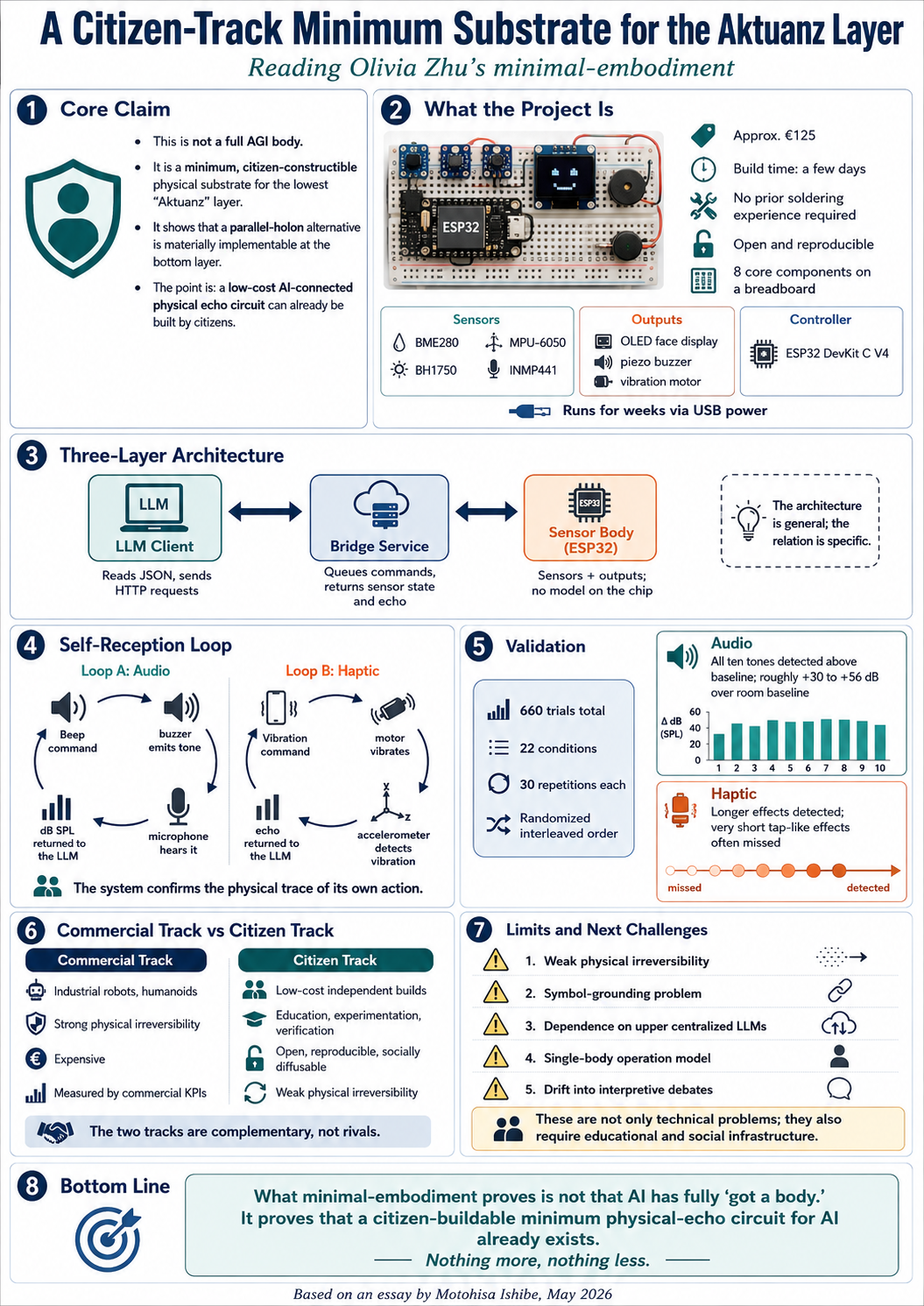
    A Citizen-Track Minimum Substrate for the Aktuanz Layer: Reading Olivia Zhu’s minimal-embodiment

    IMPACT Explores theoretical underpinnings of potential tracking technologies.

  2. Senior Video Operations

    80,000 Hours, a nonprofit focused on impactful careers, is hiring a Senior Video Operations role to manage their AI in Context YouTube channel. This position requires significant operational ownership, including production logistics, hiring pipelines, content distribution, and community management. The role is based in the San Francisco Bay Area or London, with remote options available, and offers a competitive salary. AI

    IMPACT This role supports the creation and distribution of content explaining AI, potentially increasing public understanding and engagement with AI topics.

  3. A Horn extension of DL-Lite with NL data complexity

    Researchers have introduced ELbotpreceq, a new description logic that extends DL-Lite and supports reasoning in NL. This logic is designed to be rewritable into graph query languages, addressing the limitations of existing DL-Lite systems which are restricted to first-order queries. ELbotpreceq incorporates a stratification mechanism to manage conjunction and recursion, enabling it to express many ELI and DL-Lite ontologies while maintaining NL upper bounds. AI

    IMPACT Extends expressive power for ontology-mediated query answering, potentially enabling more complex graph data querying.

  4. Bayesian Surrogate Training on Multiple Data Sources: A Hybrid Modeling Strategy

    Researchers have developed new strategies for training surrogate models by integrating data from multiple sources, including simulations and real-world measurements. One approach involves training separate models for each data type and then combining their predictions, while another trains a single model incorporating both data types. These hybrid methods aim to improve predictive accuracy and coverage, and to identify potential issues within existing simulation models, ultimately aiding in system understanding and future development. AI

    IMPACT Enhances AI model training by enabling more accurate predictions and better diagnostics through multi-source data integration.

  5. Bosch, Researchers Develop AI for Humanoid Dexterity

    Researchers from Bosch and Carnegie Mellon University have created an AI system called Humanoid Transformer with Touch Dreaming (HTD) to enhance the dexterity of humanoid robots. This system uses reinforcement learning and VR data to enable robots to predict touch and force outcomes, improving their spatial awareness and planning for complex manipulation tasks. In tests, HTD significantly boosted success rates by over 90% across various real-world tasks, with potential applications in household chores, retail, and manufacturing. AI

    Bosch, Researchers Develop AI for Humanoid Dexterity

    IMPACT Enhances humanoid robot capabilities in manipulation and task execution, potentially broadening their use in domestic and industrial settings.

  6. Neural Surrogate Forward Modelling For Electrocardiology Without Explicit Intracellular Conductivity Tensor

    Researchers have developed a deep learning model that can predict electrocardiogram (ECG) signals from intracellular electrical potentials without needing explicit intracellular conductivity tensors. This novel approach, trained on a limited dataset of 74 subjects, achieved a high R2 score of 0.949, demonstrating its potential to improve non-invasive assessments of conditions like atrial fibrillation by reducing structural uncertainty. AI

    IMPACT This novel deep learning approach could improve diagnostic accuracy for cardiac conditions by simplifying the modeling process.

  7. Meta employees are protesting the company's mouse tracking program

    Meta employees are protesting the company's new mouse and keystroke tracking software, which is intended to train AI agents. Workers have distributed flyers and started a petition, citing labor laws and expressing concerns about surveillance and potential job displacement. The company maintains the data is necessary for AI development and will be controlled, but employees remain uncomfortable with the program, especially given recent layoffs. AI

    Meta employees are protesting the company's mouse tracking program

    IMPACT Employee discontent over AI training data collection could impact Meta's ability to develop AI agents.

  8. Adaptive mine planning under geological uncertainty: A POMDP framework for sequential decision-making

    Researchers have developed a new framework for mine planning that adapts to geological uncertainty by treating it as an active component of value creation. This approach uses a Partially Observable Markov Decision Process (POMDP) to make sequential decisions, integrating future observations and belief updates into the planning process. The proposed SA-POMDP architecture, combining simulated annealing with ensemble-based belief updating, significantly reduces the gap between expected and realized net present value (NPV) compared to traditional static planning methods. AI

    IMPACT This adaptive planning framework could improve resource extraction efficiency and value creation in industries facing significant geological uncertainty.

  9. Is Anthropic Really a Frontier Lab?

    The author questions Anthropic's status as a frontier AI lab, suggesting their recent blog post implies a lack of capability in responsible AI development. This perspective challenges the company's positioning in the rapidly evolving AI landscape. AI

    Is Anthropic Really a Frontier Lab?

    IMPACT This commentary raises questions about Anthropic's AI development capabilities, potentially influencing industry perception and investment.

  10. Vanke's most valuable assets surface

    Vanke's most valuable asset is its stake in Global Logistics Properties (GLP), which is reportedly planning an IPO in Hong Kong aiming for a valuation of around $20 billion. This potential IPO could provide Vanke with a crucial exit opportunity to alleviate its current financial pressures and potentially boost its own valuation. GLP's equity value for Vanke, estimated between $4.28 billion and $6.42 billion, surpasses Vanke's traditional core assets like land reserves and properties, offering a more liquid and potentially higher-yielding investment. AI

    Vanke's most valuable assets surface

    IMPACT This IPO could provide Vanke with liquidity to manage its debt, potentially impacting its ability to invest in future technologies or ventures.

  11. A.I. and Humans Battle It Out in a # Cybersecurity Showdown Experts and college students used A.I. agents to try to break into and defend computer networks in a

    In a national competition, experts and college students pitted AI agents against human defenders and attackers in cybersecurity challenges. The AI agents demonstrated a notable capability in both offensive and defensive network operations, performing competently even when operating autonomously. AI

    IMPACT Demonstrates AI's growing proficiency in cybersecurity, potentially shifting the landscape of network defense and offense.

  12. I built an MCP server to log every AI conversation, here's what I learned

    A developer created "chron," an open-source tool that logs AI conversations locally using Anthropic's Model Context Protocol (MCP). The tool automatically sets up and records every message and timestamp in a tamper-evident SQLite database, employing a hash-chaining method similar to blockchain technology. The developer found that automating the installation and integration process was more challenging than building the core logging functionality itself, and plans to add a web UI for easier data access. AI

    I built an MCP server to log every AI conversation, here's what I learned

    IMPACT Enables users to maintain private, verifiable logs of their AI interactions, enhancing transparency and control over conversational data.

  13. Exclusive: Dr. Oz announces health coalition to streamline prior authorizations

    Mehmet Oz, the administrator of the Centers for Medicare and Medicaid Services, announced a new coalition of 29 healthcare organizations aimed at simplifying the prior authorization process. This initiative includes insurers, hospitals, and health records companies working together to streamline the review of medical procedures. The move follows voluntary pledges by major health insurers last summer to improve pre-approval processes and Oz's call to replace outdated methods with electronic prior authorization. AI

    Exclusive: Dr. Oz announces health coalition to streamline prior authorizations

    IMPACT Streamlining prior authorization with AI could reduce administrative burdens for providers and potentially speed up patient care.

  14. Ego2World: Compiling Egocentric Cooking Videos into Executable Worlds for Belief-State Planning

    Researchers have introduced Ego2World, a new benchmark designed to evaluate embodied agents' planning capabilities in realistic household environments. This benchmark compiles egocentric cooking videos into executable symbolic worlds, allowing agents to plan and act based on partial observations and feedback. Experiments using Ego2World demonstrate that traditional action-overlap scores can overestimate an agent's true success, and that robust belief memory significantly improves task completion while reducing unnecessary exploration. AI

    IMPACT Introduces a new benchmark for evaluating embodied agents' planning and belief-state capabilities in realistic scenarios.

  15. Diversity of Extensions in Abstract Argumentation

    Researchers have introduced a new quantitative measure for the diversity of extensions in abstract argumentation frameworks. This measure, based on the symmetric difference between sets of arguments, aims to quantify how fundamentally different or similar various accepted viewpoints are within a given framework. The study also includes a complexity classification for related reasoning tasks and outlines a prototype system for computing these diversity levels. AI

    IMPACT Introduces a novel way to analyze and compare different viewpoints within AI argumentation systems.

  16. FIND: Toward Multimodal Financial Reasoning and Question Answering for Indic Languages

    Researchers have introduced FinVQA, a new benchmark designed to evaluate financial reasoning and question answering capabilities across multiple Indic languages. This benchmark includes 18,900 samples in English, Hindi, Bengali, Marathi, Gujarati, and Tamil, covering 14 financial domains and various question formats. To address the challenges presented by FinVQA, the team also developed FIND, a framework that utilizes supervised fine-tuning and constraint-aware decoding to improve numerical reasoning and multimodal grounding. AI

    IMPACT Establishes a new evaluation standard for multimodal financial reasoning in underrepresented languages, potentially driving AI development in this niche.

  17. What Limits Vision-and-Language Navigation ?

    Researchers have introduced StereoNav, a new framework designed to improve the reliability of vision-and-language navigation (VLN) agents in real-world environments. The system addresses performance degradation caused by perceptual instability and vague instructions by incorporating target-location priors for stable guidance and using stereo vision to enhance depth awareness. Experiments show StereoNav achieves state-of-the-art results on benchmark datasets and demonstrates improved navigation reliability in complex, unstructured settings, outperforming larger, data-intensive models. AI

    IMPACT Enhances real-world deployment of embodied AI agents by improving navigation reliability and reducing reliance on massive datasets.

  18. When to Trust Confidence Thresholding: Calibration Diagnostics for Pseudo-Labelled Regression

    Researchers have developed a new diagnostic tool to assess the reliability of confidence thresholding in pseudo-labeling pipelines for regression tasks. This method provides a way to predict the bias introduced by thresholding calibrated classifier scores, using the residual score variance on unlabelled data. The proposed $(V^{*}, \kappa)$ decision rule aims to help practitioners determine when confidence thresholding is a safe practice. AI

    IMPACT Provides a new operational tool for practitioners to improve the reliability of pseudo-labelled regression models.

  19. DeepClaude vs Claude Code vs Codex Pro: 2026 Cost Stack

    A new method called DeepClaude allows users to run Anthropic's Claude Code harness on DeepSeek's V4 Pro model, offering a significantly cheaper alternative to using Anthropic's API directly. This approach, which involves a simple proxy and environment variable changes, is gaining traction as developers prioritize cost-effectiveness for AI agent loops. While Anthropic's Opus 4.7 model is noted for its reasoning capabilities, its high cost is leading users to explore more economical options like DeepSeek, potentially shifting the focus from model quality to the underlying infrastructure and harness. AI

    DeepClaude vs Claude Code vs Codex Pro: 2026 Cost Stack

    IMPACT Developers are prioritizing cost-effective infrastructure over specific models, potentially shifting value to the harness rather than the LLM.

  20. X-Restormer++: 1st Place Solution for the UG2+ CVPR 2026 All-Weather Restoration Challenge

    Researchers have developed X-Restormer++, a novel framework that secured first place in the UG2+ CVPR 2026 All-Weather Restoration Challenge. The method builds on the X-Restormer baseline, enhancing it with a spatially-adaptive input scaling mechanism and a new Gradient-Guided Edge-Aware loss function. Significant improvements were achieved by expanding the training dataset with an additional 24,500 image pairs, leading to superior performance in image restoration under various weather conditions. AI

    IMPACT Sets a new benchmark for all-weather image restoration, potentially improving applications in autonomous driving and surveillance.

  21. From Generalist to Specialist Representation

    Researchers have published a paper detailing a new method for extracting task-specific representations from generalist AI models. The work establishes theoretical guarantees for identifying and disentangling relevant latent information without requiring interventions or specific model structures. This approach aims to provide a provable foundation for moving from broad, generalist models to more specialized and efficient ones for downstream applications. AI

    IMPACT Establishes theoretical guarantees for creating more specialized AI models from generalist ones, potentially improving efficiency and performance in specific applications.

  22. TikTok World, upfront week, and an Amazon merger reshape the ad week: A single Wednesday carried TikTok's product cluster, three TV upfronts, and Amazon folding

    TikTok recently held its "TikTok World" event, showcasing new product features and advertising strategies. This event coincided with the TV upfronts and Amazon's integration of Rufus into Alexa, all highlighting the growing influence of AI in the advertising and tech industries. The convergence of these major events on a single Wednesday underscored significant shifts in how companies are leveraging AI for product development and marketing. AI

    IMPACT Highlights the increasing integration and impact of AI across major tech product launches and advertising strategies.

  23. Interview with Jimmy Wales about his new book: "The Seven Rules of Trust", Wikipedia, and the consequences of AI: https://www.nrc.nl/nieuws/2026/05/13

    Jimmy Wales, the founder of Wikipedia, recently discussed the growing crisis of trust and its potential impact on society. In an interview, he expressed concerns that if this trend continues, it could lead to a new dark age. Wales also touched upon the implications of artificial intelligence and its role in shaping public perception and trust. AI

    IMPACT Jimmy Wales warns that a deepening crisis of trust, potentially exacerbated by AI, could lead society into a new dark age.

  24. Show HN: Is This Agent Safe? Free security checker that platforms cannot revoke. Is This Agent Safe? is a free security checking tool that provides an immediate security report when you enter a GitHub URL, package name, etc. la

    Is This Agent Safe? is a free security checking tool that provides immediate security reports for AI agent-related packages. Users can input GitHub URLs or package names to quickly assess the security status of components like Langchain and MCP Server. The tool offers efficient repeated checks with results cached for an hour, and it requires no separate account for use. AI

    IMPACT Reduces risk of service interruptions for AI agent platforms due to security issues.

  25. Okay, we've marveled at # AI, now let's listen to a Google engineer who will tell us about optimistic and pessimistic scenarios in the sphere

    An engineer from Google discussed both optimistic and pessimistic scenarios for software engineering in the next two years. While the outlook is not entirely dire, it is far from ideal, highlighting the importance of understanding various perspectives. AI

    IMPACT Discusses potential impacts of AI on software development, offering insights into future industry trends.

  26. Skill-Aligned Annotation for Reliable Evaluation in Text-to-Image Generation

    Researchers have introduced a new method for evaluating text-to-image generation models, moving away from uniform annotation strategies. The proposed skill-aligned annotation approach tailors evaluation techniques to the specific characteristics of different assessment skills, leading to more consistent results and higher inter-annotator agreement. An automated pipeline has been developed to implement this protocol, enabling scalable and detailed evaluations with spatially grounded feedback, aiming to improve the reliability and efficiency of model assessment. AI

    IMPACT Improves the reliability and efficiency of evaluating text-to-image models, potentially accelerating development.

  27. One week countdown, AIGC Summit guests are updated again! Let's take a look at the third wave of guests

    The upcoming China AIGC Industry Summit, scheduled for May 20th, will feature over 20 industry leaders discussing AI's practical applications and monetization strategies. Key figures from companies like SenseTime, MiniMax, and JD.com are confirmed to attend. The summit will also unveil the "2026 Annual AIGC Enterprise & Product List" and release the "2026 China AI Application Panorama Report." AI

    IMPACT Provides insights into the practical application and commercialization of AI in China, featuring key industry players and upcoming reports.

  28. STAR: Semantic-Temporal Adaptive Representation Learning for Few-Shot Action Recognition

    Researchers have developed a new framework called STAR (Semantic-Temporal Adaptive Representation Learning) to improve few-shot action recognition in videos. This approach addresses issues of semantic-temporal misalignment and inadequate modeling of temporal dynamics by integrating a Temporal Semantic Attention mechanism for fine-grained consistency and a Semantic Temporal Prototype Refiner that leverages Mamba blocks. The framework also utilizes temporally dependent class descriptors from large language models to provide long-range semantic guidance, demonstrating significant gains on multiple benchmarks. AI

    IMPACT Enhances video understanding capabilities, potentially improving applications in surveillance, robotics, and content analysis.

  29. Does Engram Do Memory Retrieval in Autoregressive Image Generation?

    Researchers investigated the effectiveness of the Engram module, a memory retrieval system, in autoregressive image generation models. Adapting the module for vision tasks, they found that Engram-augmented models performed worse than the baseline in image quality metrics like FID. Further experiments indicated that the module functions more as an architectural pathway than a content-addressable memory, with its benefit stemming from the pathway itself rather than learned data retrieval. AI

    IMPACT Investigates a novel memory retrieval mechanism for image generation, finding it does not improve sample quality and functions differently than hypothesized.

  30. @ chris I work at a NFP in the health space. A CTO of a major healthcare network recently spoke to us about using AI at intake to predict which patients are mos

    An AI system is being used in healthcare to predict which patients are most likely to experience a critical decline within 24 hours. This predictive capability allows for proactive alerts and interventions, which have reportedly reduced mortality rates by 26%. While AI hallucinations are a concern in healthcare, this application demonstrates AI's potential to improve patient care outcomes when used as a supplementary tool to human expertise. AI

    IMPACT Demonstrates AI's potential to improve patient outcomes and reduce mortality in healthcare settings through predictive analytics.

  31. eu-regulation-mcp: Track EU laws, rulings & national gazettes via MCP

    An open-source project called EU Regulation Intelligence MCP Server has been released to track European Union legislation. This MIT-licensed tool monitors various EU sources like EUR-Lex, the EU Parliament, and the European Commission, as well as national gazettes. It is designed for legal teams, compliance officers, and policy analysts who need to stay updated on regulatory changes and lawmaking within the EU. AI

    IMPACT Provides a tool for tracking AI and other regulatory changes in the EU.

  32. The Vertical AI Playbook Is Here, And Legal Is Just The Latest Move

    Anthropic is expanding its strategy of creating specialized AI models tailored for specific industries. Following releases for financial services, the company has now launched Claude for Legal. This move indicates a broader playbook of developing vertical AI solutions to address niche market needs. AI

    The Vertical AI Playbook Is Here, And Legal Is Just The Latest Move

    IMPACT Anthropic's specialized AI models for industries like legal and finance aim to improve efficiency and tailor AI capabilities to specific professional workflows.

  33. Elon Musk just can't stop (potentially) violating the Clean Air Act

    Elon Musk's xAI is reportedly operating 46 natural gas turbines at its Mississippi data center without permits, potentially violating the Clean Air Act. The state of Mississippi considers the turbines "mobile" because they are on trailers, allowing them to operate for up to a year without permits, despite concerns about air quality and public health. The NAACP has filed a lawsuit, arguing that these turbines should be classified as stationary and subject to regulations, and is seeking an injunction against xAI's operations. AI

    Elon Musk just can't stop (potentially) violating the Clean Air Act

    IMPACT xAI's data center operations are under scrutiny for environmental compliance, potentially impacting future AI infrastructure development and regulatory approaches.

  34. Beyond Explained Variance: A Cautionary Tale of PCA

    Researchers have identified limitations in Principal Component Analysis (PCA) when applied to visualizing high-dimensional data that resides on a nonlinear manifold. Using a dataset of fossil teeth, they demonstrated that PCA's scatterplot can misleadingly suggest clustering, whereas more advanced techniques like t-SNE and persistent homology reveal a ring-like structure with a lower intrinsic dimensionality. The study proposes a generative model that supports these findings, explaining the observed data distribution and highlighting PCA's potential to obscure underlying data structures. AI

    IMPACT Highlights potential pitfalls in data visualization techniques used in AI model analysis.

  35. Show HN: Robot MCP Server – Connect Any Language Model and ROS Robots Using MCP

    A new open-source project, Robot MCP Server, enables large language models like Claude, GPT, and Gemini to communicate with robots. This server allows LLMs to control robots and receive real-time data without modifying the robot's existing code. It supports various ROS versions and integrates with multiple LLM clients, including ChatGPT and Cursor. AI

    IMPACT Enables LLMs to control and interact with physical robots, potentially expanding applications in robotics and automation.

  36. Unifying Physically-Informed Weather Priors in A Single Model for Image Restoration Across Multiple Adverse Weather Conditions

    Researchers have developed a novel network architecture that unifies image restoration across various adverse weather conditions. This approach incorporates a unified imaging model that accounts for both individual particle effects and aggregate scattering, unlike previous methods that overlooked these physical processes. The model enhances features by estimating occlusion and transmission, demonstrating superior performance over existing techniques in multiple adverse scenarios. AI

    IMPACT Introduces a novel approach to image restoration by unifying multiple adverse weather conditions within a single model, potentially improving performance in real-world applications.

  37. EvObj: Learning Evolving Object-centric Representations for 3D Instance Segmentation without Scene Supervision

    Researchers have developed EvObj, a novel approach for unsupervised 3D instance segmentation that overcomes the domain gap between synthetic and real-world data. The method employs an object discerning module to adapt object priors and an object completion module to reconstruct partial geometries. EvObj demonstrates state-of-the-art performance on both synthetic and real-world datasets, outperforming existing segmentation baselines. AI

    IMPACT Introduces a method to improve 3D instance segmentation by bridging the synthetic-to-real domain gap, potentially enhancing applications in robotics and autonomous systems.

  38. Pareto-Guided Optimal Transport for Multi-Reward Alignment

    Researchers have developed a new framework called Pareto Frontier-Guided Optimal Transport (PG-OT) to improve text-to-image generation models. This method addresses the challenge of aligning models across multiple, potentially conflicting, reward signals and mitigates "reward hacking," where model performance metrics improve while perceived quality declines. PG-OT constructs a prompt-specific Pareto frontier and uses optimal transport to guide dominated samples toward it, outperforming existing methods and achieving a high win rate in human evaluations. AI

    IMPACT Introduces a novel framework to enhance multi-reward alignment in generative models, potentially leading to more robust and higher-quality outputs.

  39. Robust Sequential Experimental Design for A/B Testing

    Researchers have developed a new framework for robust sequential experimental design in A/B testing, specifically addressing challenges posed by model misspecification. This approach aims to improve sample efficiency by bounding the worst-case mean squared error of estimated treatment effects. The framework's effectiveness has been demonstrated through both synthetic data and real-world datasets from a major technology company. AI

    IMPACT Introduces a more reliable method for evaluating product changes, potentially improving decision-making in tech companies.

  40. The State Of Agentic Customer Experience In 2026

    A new study by Parloa's research team reveals that large enterprises are failing to provide adequate customer support, with nearly half of their websites lacking clear contact information. The research, which involved mystery shopping 10,000 enterprise websites using AI agents, found that most chatbots are ineffective, with only 8.9% of customer interactions successfully resolving issues. Additionally, traditional voice systems remain outdated, often forcing customers through multiple menu layers and long wait times before reaching a human agent. AI

    The State Of Agentic Customer Experience In 2026

    IMPACT Reveals widespread failure of AI-driven customer support in large enterprises, indicating a need for significant improvement in CX technology adoption.

  41. Multi-Modal Guided Multi-Source Domain Adaptation for Object Detection

    Researchers have developed a new method called MS-DePro to improve object detection across different visual domains. This approach utilizes depth maps and text prompts to create more robust, domain-agnostic features. By separating the processing of multiple source domains and incorporating multi-modal guidance, MS-DePro achieves state-of-the-art results on benchmarks for multi-source domain adaptation. AI

    IMPACT Introduces a novel technique to enhance object detection accuracy across varied visual datasets.

  42. Early Semantic Grounding in Image Editing Models for Zero-Shot Referring Image Segmentation

    Researchers have developed a novel training-free framework that repurposes existing image editing models for zero-shot referring image segmentation. This method identifies that these editing models inherently perform language-conditioned visual semantic grounding, with strong foreground-background separability emerging early in their internal representations. By exploiting these intermediate representations, the framework uses attention-based spatial priors and feature-based semantic discrimination to generate accurate segmentation masks with a single denoising step, bypassing full image synthesis. AI

    IMPACT Enables precise object localization in images using existing image editing tools, potentially improving downstream AI applications.

  43. A proximal gradient algorithm for composite log-concave sampling

    Researchers have developed a new proximal gradient algorithm designed to sample from composite log-concave distributions. This algorithm assumes access to gradient evaluations for one part of the distribution and a restricted Gaussian oracle for the other. The proposed method achieves state-of-the-art iteration counts for sampling, matching previous results for simpler cases and extending to non-log-concave distributions and non-smooth functions. AI

    IMPACT Introduces a novel sampling technique that could improve efficiency in statistical modeling and machine learning applications.

  44. Libguides on environmental impacts of AI: https://guides.ou.edu/libai/environmental-impact https://libguides.ucmerced.edu/artificial-intelligence/environmen

    A collection of library guides focusing on the environmental consequences of artificial intelligence has been compiled. These resources offer information on topics such as energy consumption and the broader ecological footprint associated with AI technologies. The guides are intended for researchers and students interested in understanding AI's impact on the environment. AI

    IMPACT Provides curated resources for understanding the environmental consequences of AI technologies.

  45. Flow Augmentation and Knowledge Distillation for Lightweight Face Presentation Attack Detection

    Researchers have developed a new method for lightweight face presentation attack detection (FacePAD) that enhances motion cues during training without requiring explicit optical flow estimation at inference. A dual-branch teacher model fuses appearance and motion data, which is then distilled into an RGB-only student model. This approach allows the student to learn motion-sensitive representations efficiently, achieving high accuracy on several benchmarks while significantly reducing computational requirements for real-time deployment on resource-constrained devices. AI

    IMPACT Introduces a more efficient approach to face anti-spoofing, enabling real-time deployment on edge devices.

  46. SLM vs LLM: How to Pick the Right Model for Your Enterprise Workload

    In 2026, Small Language Models (SLMs) are emerging as a viable alternative to Large Language Models (LLMs) for enterprise workloads. SLMs are suitable for narrow, well-defined tasks, data privacy concerns, edge device deployment, and low-latency requirements. LLMs remain better for open-ended queries, complex reasoning, and creative synthesis. A common enterprise strategy involves routing high-volume, simple tasks to SLMs and complex queries to LLMs. AI

    IMPACT SLMs offer enterprises a more cost-effective and efficient option for specific tasks, potentially reducing reliance on larger, more expensive LLMs.

  47. Softbank reveals how much OpenAI is worth

    SoftBank's investment in OpenAI is reportedly boosting its quarterly profits, with analysts estimating its stake to be worth around $80 billion. However, concerns are rising about SoftBank's increasing debt to fund its AI strategy and the concentration of risk in a single company. Despite these worries, SoftBank's stock has seen significant gains, indicating investor confidence for the time being. AI

    Softbank reveals how much OpenAI is worth

    IMPACT Confirms the substantial financial impact of major AI investments and highlights the associated risks for large tech investors.

  48. HyperFrames is an open-source (Apache 2.0) HTML-based video rendering framework released by HeyGen, which closely integrates with AI agents (Claude Code, Cursor, Codex, Gemini CLI, etc.). Compositions are written in pure HTML+data attributes.

    HeyGen has released HyperFrames, an open-source HTML-based video rendering framework. It integrates with various AI agents, including Claude Code, Cursor, Codex, and Gemini CLI. HyperFrames allows compositions to be written in pure HTML with data attributes, eliminating the need for builds and supporting deterministic rendering with runtime adapters like GSAP. AI

    IMPACT Enables developers to integrate AI agents into HTML-based video rendering workflows.

  49. Model-based Bootstrap of Controlled Markov Chains

    Researchers have developed a new model-based bootstrap method for controlled Markov chains, particularly useful in offline reinforcement learning scenarios where the data-generating policy is unknown. This technique establishes distributional consistency for transition estimators and extends to policy evaluation and recovery, providing asymptotically valid confidence intervals for value and Q-functions. Experimental results on the RiverSwim problem demonstrate that the proposed confidence intervals offer improved calibration and coverage compared to existing methods, especially with limited data. AI

    IMPACT Improves confidence interval calibration for offline reinforcement learning, aiding in more reliable policy evaluation and recovery.

  50. Multi-Variable Conformal Prediction: Optimizing Prediction Sets without Data Splitting

    Two new research papers introduce advanced conformal prediction techniques to improve the accuracy and efficiency of prediction sets. The first paper, "Multi-Variable Conformal Prediction (MCP)," extends conformal prediction to handle vector-valued score functions, allowing for more flexible prediction set shapes without sacrificing coverage guarantees and eliminating the need for data splitting. The second paper, "Shape-Adaptive Conditional Calibration for Conformal Prediction via Minimax Optimization," presents the Minimax Optimization Predictive Inference (MOPI) framework, which optimizes over a flexible class of set-valued mappings to achieve superior shape adaptivity and more efficient prediction sets, even for complex conditional distributions. AI

    IMPACT These new methods could lead to more reliable and efficient predictive models in machine learning by improving the calibration of prediction sets.