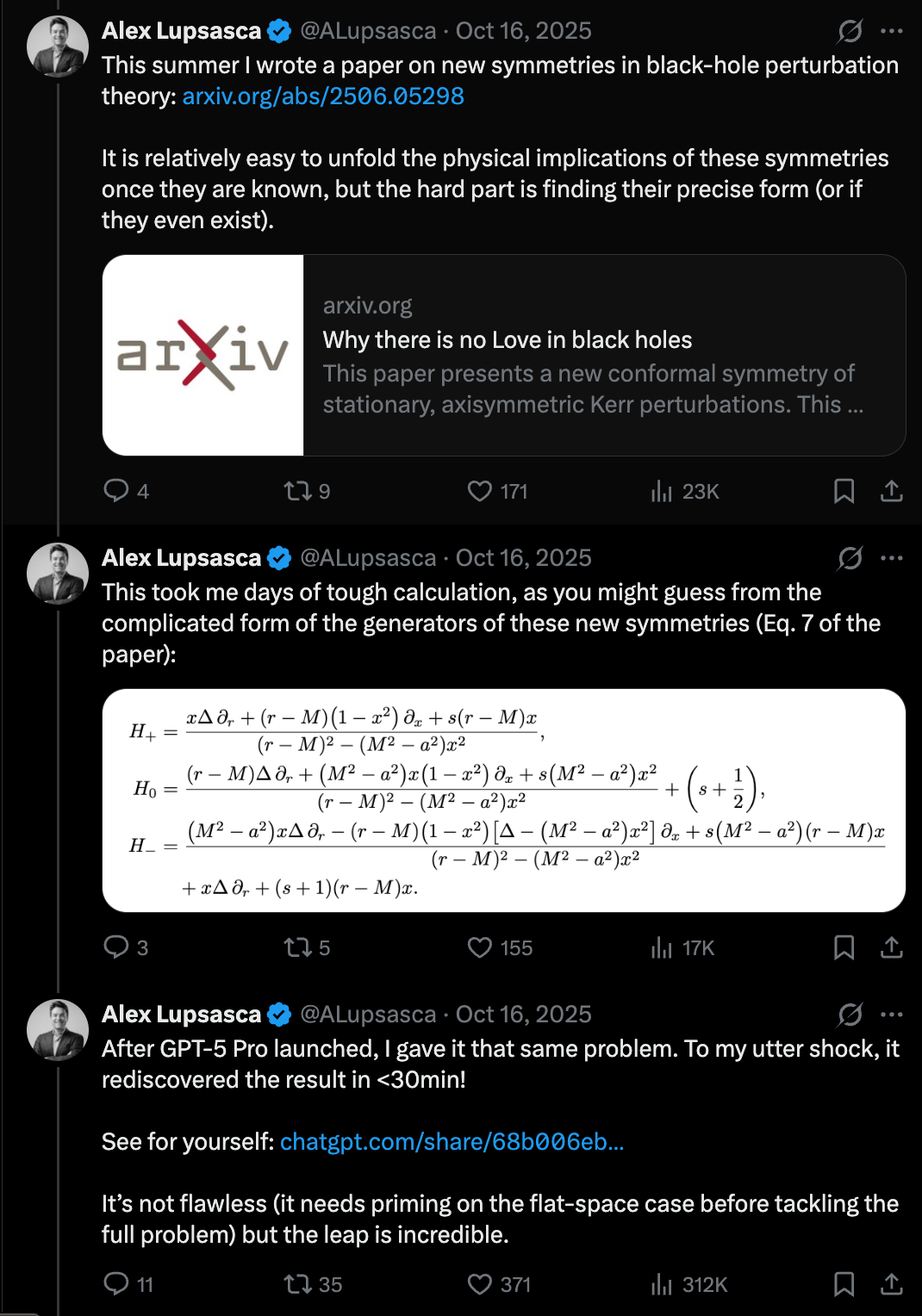
Theoretical physicist Alex Lupsasca has found that recent AI models, specifically GPT-5.5, are significantly advancing the frontier of scientific research, particularly in physics. While initial public reception to GPT-5.5 was lukewarm due to its perceived lack of improvement in everyday tasks like email writing, Lupsasca observed that its capabilities in complex problem-solving have dramatically expanded. He demonstrated this by having GPT-5.5 reproduce a year's worth of his research in mere minutes, a feat that highlights AI's potential to accelerate scientific discovery. AI
Summary written by gemini-2.5-flash-lite from 1 source. How we write summaries →
IMPACT Accelerates scientific discovery by enabling rapid reproduction of complex research and solving intractable problems.
RANK_REASON This cluster discusses a new frontier model release (GPT-5.5) and its impact on scientific research, as detailed by a physicist using it. [lever_c_demoted from frontier_release: ic=1 ai=1.0]