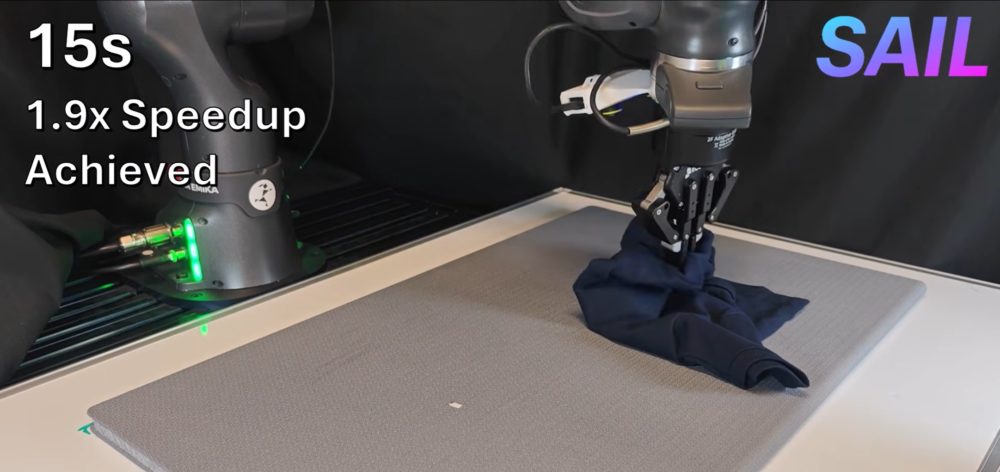
Researchers at Georgia Tech have developed a new system called SAIL (Speed Adaptation for Imitation Learning) that enables robots to perform tasks significantly faster than human instructors. Traditional imitation learning methods limited robots to the speed of the person demonstrating the task, but SAIL overcomes this by smoothing motion, compensating for hardware latency, and dynamically adapting speed based on task requirements. In tests, robots using SAIL completed tasks up to 3.2 times faster than humans in real-world scenarios and up to 4 times faster in simulations, without sacrificing precision. AI
Summary written by gemini-2.5-flash-lite from 1 source. How we write summaries →
IMPACT Robots trained with SAIL could significantly increase automation efficiency, potentially impacting job markets and enabling new applications in various industries.
RANK_REASON The cluster describes a new robotics system developed by a research institution that improves upon existing machine learning methods. [lever_c_demoted from research: ic=1 ai=0.7]