PulseAugur / Brief
LIVE 23:15:24

Brief

last 24h
[30/30] 185 sources

Multi-source AI news clustered, deduplicated, and scored 0–100 across authority, cluster strength, headline signal, and time decay.

  1. COMMENTARY · dev.to — MCP tag ·

    Should you build or buy an MCP runtime for enterprise AI agents in 2026?

    The article discusses the architectural decision enterprises face regarding AI agent runtimes in 2026, specifically whether to build or buy the necessary infrastructure. It highlights that the engineering bottleneck has shifted from agent development to securely integrating these agents into enterprise systems for widespread use. The decision hinges on whether to develop a custom runtime layer handling aspects like authorization, credential vaulting, and auditing, or to purchase an off-the-shelf solution. AI

    IMPACT Guides enterprise AI strategy by outlining build vs. buy trade-offs for agent runtime infrastructure, impacting deployment costs and security.

  2. COMMENTARY · Mastodon — fosstodon.org ·

    Where Are All The Data Centers? "Building A Data Center Is Difficult, And Nobody Has Built A 1GW Data Center Yet" # AI # KI # datacenters # hype # scam # bubble

    The construction of massive 1-gigawatt data centers, essential for AI development, is proving far more challenging than anticipated. Experts note that no such facility has been successfully built to date, highlighting significant hurdles in scaling infrastructure to meet the growing demand for AI computation. This difficulty suggests a potential bottleneck in the rapid expansion of AI capabilities. AI

    Where Are All The Data Centers? "Building A Data Center Is Difficult, And Nobody Has Built A 1GW Data Center Yet" # AI # KI # datacenters # hype # scam # bubble

    IMPACT The scarcity of sufficiently large data centers could significantly slow the pace of AI development and deployment.

  3. COMMENTARY · Hacker News — AI stories ≥50 points ·

    The US is winning the AI race where it matters most: commercialization

    The United States is leading the global AI race primarily through its dominance in commercialization, cloud infrastructure, and data platforms, rather than solely on model development or engineer count. American companies like OpenAI and Anthropic are rapidly integrating AI into products and services, leveraging existing platforms such as AWS, Azure, and Google Cloud. While energy costs and supply chain autonomy are factors, the US's advantage lies in its comprehensive ecosystem, from chips to enterprise software, enabling faster application and adoption across the economy. AI

    IMPACT Confirms that commercialization and infrastructure, not just model performance, are key differentiators in the global AI race.

  4. COMMENTARY · Medium — MLOps tag ·

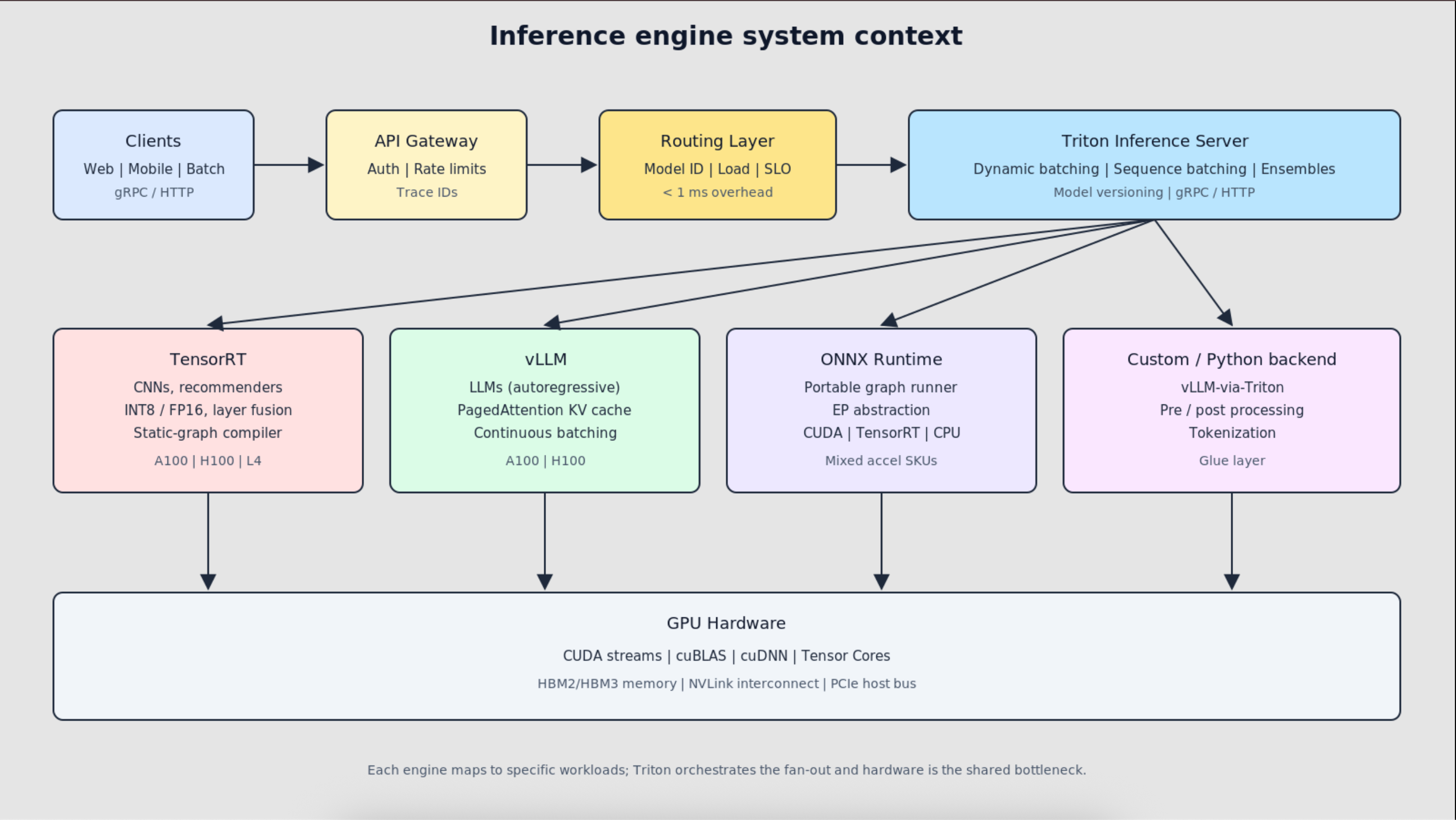
    The GPU Inference Stack: TensorRT, vLLM, Triton, and ONNX Runtime Compared

    This article compares four key GPU inference frameworks: NVIDIA's TensorRT, vLLM, Triton, and ONNX Runtime. It delves into their architectures, performance characteristics, and suitability for different large language model (LLM) deployment scenarios. The author, a Principal Engineering Manager at Microsoft, aims to guide practitioners in selecting the optimal stack for their specific inference needs. AI

    The GPU Inference Stack: TensorRT, vLLM, Triton, and ONNX Runtime Compared

    IMPACT Provides guidance on optimizing LLM deployment, impacting AI operators focused on inference performance.

  5. COMMENTARY · Mastodon — fosstodon.org ·

    This demands a lot of questions: how sovereign will it be? What are the real impacts to the environment such as water and power? On paper it sounds like a good

    British Columbia is developing a new data center cluster, sparking discussions about AI sovereignty and environmental impacts. Concerns have been raised regarding the real-world effects on water and power resources, alongside questions about the level of control and independence the region will maintain over its AI infrastructure. AI

    IMPACT Raises questions about the environmental and sovereignty implications of expanding AI infrastructure.

  6. COMMENTARY · Forbes — Innovation ·

    The Physicalization Of Intelligence: Why The Greater Bay Area Matters Now

    The Greater Bay Area (GBA) is emerging as a critical hub for the "physicalization of intelligence," representing a significant shift from purely digital AI to AI integrated into manufacturing, logistics, and healthcare. This region's dense ecosystem of research, component suppliers, and manufacturing capacity allows for rapid co-evolution of hardware and software. The GBA's model, characterized by proximity and specialized supplier networks, offers a competitive benchmark, even for vertically integrated companies like Tesla, which rely on its manufacturing capabilities. However, the region faces constraints, particularly concerning U.S. export controls on advanced semiconductors. AI

    The Physicalization Of Intelligence: Why The Greater Bay Area Matters Now

    IMPACT Highlights the growing importance of geographic concentration and manufacturing infrastructure for the next wave of AI development.

  7. COMMENTARY · Medium — MLOps tag ·

    From Token Guesswork to Cost Clarity: A Practical AI FinOps Playbook with Virtual Credentials

    This article provides a practical guide to AI FinOps, focusing on how teams can achieve cost clarity beyond monthly summaries. It details a method for moving from shared API keys to minute-level cost tracking, enabling a more granular understanding of AI expenses. AI

    IMPACT Provides actionable strategies for managing and understanding AI operational costs.

  8. COMMENTARY · Forbes — Innovation ·

    From Pre-Computed To Generative: The New Economics Of AI Personalization

    The economics of AI-driven personalization are shifting as e-commerce moves from pre-computed recommendations to real-time generative models. While generative AI offers true one-to-one personalization, the cost of inference, particularly output tokens, can significantly outweigh conversion gains. To mitigate these rising costs, companies are exploring semantic caching, which stores and reuses generative responses for similar user queries, thereby reducing reliance on expensive real-time model inference. AI

    From Pre-Computed To Generative: The New Economics Of AI Personalization

    IMPACT Generative AI personalization introduces significant inference costs, necessitating solutions like semantic caching to maintain profitability in e-commerce.

  9. COMMENTARY · Medium — MLOps tag ·

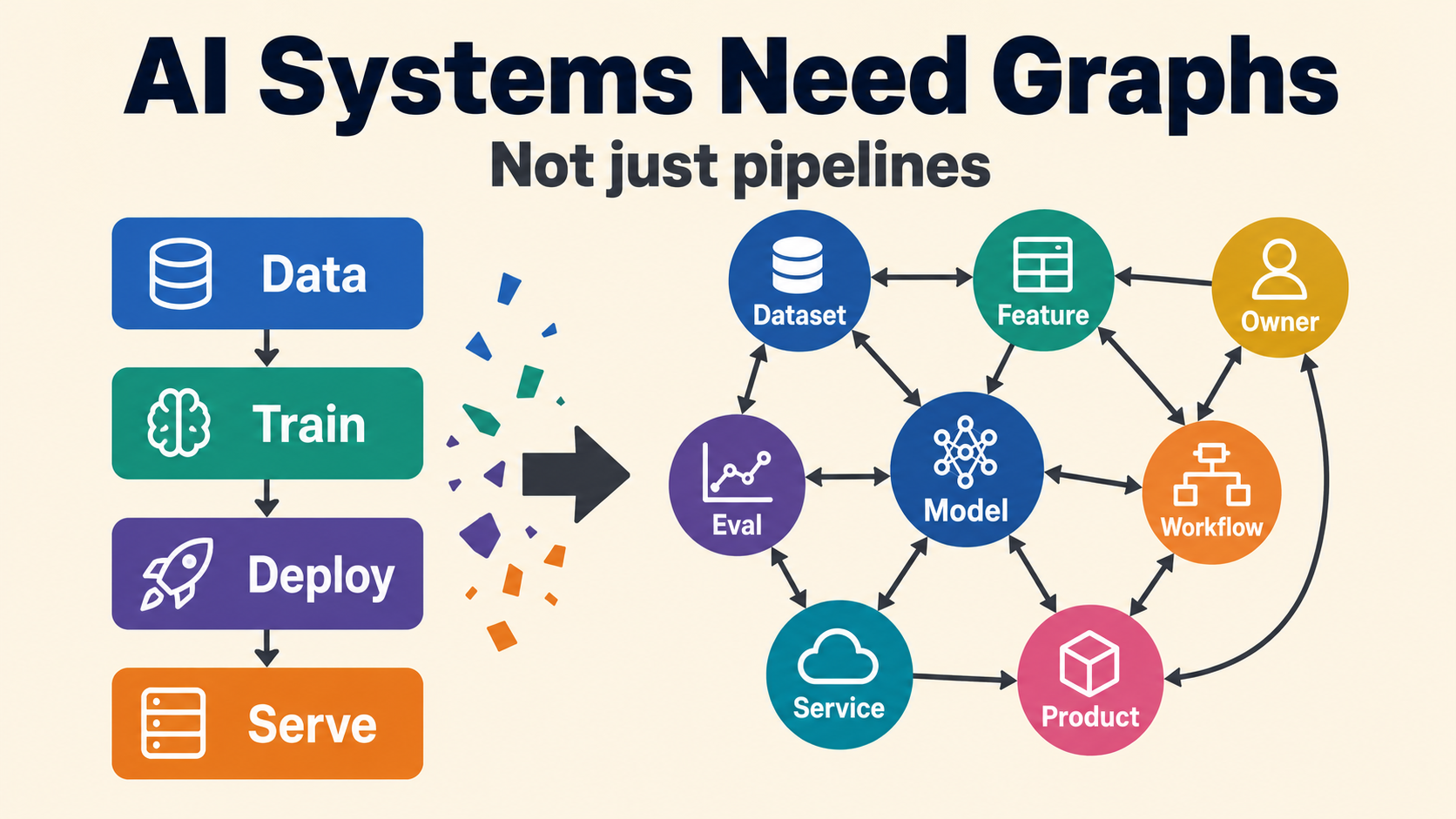
    Stop Drawing Pipelines. Netflix Just Showed Why AI Systems Need Graphs

    Netflix's approach to MLOps emphasizes the use of graph-based systems over traditional pipelines. This method acknowledges that AI systems are complex, interconnected webs of dependencies rather than linear processes. By adopting a graph structure, Netflix aims to better manage the dynamic and evolving nature of AI model lifecycles. AI

    Stop Drawing Pipelines. Netflix Just Showed Why AI Systems Need Graphs

    IMPACT Highlights the shift towards graph-based systems in MLOps for managing complex AI dependencies.

  10. COMMENTARY · dev.to — LLM tag ·

    I have talked to dozens of AI teams about production. The same things keep breaking.

    Many AI teams struggle with a "visibility gap" in production, where standard monitoring tools fail to detect subtle drops in model quality or unexpected cost increases. These issues often surface only after user complaints or financial reviews, weeks after a change was implemented. The author argues that current tooling is insufficient, as it focuses on system health rather than performance improvement and user experience. Implementing robust evaluation, simulation, and alerting systems can proactively identify these problems, enabling teams to validate changes and prevent negative impacts before they reach users. AI

    IMPACT Highlights critical operational gaps in AI production, suggesting a need for better monitoring and evaluation tools to ensure consistent quality and cost control.

  11. COMMENTARY · The Verge — AI · · [3 sources]

    Data centers are coming for rural America

    Data center developers are increasingly targeting rural areas across the United States, promising job creation and economic revitalization. However, these projects often fail to deliver on their employment promises, with early reports suggesting that the number of permanent jobs created is minimal compared to the scale of the facilities. Rural communities, often lacking the expertise to evaluate these proposals, are finding themselves with power- and water-intensive industrial sites that offer few long-term economic benefits. AI

    Data centers are coming for rural America

    IMPACT Data centers are essential infrastructure for AI, and their proliferation in rural areas raises questions about resource allocation and local economic impact.

  12. COMMENTARY · 36氪 (36Kr) 中文(ZH) ·

    Airbus Services Company Satair Completes Acquisition of Unical Aviation and ecube

    Large tech companies are pushing their programmers to focus on AI development, leading to rapid budget depletion within four months and surprising CTOs. This intense focus on AI development is consuming annual budgets at an accelerated pace. The situation highlights a significant shift in resource allocation towards AI initiatives within these organizations. AI

    IMPACT Accelerated AI development is rapidly consuming resources, signaling a significant shift in tech industry priorities and budget allocation.

  13. COMMENTARY · X — SemiAnalysis ·

    Building a GenAI demo takes hours but deploying to production is where most customers hit a wall. https://t.co/SkQ6JZaZFd

    Deploying generative AI applications into production presents significant challenges for most customers, despite the relative ease of creating initial demos. The complexity of scaling, integrating, and maintaining these systems in a live environment is a major hurdle. Addressing these production deployment issues is crucial for widespread GenAI adoption. AI

    IMPACT Highlights the gap between GenAI demo creation and production readiness, indicating a need for better deployment tools and strategies.

  14. COMMENTARY · Forbes — Innovation ·

    Automation First: How Metadata-Driven Data Engineering Is Reshaping Analytics

    Metadata-driven data engineering is reshaping analytics by prioritizing automation to overcome the limitations of traditional manual coding and ETL pipelines. This approach uses "data about data" to enable pipelines to automatically adjust to changes, improving efficiency and governance. Ultimately, this accelerates AI and ML adoption by ensuring high-quality, well-governed data is readily available, transforming data quality from a bottleneck into a strategic advantage. AI

    Automation First: How Metadata-Driven Data Engineering Is Reshaping Analytics

    IMPACT Accelerates AI and ML adoption by ensuring high-quality, well-governed data is readily available.

  15. COMMENTARY · Mastodon — fosstodon.org ·

    4/4 Only then can the rating scheme support investment in Europe’s # AI infrastructure instead of creating new barriers. 📄 Discover our eight recommendations: h

    The Computer & Communications Industry Association (CCIA) Europe has published a position paper outlining eight recommendations for the EU's draft rating scheme for data centers. The paper argues that the scheme should be designed to encourage investment in AI infrastructure across Europe, rather than imposing new obstacles. CCIA Europe emphasizes that a supportive rating system is crucial for the growth of the European AI sector. AI

    IMPACT The proposed EU data center rating scheme could impact the cost and availability of AI infrastructure, influencing investment decisions.

  16. COMMENTARY · Mastodon — mastodon.social Polski(PL) · · [2 sources]

    🤖 [TechCrunch] Report: Google and SpaceX in talks to place data centers in orbit 🔗 More: https://techcrunch.com/2026/05/12/report-go

    OpenAI has published a guide detailing how financial teams can leverage its Codex tool for various tasks. Separately, Google and SpaceX are reportedly in discussions to establish data centers in orbit, potentially utilizing Google's AI technologies like Gemini and DeepMind. AI

    IMPACT OpenAI's guide highlights practical applications of its AI for finance professionals, while Google and SpaceX's potential orbital data centers could impact future AI infrastructure.

  17. COMMENTARY · Forbes — Innovation ·

    Why Practical Innovation Is Driving A New Era Of Scalable, Service-Based Companies

    Practical innovation, particularly driven by applied artificial intelligence and automation, is enabling service-based companies to scale efficiently. These advancements allow businesses to decouple revenue growth from headcount increases by automating tasks previously requiring significant human effort. This shift transforms labor-intensive service models into more scalable, leverage-driven enterprises. AI

    Why Practical Innovation Is Driving A New Era Of Scalable, Service-Based Companies

    IMPACT Enables service businesses to scale revenue without proportional headcount growth through AI-driven automation.

  18. COMMENTARY · dev.to — LLM tag ·

    Engineering is the Secret to Production-Grade LLMs

    Production-grade AI agents require a robust "AI Harness" rather than just a superior model, as most AI projects fail due to infrastructure issues. This harness acts as an operating layer managing context, tools, memory, control loops, safety guardrails, and evaluation. Key components include agent frameworks like LangChain and LlamaIndex, execution layers such as coding harnesses or workflow orchestrators, and evaluation tools like Promptfoo. AI

    IMPACT Focuses on the engineering and infrastructure needed to make LLM agents reliable and production-ready.

  19. COMMENTARY · CSET (Georgetown — Center for Security & Emerging Tech) Nederlands(NL) ·

    China Seeks A.I. Independence, Weakening Trump’s Leverage

    China is intensifying efforts to achieve self-sufficiency in artificial intelligence, driven by U.S. export controls. Chinese AI companies like DeepSeek are collaborating with domestic chip manufacturers such as Huawei to improve performance and reduce reliance on foreign technology. This strategic shift aims to create a robust internal AI ecosystem, potentially diminishing the impact of U.S. policies. AI

    IMPACT China's push for AI independence could reshape global AI development and supply chains.

  20. COMMENTARY · Forbes — Innovation ·

    The Next Phase Of Cloud Architecture: Why Platform Thinking Matters

    Cloud adoption initially promised simplified infrastructure, but many organizations found complexity merely shifted to a different environment. A common pattern involves transferring applications to the cloud without altering their architecture, leading to inconsistent deployment pipelines and fragmented monitoring. To address this, companies are increasingly adopting platform thinking, which involves building internal platforms that offer shared capabilities for engineering teams, thereby standardizing deployment, monitoring, and operational workflows. This shift allows engineers to focus more on product features rather than infrastructure maintenance. AI

    The Next Phase Of Cloud Architecture: Why Platform Thinking Matters

    IMPACT Platform thinking in cloud architecture can streamline AI development and deployment by providing consistent infrastructure and tooling, accelerating innovation.

  21. COMMENTARY · dev.to — LLM tag ·

    Building CineLog: What It Takes to Ship a Local-First, Real-Time Sync App as a Solo Developer

    A solo developer has detailed the technical architecture and development process behind CineLog, a pre-production software for filmmakers. The application is designed to be local-first, functioning offline while syncing data in real-time across devices. The developer drew inspiration from Linear's sync engine for CineLog's custom sync mechanism, which handles user changes as semantic actions rather than direct mutations. AI

    IMPACT Provides insight into how LLMs are being integrated into niche developer tools.

  22. COMMENTARY · Medium — fine-tuning tag ·

    It's been months working with LLM training pipelines.

    The author details their experience working with large language model (LLM) training pipelines over several months. The piece focuses on the practical aspects and challenges encountered during this process. It aims to share insights gained from hands-on involvement with LLM development infrastructure. AI

    IMPACT Provides a personal account of the complexities involved in LLM training infrastructure.

  23. COMMENTARY · The Register — AI ·

    ZTE advances intelligent network monetization strategy at AGC2026, empowering ISPs for sustainable growth

    ZTE is promoting its strategy for monetizing intelligent networks at the AGC2026 conference, aiming to help internet service providers achieve sustainable growth. The company is focusing on empowering operators with advanced AI and ODN systems to move beyond basic connectivity. Additionally, ZTE, in collaboration with MediaTek, has introduced a Tri-band Wi-Fi 7 solution targeting a specific market niche in Brazil. AI

    ZTE advances intelligent network monetization strategy at AGC2026, empowering ISPs for sustainable growth

    IMPACT Focuses on how AI can enhance network infrastructure and services for ISPs, potentially improving efficiency and new revenue streams.

  24. COMMENTARY · Mastodon — fosstodon.org ·

    Ed Zitron asking the very important # AI question: Where are the data centres? (It's a salty take with plenty of effin and jeffin - but he's spot on with the sk

    Ed Zitron questions the current narrative surrounding AI development, pointing out the significant and often overlooked infrastructure requirements, specifically data centers. He argues that the rapid pace of AI advancement is outpacing the construction and availability of the necessary physical facilities. Zitron's take is critical of the industry's focus on software and models without adequately addressing the hardware and energy demands. AI

    IMPACT Highlights the critical infrastructure bottleneck of data centers for AI development.

  25. COMMENTARY · dev.to — LLM tag ·

    Self-Hosting LLMs on GKE: Why Most Teams Decide Wrong

    Many teams incorrectly choose to self-host large language models on infrastructure like Google Kubernetes Engine (GKE) by focusing solely on per-token pricing, overlooking crucial factors like idle compute costs and ongoing operational responsibilities. The decision should instead be driven by data residency and compliance requirements, actual sustained token volume, and the organization's capacity to manage complex GPU infrastructure. Ignoring these elements can lead to significant financial waste and operational burdens, making managed API services a more economical and practical choice for many use cases. AI

    IMPACT Highlights that compliance and operational capacity, not just cost, are critical for self-hosting LLMs, impacting infrastructure decisions for AI operators.

  26. COMMENTARY · Mastodon — fosstodon.org · · [2 sources]

    A big lesson of my China visit: compute shortages are holding back Chinese AI - Kai Williams https://www. understandingai.org/p/a-big-le sson-of-my-china-visit-

    A recent visit to China revealed that the country's artificial intelligence development is significantly hampered by a shortage of computing power. This scarcity of necessary hardware is a primary bottleneck, preventing Chinese AI companies from scaling their operations and advancing their research effectively. The situation suggests that access to advanced computing infrastructure is a critical factor in the global AI race. AI

    A big lesson of my China visit: compute shortages are holding back Chinese AI - Kai Williams https://www. understandingai.org/p/a-big-le sson-of-my-china-visit-

    IMPACT Compute shortages in China could reshape the global AI landscape by limiting a major player's advancement.

  27. COMMENTARY · Axios Technology · · [14 sources]

    AI can cost more than human workers now

    Some companies are now spending more on AI compute and services than on their human workforce, a trend highlighted by Nvidia's VP of applied deep learning. This shift is driven by increasing AI infrastructure, software, and cloud service costs, with some executives reporting blown budgets due to token expenses. As AI costs rise, the focus is shifting towards proving the return on investment and demonstrating productivity gains from AI expenditures. AI

    AI can cost more than human workers now

    IMPACT Rising AI operational costs may force a re-evaluation of AI adoption strategies and a greater focus on efficiency and ROI.

  28. COMMENTARY · Mastodon — sigmoid.social · · [295 sources]

    https://www. europesays.com/2946030/ How can we best evaluate agentic AI? # AgenticAI # AgenticArtificialIntelligence # AI # article # ArtificialIntelligence #

    The concept of 'agentic AI' is gaining traction, with discussions around its governance, risks, and integration into business operations. Companies like Amazon are building dedicated teams for agentic commerce, while UiPath is exploring self-hosted agentic AI for regulated clients. This trend is also influencing infrastructure and investment, with a rotation beyond NVIDIA expected in AI infrastructure stocks for 2026. However, the broader implications of AI, including its 'tokenmaxxing' obsession and the ethical considerations raised by philosophers, are also being debated. AI

    https://www. europesays.com/2946030/ How can we best evaluate agentic AI? # AgenticAI # AgenticArtificialIntelligence # AI # article # ArtificialIntelligence #

    IMPACT Agentic AI's rise prompts discussions on governance, business integration, and infrastructure shifts, influencing investment and risk management strategies.

  29. COMMENTARY · X — Demis Hassabis · · [453 sources]

    Thanks for inviting me @garrytan, was awesome to chat and loved the inspirational space! Great to see so many startups building with @googlegemma mode...

    Demis Hassabis of Google visited Y Combinator, expressing enthusiasm for startups utilizing Google's Gemma models. Meanwhile, SemiAnalysis discussed emerging trends in AI accelerator packaging, highlighting test consumable players like Winway and ISC. The outlet also featured a podcast discussing the competitive landscape between OpenAI's GPT 5.5 and Anthropic's Claude 4.7. AI

    Thanks for inviting me @garrytan, was awesome to chat and loved the inspirational space! Great to see so many startups building with @googlegemma mode...

    IMPACT Provides insights into model competition and supply chain trends within the AI industry.